
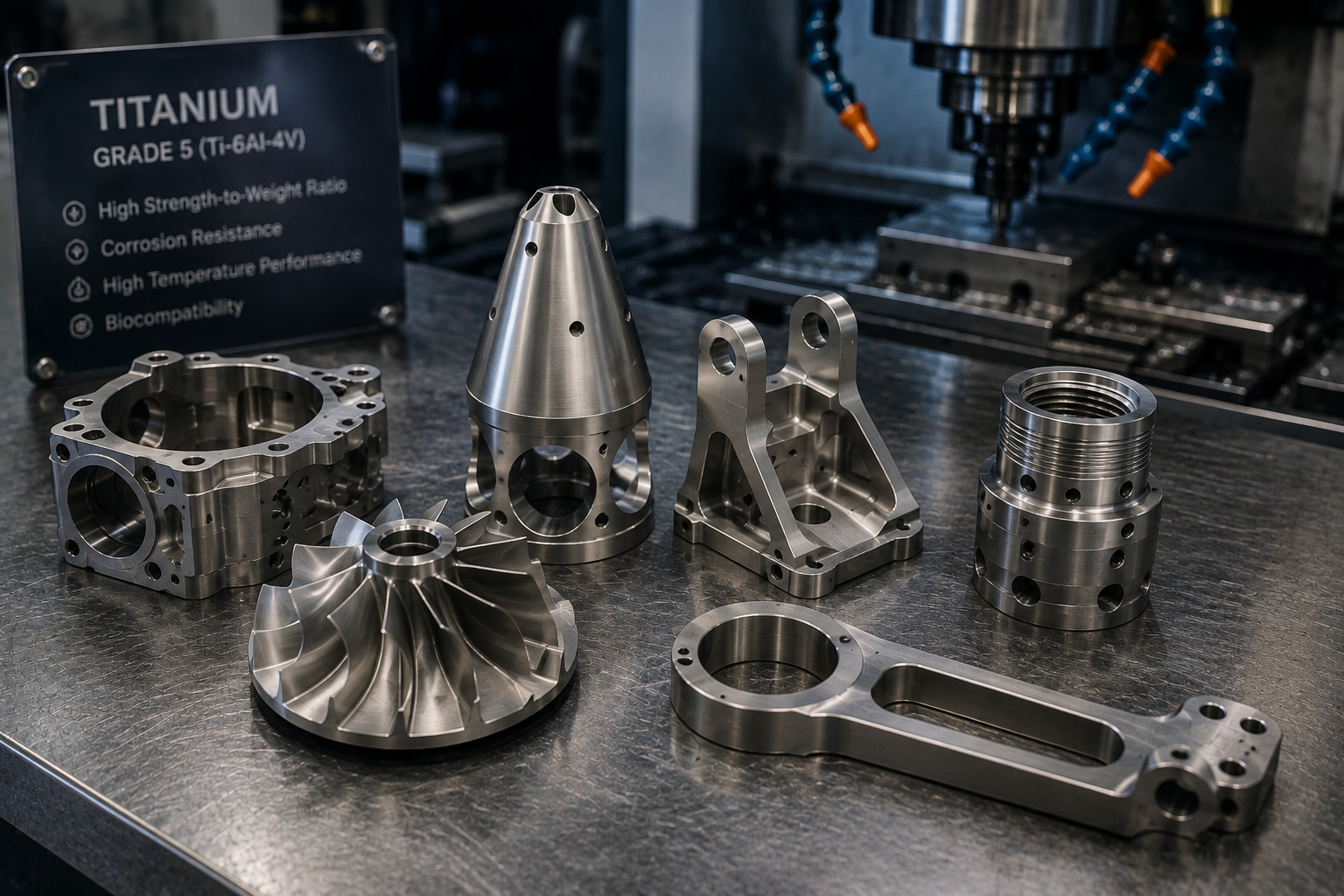
Titanium machines are nothing like steel. It runs hot, work-hardens fast, and eats tools when you push the speed. The fix is low surface speed, heavy feed, flood coolant, and sharp carbide. Do it right and you get parts with a strength-to-weight ratio no aluminum touches, held to ±0.005 mm. Below: the grades, the cutting data, and the design calls that keep titanium on spec and on budget.
Titanium looks easy on the CAM screen. Then it punishes you on the floor. Half the weight of steel, roughly the same strength, which is exactly why aerospace and medical keep speccing it. But here is the catch nobody feels until the chips fly: titanium barely conducts heat. The warmth you generate at the edge has nowhere to go. It parks itself in the tool. I once watched a fresh carbide end mill go from sharp to garbage in under four minutes, all because someone reused their aluminum feeds and speeds. Machine titanium like it is 6061 and you will burn tools, chatter the walls, and blow your tolerances by lunch. This is the rundown I wish more buyers read before firing a Ti-6Al-4V drawing over for a quote.
What Makes Titanium So Hard to Machine?
Titanium fights back because of three properties. Heat concentrates at the cutting edge instead of leaving in the chip, the part flexes under tool pressure, and the metal reacts with the tool at temperature. The result is short tool life and rough finish unless you keep the speed down.
Why is it such a pain? Three things, mostly. First, heat. Titanium moves it at about 7 W/m·K, roughly a third of steel, so the chip cannot carry the temperature away and the edge just cooks. Second, it flexes. Low modulus means the part springs under tool pressure, and thin walls push away and chatter instead of cutting clean. Third, it is chemically needy. At cutting temperatures it welds itself onto the edge, and that built-up edge tears the surface as it drags. Then work-hardening sits on top of all of it. Let the tool rub or dwell for even a moment and the surface hardens, so the next pass fights a tougher material than the one before. That is why timid, feather-light cuts often fail worse than aggressive ones.
Titanium Grades You Will Actually Machine
Most jobs land on a handful of grades. Commercially pure titanium cuts easier but gives up strength. The alloyed stuff, Ti-6Al-4V above all, is stronger and shows up in nearly everything that carries load. Grade 5 is the workhorse, and honestly it is the bulk of what we run. If a print says medical or implant, expect Grade 23 instead. Same chemistry more or less, just cleaner, and it machines about the same, so do not let the different number scare you.
| Grade | Nom commun | Key Trait | Utilisation typique | Usinabilité |
| Niveau 2 | CP Titanium | Corrosion resistant, ductile | Chemical, marine hardware | Bon |
| 5e année | Ti-6Al-4V | High strength-to-weight | Aérospatiale, implants médicaux | Modéré |
| Niveau 23 | Ti-6Al-4V ELI | Extra-low interstitial, biocompatible | Surgical implants | Modéré |
| 9e année | Ti-3Al-2,5V | Weldable, tubing | Aerospace tubing, bike frames | Juste |
Pick the grade for the job first, then plan the cutting strategy around whatever that hands you. Need help matching stock to the application? Our materials overview lays out what we keep on the shelf.
The Payoff: Why Engineers Keep Choosing Titanium
People gripe about the price and the slow cycle times, and then they spec it anyway, because on the right part nothing else comes close. Strength-to-weight is the headline everyone knows: Ti-6Al-4V pushes near 900 MPa at about 60 percent the density of steel, so an aircraft bracket sheds weight without giving up load. The corrosion story is quieter but just as real. Titanium grows a stable oxide skin that shrugs off seawater, chlorides, most acids, which is why it turns up in marine and downhole hardware where stainless would pit and weep. And the body simply tolerates it, so orthopedic implants and dental posts lean on it hard. That last one is why the paperwork, our ISO 13485 process included, matters as much as the part.
What Cutting Parameters Work Best for Titanium?
Keep surface speed low and feed high. For Ti-6Al-4V on carbide, start somewhere around 30 to 60 m/min with a feed heavy enough to keep the chip thick, and run flood coolant with sharp tools and a constant feed so the edge never dwells and hardens the surface under itself.
Now the part people actually want, the cutting data. These are starting numbers, not commandments. Your rigidity, your tool coating, your part shape, all of it shifts the window. Start careful, then open it up once the cut proves it will behave. One rule beats every number in the book though: never let the tool rub.
| Paramètres | Steel (reference) | Titanium Ti-6Al-4V | Why It Changes |
| Vitesse de coupe | 100-200 m/min | 30-60 m/min | Limit heat at the edge |
| Feed per tooth | 0.05-0.15 mm | 0.10-0.20 mm | Thicker chip pulls heat out |
| Coolant | En option | High-pressure flood | Cools edge, clears chips |
| Tool material | Carbide/HSS | Sharp carbide, AlTiN | Resists heat and galling |
| Radial engagement | Up to 50%+ | 10-30% (roughing) | Spreads tool wear |
Climb mill it, hold the feed steady, ease into the entry. For the trickier titanium work we run it on multi-axis CNC milling so the tool stays at the right angle through the whole path.
Design Rules That Keep Titanium Parts Affordable
Half the cost of a titanium part gets decided in CAD, before a single chip lands in the pan. So a few design calls matter more than anything the machinist does later. Skip the thin, tall walls, titanium deflects and they will chatter, so keep wall height under roughly fifteen times the thickness. Give internal corners a real radius that matches a standard tool, because sharp inside corners force tiny cutters that snap and rattle. Loosen whatever tolerance the function does not actually need, since every tightened decimal can pile 20 to 40 percent onto cycle time here. And decide the finish early, anodize, passivate, bead blast, whatever it is, so machining leaves the right stock behind. Our options de finition de surface cover the usual medical and aerospace calls. One more thing: if your last part was aluminium, do not just clone the design. Aluminum forgives thin walls and sharp corners. Titanium will not.
Common Titanium Machining Failures and How to Stop Them
When a titanium part goes sideways, it is almost always one of four things, and the fix is usually fast once you know the tell. Burnt or discolored surface? Speed is too high or coolant is not reaching the edge, so drop the RPM and crank the pressure. Tool dying early? That is built-up edge from heat and galling, so grab a sharper coated cutter and feed harder to keep the chip thick. Chatter on the walls means something is flexing, so add support, kill the overhang, or lighten the radial engagement. And a finish that just will not clean up is a work-hardened skin from a dull tool, so change the insert and, again, stop letting it dwell.
The Bottom Line on Titanium CNC Machining
Titanium rewards discipline and nothing else. Slow the surface speed. Feed it hard enough that the chip carries the heat away. Flood the edge. Never let a dull tool sit and rub. Do that and you get parts that are light, strong, corrosion-proof, and biocompatible, held tighter than most applications will ever actually use.
Three moves for today: nail down your grade before you tolerance the print, open up anything the function does not need, and match your internal radii to real tooling.
Got a titanium part in CAD right now? Send the file over and our engineers will flag the machinability risks before you commit. Obtenir un devis immédiat or upload your design for a DFM review from a shop that cuts Ti-6Al-4V every week.
Questions fréquemment posées
Is titanium harder to machine than stainless steel?
Yes, and not by a little. It conducts heat far worse than stainless, so the heat parks right at the edge and chews through tools. Add work-hardening and a metal that reacts with the tool, and you end up running it at maybe a third of steel’s speed, flood coolant on, carbide sharp, just to keep the edge alive.
What tolerance can you hold on titanium parts?
On most functional features, ±0.005 mm as standard. Multi-axis setups get us to ±0.025 mm on the critical geometry. Tighter than that is doable, but you pay for it, because every decimal place tighter can pile another 20 to 40 percent onto cycle time in titanium.
Which titanium grade should I choose for a strong, lightweight part?
Default to Ti-6Al-4V, Grade 5. Near 900 MPa tensile at roughly 60 percent the density of steel, which is the whole reason people reach for it. Building a medical implant? Switch to Grade 23. Cleaner chemistry, biocompatible, and it cuts almost identically, so nothing about your process changes.
Why do titanium parts cost more to machine?
Pricey metal, low cutting speeds, heavy tool wear. Cycle times run long and you go through tooling. The good news is you control a lot of it: loosen the tolerances that do not matter, open up your internal radii, and stop designing thin unsupported walls, and the quote comes back down.
Does titanium need coolant during CNC machining?
Almost always, and high-pressure flood specifically. It hauls out the heat the chip cannot carry and flushes chips before they get re-cut. Run titanium dry and you are usually looking at a dead tool and a burnt surface in short order.
Can titanium parts be anodized or finished after machining?
They can. Titanium takes passivation, bead blast, and type II or type III anodizing, that last one giving the colored oxide shops use to code medical instruments. Just lock the finish down before machining so the toolpath leaves the right stock behind for it.
À propos de l'auteur
Rédigé par l'équipe d'ingénierie de précision de Yicen. Our engineers bring over a decade of hands-on CNC machining across aerospace, medical, and industrial titanium work. Yicen Precision runs 300+ machines in Shenzhen, holds ISO 9001:2015, ISO 13485, ISO 14001, and IATF 16949 certifications, and machines 50+ materials to tolerances as tight as ±0.005 mm. Every number here reflects parameters we actually run. Explore our Services d'usinage CNC ou request a quote.






 French
  English
  Spanish
  Japanese
  German
  Portuguese