Ask five fabricators which process they’d pick and you’ll hear five answers. The honest reply is that laser cutting vs waterjet cutting isn’t a contest with one winner. It’s a match between your material, thickness, tolerance and budget. Get the match right and parts come off the table clean and cheap. Get it wrong and you pay for rework, burned edges or machine time you never needed. Here’s how each process works, where each one runs out of steam, and what it really costs to run them.
The Two Processes in Plain Terms
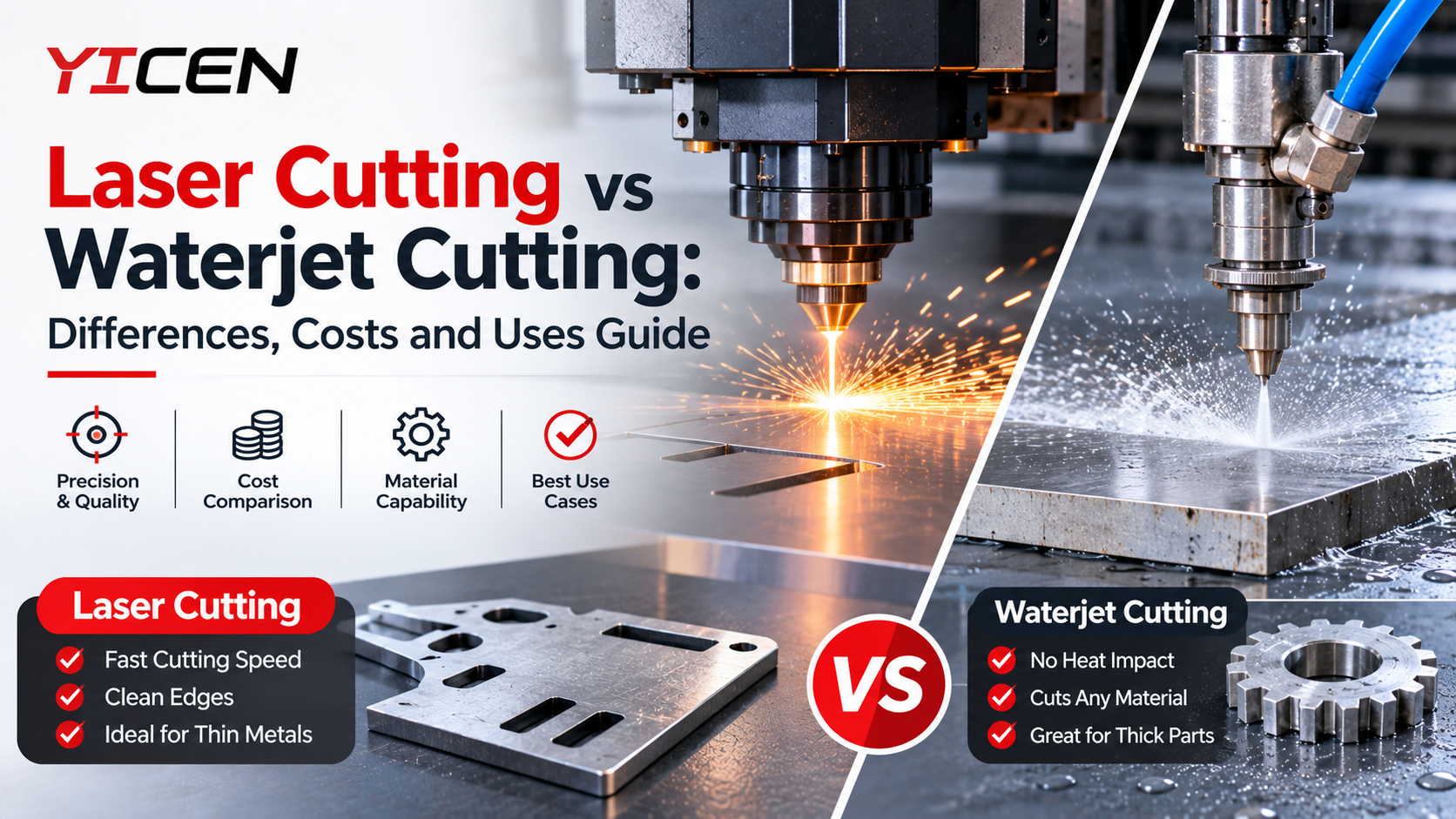
A laser melts or vaporizes metal with a tightly focused beam, while a gas jet blows the molten material out of the cut. It’s fast, precise and very good at thin and medium sheet. If you want to see what that looks like in production, our services de découpe au laser page covers the setups we run.
Waterjet cutting works on a different principle. A pump pushes water to extreme pressure and forces it through a tiny nozzle. For hard materials, the stream carries garnet abrasive, and the whole thing erodes the material instead of melting it. No flame, no beam, no heat. That single fact explains most of the differences you’ll read about below.
Laser Cutting Thickness Limits and Where They Stop
Laser cutting thickness limits depend on the material and the laser power. As a rough guide, a modern fiber laser handles mild steel up to about 20 to 25 mm, stainless steel a bit less, and aluminum somewhere around the same range. Quality tends to drop long before you hit the maximum, though. Edges get rougher, the kerf gets wider at the bottom, and speed falls off a cliff.
Thin sheet is where lasers shine. Under 6 mm, a laser can cut intricate shapes at a speed waterjet can’t touch. Reflective metals like copper and brass used to give lasers trouble, but fiber lasers have mostly solved that. Still, ask your supplier what they’ve actually run, not just what the brochure says.
Where Waterjet Cutting Takes Over
Waterjet cutting doesn’t care much about material type. Steel, titanium, aluminum, stone, glass, rubber and composites all go under the same stream. Thickness reaches well past what a laser can manage, and cuts of 100 mm or more in metal are possible, just slowly.
The big win is the lack of heat. There’s no heat-affected zone, so hardened tool steel keeps its properties and thin parts don’t warp. That matters for aerospace brackets, heat-sensitive alloys and anything that gets machined after cutting. If your project needs this process, our services de découpe au jet d'eau are set up for it.
Accuracy and Edge Quality
Both processes hold tight tolerances, and the difference is smaller than most people expect. A laser typically cuts within about 0.1 mm on thin sheet, with a very narrow kerf, which lets you nest parts closely and cut small holes. Waterjet usually lands near 0.1 to 0.2 mm, and its wider stream makes very fine detail harder.
Edges tell a different story. Laser edges on thin material are smooth, but you may see a slight bevel or oxide layer, especially on thick plate. Waterjet leaves a matte, slightly textured edge with no thermal discoloration. Taper can show up on thick cuts, though modern machines tilt the head to correct most of it.
Laser Cutting vs Waterjet Cutting on Cost per Part
Cost is where people get surprised. Laser machines cut thin metal much faster, so cost per part is usually lower on sheet under about 10 mm. Waterjet runs slower, burns through garnet abrasive and wears nozzles and seals, so the hourly cost climbs. On thick material, though, the math can flip. A laser struggling through 25 mm plate may need slower passes, extra cleanup and secondary finishing, and waterjet suddenly looks competitive.
Setup and programming matter too. Both processes need little tooling, so short runs stay affordable. A few things push the price up on either one:
- Large amounts of scrap from poor nesting
- Tight tolerances that force slower cutting
- Extra finishing, such as deburring or edge grinding
- Unusual or expensive material that you can’t afford to waste
Sheet Metal Cutting Methods and Where Each Fits
Lasers and waterjets are two of several sheet metal cutting methods. Punching, plasma and shearing all have a place too, and punching beats both on large runs of simple holes and shapes. Plasma wins on cheap, thick steel where edge quality barely matters. Most shops don’t pick one method for everything, and neither should you.
For flat parts that then get bent, welded or assembled, cutting is only the first step. That’s why we pair it with our fabrication de tôles work, so the flat pattern, bend allowance and finish all get planned together instead of fixed later.
Quick Picks by Material and Part
When you’re short on time, use this as a starting point:
- Thin steel, stainless or aluminum sheet: laser, almost every time.
- Thick plate or stacked layers: waterjet.
- Heat-sensitive alloys, hardened steel or titanium: waterjet.
- Glass, stone, ceramics or composites: waterjet only.
- High volume of small, detailed parts: laser.
- Mixed materials in one job: waterjet, since one setup handles them all.
Real parts rarely fit a list neatly. A bracket might need a laser-cut profile, then a milled pocket and a tapped hole. For that kind of mixed job, Custom cnc machining services fill the gap after cutting, and one supplier handling both avoids handoff errors.
Who We Are and How We Work
We’re a precision shop that cuts, machines and finishes parts for engineers and buyers who care about the details. If you’d like to know more about our team and equipment, take a look at about our company. Many of our customers need small batch precision machining for prototypes and pilot runs, and we’d rather help you pick the right process on the first order than rework a second.
Get a Straight Answer for Your Part
Still weighing laser cutting vs waterjet cutting for your project? Send us your drawing, material and quantity, and we’ll tell you which process gives the best result for the money. We check every file for manufacturability and reply with a clear quote and honest advice, even when the answer is the cheaper option.
Questions fréquemment posées
What is the main difference in laser cutting vs waterjet cutting?
Laser cutting uses a focused beam that melts metal, while waterjet uses high-pressure water and abrasive to erode it. That means waterjet adds no heat. Laser is faster on thin sheet, and waterjet handles thick or heat-sensitive material.
Which is more accurate, laser or waterjet cutting?
Laser usually wins on thin sheet, with a narrower kerf and finer detail. Waterjet is still very accurate, often within about 0.1 to 0.2 mm. For thick material, waterjet can hold its accuracy better.
Can waterjet cut thicker material than a laser?
Yes. Waterjet cutting can handle much thicker metal, stone and composites than most lasers. The cut is slower on thick stock, but quality stays consistent and there’s no heat damage.
Which cutting method costs less per part?
Laser is usually cheaper on thin and medium sheet because it cuts so fast. Waterjet can cost less on thick plate or when you’d need extra finishing after a laser cut. The right answer depends on thickness, quantity and tolerance.
What are the laser cutting thickness limits for steel?
A modern fiber laser can cut mild steel up to roughly 20 to 25 mm. Edge quality and speed drop as thickness rises, so many shops switch to waterjet or plasma on heavier plate.