
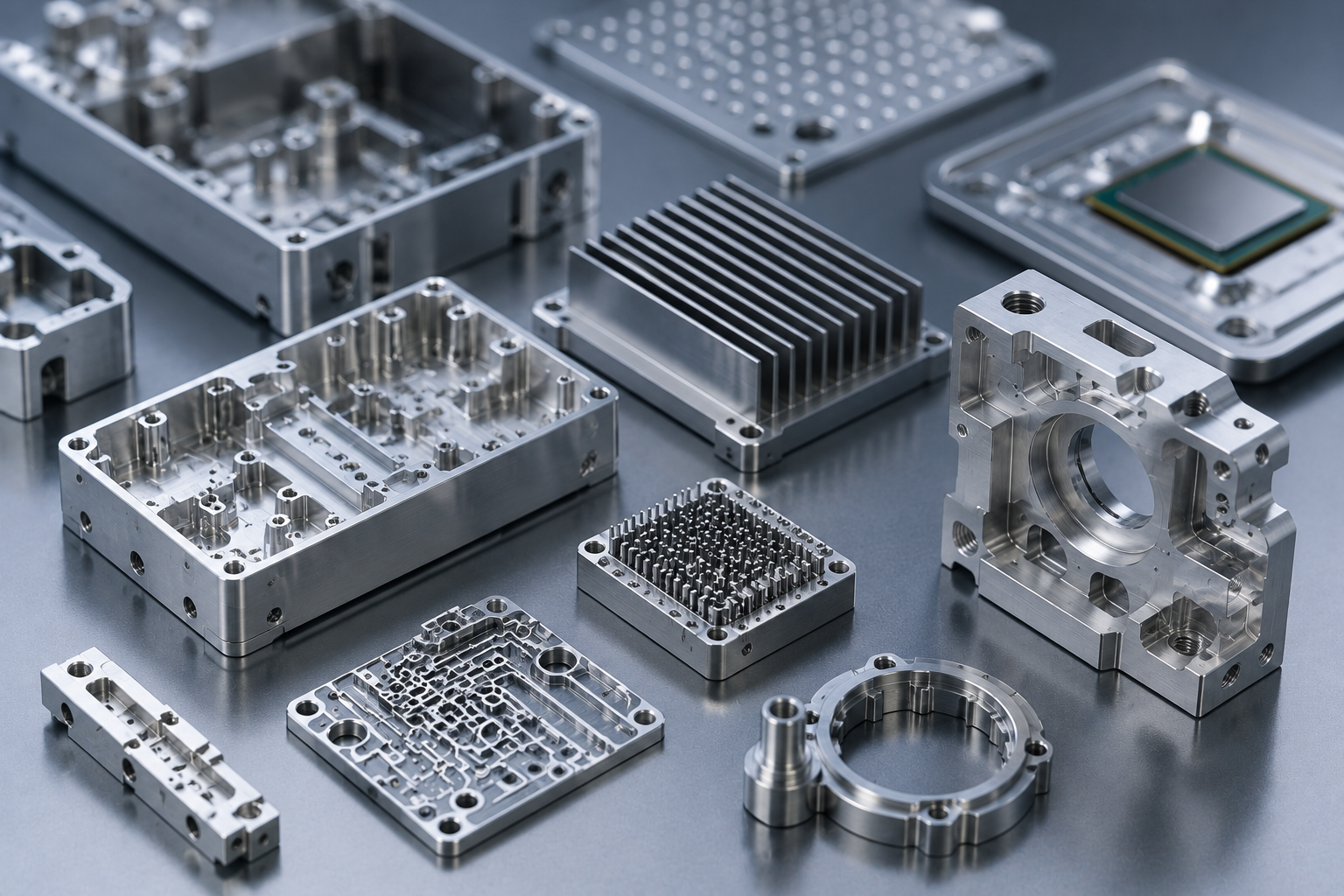
Electronics need tight tolerances, EMI shielding, thermal control, and clean surfaces, and machining hands you all four, at any volume from one prototype to production. Enclosures, heat sinks, PCB housings, wafer fixtures, they all lean on ±0.005 mm accuracy and repeatability. Here is why it beats casting and molding for precision electronics, and how to design parts that actually protect the board inside.
A circuit board is only as good as the metal around it. Teams sink months into tuning a PCB. Then they drop it into an enclosure that traps heat, leaks interference, or flexes just enough to crack a solder joint. And the board pays for it. That is the piece people keep forgetting. In electronics the machined metal is not packaging. The enclosure, the heat sink, the shield, the wafer fixture, each is doing an electrical or a thermal job. Get it wrong and the expensive board underneath eats the failure. Machining earns its spot because it holds the tolerances, leaves clean conductive metal for grounding and shielding, and goes from one prototype to full production without a single redraw.
Why Is CNC Machining Ideal for Electronic Components?
Machining fits electronic components because it pairs tight tolerances, down to ±0.005 mm, with conductive metal for shielding and grounding and strong thermal performance in aluminum and copper. It runs one prototype or thousands of parts with no tooling change, and it holds the flatness and finish connectors, seals, and heat interfaces need.
Why machining and not something else? Precision, first. A connector cutout or a board standoff lands within microns or nothing goes together. Then heat. Aluminum and copper pull warmth off a component in a way plastic never touches. Then shielding, because a solid metal box with tight seams stops interference cold, both directions. And cleanliness, the burr-free faces a semiconductor part cannot live without. Four demands. One process. No tooling. One part or ten thousand, same setup.
What Electronic Parts Are Commonly CNC Machined?
Walk consumer gear, industrial boxes, semiconductor tooling, and the same parts keep showing up. Each one leans on a different machining strength.
| Part | Typical Material | Why Machined | Key Requirement |
| Enclosures / housings | Alumínio 6061 | EMI shield, rigidity | Flatness, seam fit |
| Heat sinks | Aluminum, copper | Thermal dissipation | Fin accuracy, flat base |
| PCB standoffs / brackets | Aluminum, brass | Precise board mounting | ±0.01 mm holes |
| Connector housings | Aluminum, stainless | Tight mating fits | Clean cutouts |
| Semiconductor fixtures | Aluminum, stainless | Wafer handling accuracy | Particle-free finish |
| RF shielding cans | Aluminum, brass | Signal isolation | Tight seams |
Aluminum 6061 takes most of it. Cuts fast, moves heat, shields itself, and anodizes when you want insulation or color. For the turning side of these parts, our aluminum machining fundamentals dig into how the material behaves.
How Does CNC Machining Handle Thermal Management?
Machining handles heat by cutting sinks and enclosures out of high-conductivity metal with tight fin geometry and flat mating faces. Aluminum runs about 200 W/m·K and copper closer to 400, both miles past any plastic. A flat base finished to Ra 0.8 µm maximizes contact with the component and drops the thermal resistance at the interface.
Thermal is where machining really flexes. It carves a sink out of solid conductive metal, fins packed tighter than a casting could hold, base flat enough to actually mate to a chip. That base has to be dead flat, because a hair of air gap and the heat stacks up behind it and the part cooks. Milling hands you the flat face and the thin fins right off the tool. For the high-power stuff we machine copper cold plates and aluminum sinks on our Serviço de fresagem CNC, holding fin geometry that keeps junction temperatures in check.
Machining vs Casting and Molding for Electronics
Cast it? Mold it? Sometimes, sure. But for precision and low to middling volume, machining wins outright. No tooling to pay down, prototypes in a day or two, and tolerances a mold cannot reach.
| Fator | Maquinação CNC | Die Casting | Moldagem por injeção |
| Tolerância | ±0,005 mm | ±0.1 mm typical | ±0.1 mm typical |
| Custo das ferramentas | Nenhum | Elevado | Elevado |
| Prototype speed | Fast (24 hr+) | Slow (tool build) | Slow (tool build) |
| EMI shielding | Excellent (solid metal) | Bom | Needs plating |
| Thermal path | Excelente | Bom | Poor (plastic) |
| Melhor volume | 1 to ~10,000 | Volume elevado | Volume elevado |
Casting only pulls ahead per part at big volume with loose tolerances, so plenty of teams machine the prototypes and the first production run, then jump to a mold once the design stops moving. Our serviço de prototipagem rápida turns electronics enclosures around in as little as 24 hours.
Design Tips for Machined Electronics Parts
A few habits keep an enclosure buildable and protective. Seams first, since interference sneaks through any gap, so overlap a lip on a flat face instead of butting two edges. Keep holes standard, tooling and inspection stay cheap. And do not forget anodized aluminum is an insulator, so a spot that has to ground needs a mask or a bare-metal pad, or you spend next week hunting a dead ground. Skip hogging a whole enclosure from billet when a machined frame plus sheet metal panels does it for half the money.
Common Challenges in Electronics Machining
Traps? Plenty, the kind that stall a build at inspection. Thin walls warp, and a lightweight box loves a sub-millimeter wall that loses flatness the second you cut it hard, so those get gentle fixturing and a light finish pass. One stray burr on a grounding pad shorts a circuit or jams the assembly, so deburring is not optional. Anodize over a ground point and it dies, mask it first. Stack a frame against covers and boards and the tolerances add up fast, so reference everything off shared datums. None of it kills a job. It is just the checklist a shop that has been burned before runs before the first chip flies.
The Bottom Line on Electronics CNC Machining
The real reason machining fits electronics is that the metal earns its keep. It does electrical and thermal work, not just wrapping. You get the tolerances the connectors need, the flat conductive faces that shield and sink heat, the cleanliness the semiconductor side runs on. Any volume. No tooling.
Three moves make these parts better every time: build seams that actually block interference, machine flat contact faces so heat truly moves, and prototype in the real production material so nothing bites you later.
Got an enclosure, heat sink, or semiconductor fixture to make? Obter um orçamento instantâneo and our engineers will review the design for thermal, shielding, and manufacturability before you commit to a build.
Perguntas mais frequentes
Why use CNC machining instead of plastic molding for electronics enclosures?
A machined metal box shields interference, dumps heat, holds tight tolerances. Molding does none of that. It also skips tooling, so machining is faster and cheaper for prototypes and volumes up to a few thousand. Molding only takes the lead way out at high volume, loose tolerances, nothing thermal or electrical riding on the part.
What is the best material for a machined electronics enclosure?
Aluminum 6061, nearly always. Cheap to cut, good heat, shields as a solid conductor, anodizes for insulation or looks. Chasing maximum thermal performance? Go copper, in the heat sinks and cold plates. Rough environment? Stainless, for the corrosion.
Can CNC machining make semiconductor-grade clean parts?
It can. Machining plus deburring and finishing gets you the burr-free, particle-controlled surfaces that side of the industry demands. Stainless and aluminum fixtures get cut tight, then electropolished or precision-cleaned, so nothing loose is left on a wafer-handling face.
How does a machined heat sink improve thermal performance?
Three things at once. High-conductivity metal, tight fin geometry, a flat base finished to around Ra 0.8 µm. The base maximizes contact with the component and drops thermal resistance; the fins add convection area. Together they run junction temperatures lower than any cast or molded part manages.
What tolerances can you hold on electronic components?
Down to ±0.005 mm as standard, ±0.025 mm on multi-axis critical features, with finishes to Ra 0.8 µm where a part has to seal or mate. That sits comfortably inside what connector cutouts, board standoffs, and heat sink bases need to assemble clean and transfer heat.
Is CNC machining cost-effective for low volumes of electronic parts?
Very. No tooling to pay off, so it is usually the cheapest route from one part up to a few thousand, and prototypes can ship in as little as 24 hours. Casting and molding only get cheaper per part once you are at high volume and the tooling cost spreads out across many units.
Sobre o autor
Escrito pela equipa de engenharia de precisão da Yicen. Our engineers have over a decade of machining enclosures, heat sinks, and semiconductor fixtures for consumer electronics and semiconductor customers. Yicen Precision runs 300+ machines in Shenzhen, machines 50+ materials to ±0.005 mm, and holds ISO 9001:2015, ISO 13485, ISO 14001, and IATF 16949 certifications. Explore our Serviços de maquinagem CNC ou get an instant quote.


 Portuguese
  English
  French
  Spanish
  Japanese
  German