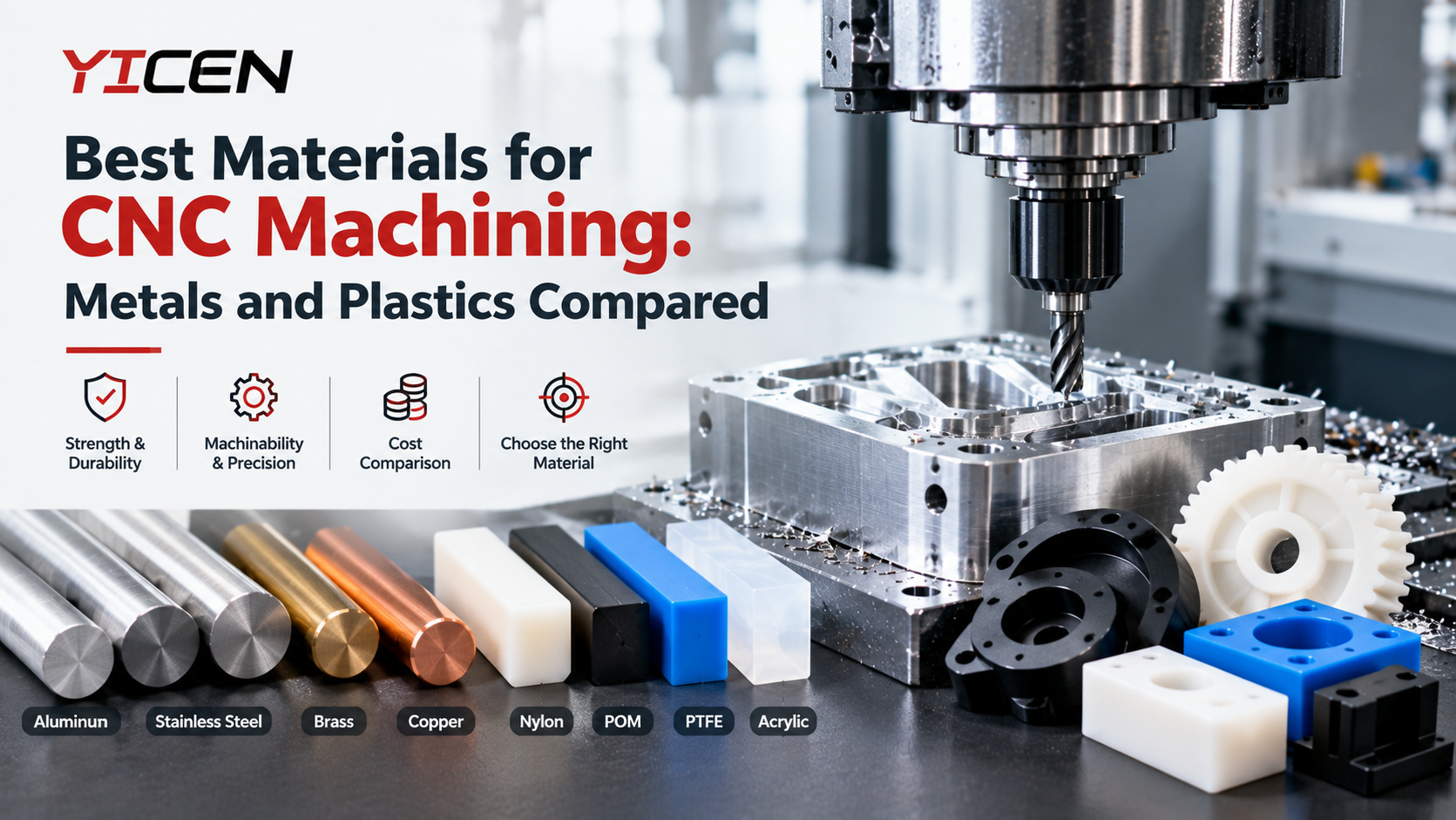
You can draw a perfect part and still lose money on it. Pick the wrong stock and the job runs slow, the tools wear out early, or the finished piece cracks under load. Choosing the right CNC machining materials before you ask for a quote is the cheapest fix in the whole process. Below, I compare the metals and plastics we cut most often, say where each one shines, and point out where each one causes trouble.
Five Questions to Answer Before You Pick Stock
Every material is a compromise. Before you browse grades, write down what the part actually has to do. Five things usually decide it.
- Strength and stiffness. Does the part carry load, or does it just hold a shape?
- Weight. Aluminum and plastics are light. Steel and brass are not.
- Environment. Heat, water, chemicals and sunlight all change the answer.
- Cost. Stock price is only the start. Cutting time and tool wear often cost more than the bar itself.
- Cutting behavior. Some stock cuts clean. Some fights back.
That last one gets ignored too often. Machinable materials let the tool run fast, hold tolerance and leave a decent surface. Gummy or hard stock slows everything down, and you pay for every extra minute on the machine. A cheap bar that takes twice as long to cut isn’t cheap.
Best Metals for CNC Machining
Metals give you strength, heat resistance and a long service life. These are the ones people ask about most.
Aluminum. It’s the default for good reason. It cuts fast, weighs little and resists corrosion. Grade 6061 covers most brackets, housings and fixtures. Grade 7075 is stronger and suits parts under real stress, though it costs more. If you can’t decide, this comparison of 6061 vs 7075 aluminum lays out where each grade fits.
Stainless steel. It shrugs off rust and handles heat. Grades 304 and 316 turn up in food, marine and medical work. It’s harder on tools than aluminum, so expect longer cycle times and a higher price.
Carbon and alloy steel. Strong, tough and affordable. They rust unless you coat or treat them, but for shafts, gears and structural parts they’re hard to beat.
Brass and copper. Brass is among the easiest metals to cut, and it finishes beautifully. Think fittings, connectors and decorative pieces. Copper moves heat and current well, but it can smear on the tool.
Titanium. Light, strong and corrosion resistant. Also slow to cut and expensive. Use it when aerospace or medical specs demand it, not because it sounds impressive.
Ask ten machinists for the best metals for cnc machining and you’ll get ten answers, because the right pick depends on load, environment and budget. For general parts, aluminum usually wins on price and speed. Steel wins on strength. Stainless wins when corrosion is the main enemy.
Where CNC Machining Plastics Make Sense
Plastics are light, resist many chemicals and often cost less to cut. They have quirks, though. Heat can melt them, clamps can squeeze them out of shape, and temperature swings change their size. Sharp tools and gentle fixturing help a lot.
The cnc machining plastics we see most:
- Delrin (acetal). Stiff, slippery and stable. It’s the go-to for gears, bushings and tight-tolerance parts.
- Nylon. Tough and wear resistant. It soaks up moisture, so sizes can drift in humid places.
- ABS. Cheap and easy to cut. Good for prototypes and enclosures.
- Polycarbonate. Strong, impact resistant and available clear. Works for covers, guards and lenses.
- PEEK. Handles heat and chemicals very well. It’s also pricey, so save it for demanding jobs.
- Acrylic. Clear and attractive, but brittle. Fine for display pieces, poor for anything that takes a hit.
If the part will sit near a motor or in a hot vehicle, check the heat limit first. A plastic that behaves at room temperature can warp fast once it warms up.
Metals and Plastics Side by Side
A table won’t make the decision for you, but it narrows the field.
| Faktor | Metalle | Kunststoffe |
|---|---|---|
| Stärke | Hoch | Gering bis mittel |
| Gewicht | Medium to heavy | Licht |
| Heat resistance | Stark | Varies, often limited |
| Corrosion | Depends on grade | Usually excellent |
| Schnittgeschwindigkeit | Varies by metal | Usually fast |
| Typical cost | Mäßig bis hoch | Low to high (PEEK is costly) |
Treat it as a starting point. PEEK can outperform a weak metal in the right setting, and a plain aluminum bracket can beat an expensive plastic in many structural jobs.
Material and Finish Work Best as a Pair
Finish changes what you can use. Aluminum anodizes well. Brass polishes nicely. Some plastics only accept a light bead blast, and a few won’t take a coating at all. If your part needs a certain look or extra protection, check the Optionen für die Oberflächenbeschaffenheit before you lock in the stock. Settling both together avoids ugly surprises at the end of the job.
A Simple Way to Choose Best CNC Machining Materials
Work through it in this order:
- Define the load and the operating environment.
- List any hard rules, like food contact or flame ratings.
- Pick two or three candidates that pass.
- Compare stock price and cutting time for each.
- Take the cheapest one that still meets the requirement.
Step five saves the most money. Plenty of parts are over-specified. Moving from stainless to aluminum, or from PEEK to Delrin, can cut the price sharply when the job allows it.
Still unsure? Look through our Materialauswahl to see what we stock and cut every day. Send us your drawing and the part’s end use, and we’ll recommend the right CNC machining materials and send back a clear quote. Our engineers check every file for manufacturability before cutting starts, so problems show up early instead of on your invoice.
Have a drawing ready? Fordern Sie noch heute Ihr Angebot an and our engineers will recommend the best material for your part. Not ready yet? Explore Yicen Precision.
Häufig gestellte Fragen
What is the easiest CNC Machining Materials?
Free-machining brass is usually the easiest metal to cut, with aluminum 6061 close behind. Among plastics, Delrin cuts clean and holds tolerance. These machinable materials save time and keep part cost down.
Which plastics work best for CNC machining?
Delrin is the top pick for precision parts, and nylon suits wear applications. ABS works for cheap prototypes, and polycarbonate handles impact. PEEK is the choice when heat and chemicals are involved.
How do I choose a CNC material for strength and cost?
Start with the load and environment, then take the cheapest option that meets them. Aluminum often gives the best balance for general parts. Compare cutting time along with stock price, since both shape the final cost of your CNC machining materials.