Every part starts with a drawing, and every drawing makes a promise about size. CNC machining tolerances tell the machinist how far a finished dimension can drift from that promise before the part stops working. If you set them too loose, your assembly rattles, leaks, or jams. If you set them too tight, your quote jumps for no good reason.
This guide walks you through the usual limits, shows you how to read them, and helps you pick the right ones for your own part.
What Are Standard CNC Tolerances?
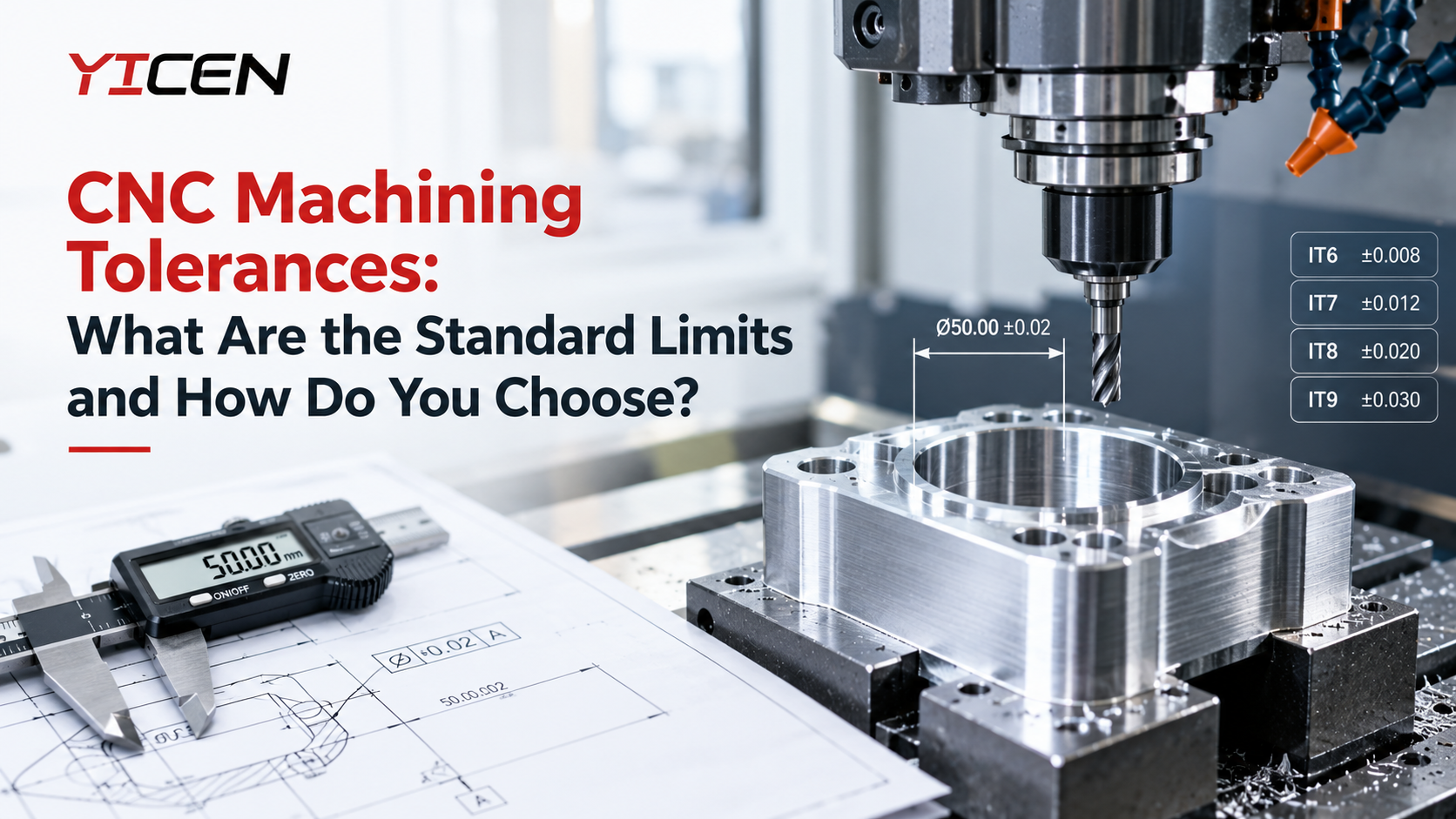
When a drawing gives no specific limit, most shops fall back on a general tolerance. For milling and turning, that usually means about ±0.1 mm. Plenty of shops quote ±0.125 mm (±0.005 in) as their default. These standard CNC tolerances work well for brackets, covers, housings, and other parts where the fit is forgiving.
What decides the default limit?
Four things matter most:
- Machine condition: A rigid, well-kept machine holds size better than a tired one.
- Cutting tools: Sharp, well-chosen tools cut cleanly and wear in a predictable way.
- Workholding: A part that bends under clamping pressure will measure differently once you release it.
- Inspection: A shop can only promise what it can measure, so calibrated gauges and a coordinate measuring machine (CMM) count.
Many suppliers also follow ISO 2768 for general tolerances. Ask yours which grade it uses, then name that grade in your title block so everyone reads the same rule.
What Does a CNC Tolerance Chart Look Like?
A CNC tolerance chart gives you quick reference points before you commit a number to paper. The figures below show typical ranges. Your shop, material, and part shape will shift them.
| Merkmal | Typical tolerance | Precision tolerance |
|---|---|---|
| Milled linear dimensions | ±0,1 mm | ±0,025 mm |
| Turned diameters | ±0,05 mm | ±0,01 mm |
| Drilled holes | ±0,1 mm | ±0,05 mm |
| Reamed or bored holes | ±0,025 mm | ±0,01 mm |
| Flatness (per 100 mm) | 0,1 mm | 0.02 mm |
| Surface finish (Ra) | 3,2 µm | 0,8 µm |
Why Do Tolerances Change from Material to Material?
How do metals behave under the cutter?
Aluminum cuts easily and holds size well, but it grows noticeably when it warms up. Stainless steel work-hardens and pushes back against the tool. Titanium holds heat at the cutting edge because it carries heat away so poorly. Each metal asks for a slightly different approach, and that shows up in what the shop can promise.
What about plastics and thin parts?
Plastics like nylon soak up moisture and relax after cutting, so their size can drift over days. Thin walls vibrate and spring back. Deep, narrow pockets need long tools that bend. Large parts also react more to room temperature than small ones. If a feature is flexible or hard to reach, you can often loosen its limit without hurting how the part works, and that saves money.
Tight Tolerance Machining and When Do You Need It?
How does the shop change its process?
Tight tolerance machining usually means working below ±0.025 mm. At that level, the shop changes the whole method, not just the care it takes. Machinists often rough out the part, let it rest so internal stress settles, and then take a light finishing pass. They may control the room temperature, measure parts at a set temperature, and check size in the middle of a run instead of only at the end. Feeds slow down, and tools get swapped sooner.
When does grinding make more sense?
Some features go past what cutting can hold at a fair price. Hardened surfaces and very fine finishes are common examples. In those cases, Präzisionsschleifen takes over. It removes tiny amounts of material and reaches limits that milling and turning struggle to match.
How Do You Choose the Right CNC Machining Tolerances?
Which features really need precision?
Start with function, not habit. Look at each feature and ask what job it does. Then give it the loosest limit that still lets it do that job.
- Mark the critical features. These are the surfaces that mate, seal, slide, or locate another part.
- Relax the rest. Apply the general tolerance everywhere else and say so in the title block.
- Check the stack-up. When parts assemble, small errors add up, so work out the worst case.
- Match the fit type. Press fits, sliding fits, and clearance fits each need a different range.
- Respect the material. A thin plastic part will never hold what a steel block can.
- Call your machinist early. A five-minute chat during design can remove a costly requirement before it hits the quote.
Sometimes the best answer is a different method. Complex internal channels, lattice shapes, and merged assemblies often suit 3D-Druck von Metall. You can then machine only the mating surfaces to tight limits. That way, you spend precision where it counts and let the printer handle the shape.
Do Tighter Tolerances Cost More?
Why does the price climb?
Yes, and for clear reasons. Tighter limits need slower cutting, more inspection, special tooling, and extra setup time. Scrap rates rise too. The cost also grows faster as you tighten. Going from ±0.1 mm to ±0.05 mm adds a little. Going from ±0.025 mm to ±0.005 mm can multiply the price.
How can you keep the quote low?
Go through your drawing line by line and ask which dimensions truly need precision. Cutting even a handful of unneeded tight callouts often lowers the price and shortens lead time. The part usually works just as well.
Mistakes Should You Avoid When Setting Tolerances?
- Copying limits from an old drawing without checking the new part’s needs.
- Putting one tight tolerance on every feature instead of only the critical ones.
- Ignoring surface finish. A rough surface makes a tight size hard to measure with confidence.
- Skipping datums. Without clear reference surfaces, the shop has to guess how you want to measure.
Ready to Get Your Tolerances Reviewed?
Good limits come from understanding how your part works. Send us your drawing, and our engineers will check every callout, flag any limit that adds cost without adding value, and suggest the process that fits best. If your part needs finer finishes or complex shapes, we also offer Präzisionsschleifen.
Request a free tolerance quote today and move into production with confidence.
What Questions Come Up Most Often?
What is the standard tolerance for CNC machining?
Most shops hold about ±0.1 mm (±0.005 in) on general features unless the drawing says otherwise. You can tighten single dimensions whenever the function needs it.
Can CNC machines hold ±0.01 mm?
Yes, many modern machines hold ±0.01 mm on selected features. Material, part size, tooling, and inspection all affect the result. Expect a higher price than general work.
Do tighter tolerances increase part cost?
Yes. Tighter CNC machining tolerances need slower cutting, more inspection, and extra setup care. Apply them only to critical features and your price stays fair.
What about temperature and inspection?
For very tight limits, state the inspection temperature on the drawing. Most shops use 20 °C. Metal grows and shrinks with heat, so a part that passes in a warm shop can fail in a cool lab.