
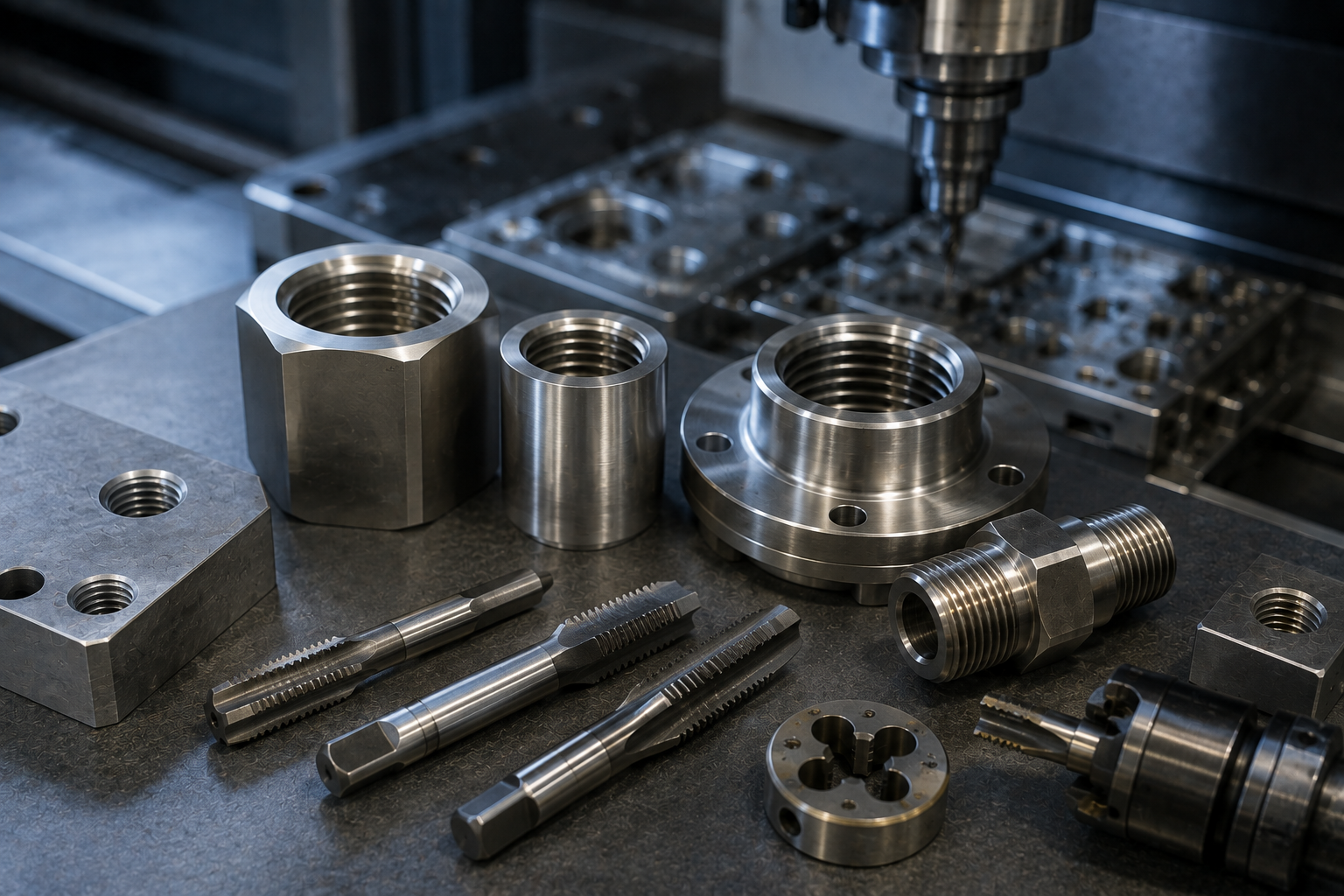
CNC threads get cut by tapping, thread milling, or single-point turning. Thread milling is the most forgiving: one tool covers many sizes and a broken one backs out instead of jamming. Tapping is fast on standard sizes. Nail the standard, the class, and the hole prep and threads hold. Miss any of them and they strip, cross, or gall. Below: the methods, the standards, and the design rules that keep threads reliable.
A stripped thread on a two-dollar fastener boss can scrap a four-hundred-dollar part. Think about that ratio for a second. Threads look like nothing on a drawing, one callout, a few characters, and yet they carry more failure risk per feature than almost anything else on the whole part. I have pulled parts off the bench where a tapped hole cross-threaded because the pilot drill ran two tenths of a millimeter undersize. Pulled others where an external thread galled because the material and the speed were quietly at war. Threading is the spot where machining bumps into fastener standards, and both sides have to be right or the joint fails, in assembly or worse, out in the field. Here is how the machines actually cut threads, which standards you will run into, and the design calls that keep them from letting go.
What Are the Main Methods of CNC Thread Machining?
There are four ways to cut a thread on a CNC machine: tapping, thread milling, single-point turning, and thread rolling. Tapping and thread milling make internal threads in a hole. Single-point turning cuts external threads on a lathe. Thread rolling forms the thread by squeezing metal instead of cutting it. Which one fits depends on size, material, quantity, and how much you can stomach losing a part to a snapped tool.
A tap is a multi-tooth tool that cuts the whole thread in one shove, fast and cheap on standard sizes, but snap one and it is welded in the hole and the part is usually done. A thread mill spirals down the bore on a single point, slower per hole, but one cutter covers a whole range of diameters, it laughs at hard material, and if it breaks it just backs out. Single-point turning traces the form pass after pass on a diameter, the standard move for studs and fittings. Rolling makes the strongest thread of the lot because it flows the grain instead of severing it, but it only works on ductile stuff and simple shapes.
Tapping vs Thread Milling: Which Should You Choose?
Tap when you are running a pile of standard sizes in friendly material and speed per hole is what pays. Thread mill when the material is hard, the thread is big or oddball, the hole is blind and you need to run near the bottom, or the part is simply too expensive to gamble on a tap.
| Fator | Tapping | Thread Milling |
| Speed per hole | Faster | Mais lento |
| Broken-tool risk | High (jams in hole) | Low (backs out) |
| Gama de materiais | Best in soft metals | Handles hard/tough alloys |
| Thread sizes per tool | One size per tap | Many sizes per cutter |
| Blind-hole bottom | Limited thread depth | Threads close to bottom |
| Melhor para | High volume, standard sizes | High-value or hard parts |
On titanium or stainless I default to thread milling and do not think twice, and we run it on our CNC milling machines. The math is not subtle: one part scrapped by a broken tap costs more than the few extra seconds thread milling adds across the entire run.
Thread Standards and Tolerance Classes You Will Meet
Standards exist so a bolt from one shop threads into a nut from another, and mixing the two big systems is a classic, expensive screwup. Metric and unified do not interchange, ever.
| Padrão | System | Callout Example | Common Region/Use |
| ISO Metric (M) | Metric | M8 x 1.25 | Global, most industries |
| Unified (UNC/UNF) | Imperial | 1/4-20 UNC | North America |
| NPT | Tapered pipe | 1/2-14 NPT | Fluid/gas sealing |
| BSP | Parallel/taper pipe | G1/2 | Europe, hydraulics |
On top of the size there is the fit class, which sets how tight the two halves engage. For metric, 6H and 6g are the everyday defaults. Go tighter to kill play in a precision assembly, looser to ease assembly or make room for a coating. Just state the class. An M8 with no class attached leaves the shop guessing, and a guess turns into rework.
Design Tips That Prevent Thread Failures
Most thread trouble gets designed in, not machined in. So, off the floor, a few rules. Size the pilot hole right, because undersize strips or cross-threads and oversize leaves a shallow, weak thread with nothing to grab, follow the drill chart for the class you asked for. Do not thread deeper than you need either; engagement of one and a half to two times the diameter already carries basically the full load, and going deeper just buys cost and tap-breakage risk for zero strength. Put a small chamfer at the mouth so the fastener finds the start instead of cross-threading. Leave room at the bottom of a blind hole for chips and tool relief. And match the material to the method, gummy alloys tear when you tap them fast, free-machining brass turned parts thread like butter, stainless wants slower speed and real coolant or it galls on you.
How External Threads Are Cut on Turned Parts
External threads, the ones on shafts and studs and fittings, come off single-point turning. The tool traces the profile over several passes, each one biting a hair deeper, until the form is full. Precise, and it works on anything the lathe can hold. A couple of things make or break the quality. Light passes beat one heavy plunge, because heavy engagement tears the flank and burns up the tool. Cut a relief groove at the shoulder so the tool has somewhere to exit and the mating part has a place to seat. And watch speed and coolant, too fast in stainless and it galls, too slow in aluminum and it smears the crest. We cut these daily on our Serviço de torneamento CNC, from fine instrument threads to coarse structural studs.
The Bottom Line on CNC Thread Machining
Threads punch way above their size when it comes to failure risk. Method matters, tap standard sizes in soft metal at volume, thread mill anything hard or big or expensive. The standard and the class matter just as much, because a thread that misses its class will not mate right no matter how pretty it looks. And most of the failures, when you trace them, started on the drawing, not at the machine.
Three things to pin down before you order: state the full callout with its class, size the pilot to the standard, and keep the depth to one and a half to two diameters.
Not sure which method or class fits your part? Obter um orçamento instantâneo and our engineers will recommend the right approach, flag any risky callouts, and confirm the threads will hold before you commit to a run.
Perguntas mais frequentes
Which is better, tapping or thread milling?
Depends on the part. Tap when you are running standard sizes in soft material at volume, that is where speed pays. Thread mill when the alloy is hard, the thread is big or odd, or the part is expensive, because a broken thread mill backs out of the hole instead of jamming in and scrapping the whole thing.
What thread standard should I use for a global product?
ISO metric, the M-series like M8 x 1.25, is the safest default worldwide. Unified threads (UNC/UNF) rule North America. For fluid sealing, NPT or BSP. Whichever you land on, put the standard and the fit class right on the drawing, because a bare size forces the shop to guess.
Why do tapped threads strip or cross-thread?
Almost always a wrong-size pilot hole, a missing lead-in chamfer, or threading too fast in gummy stock. Size the drill off the standard chart for your class, add an entry chamfer, match the speed to the material, and you head off nearly every one of those failures before it happens.
How deep should a threaded hole be?
One and a half to two times the fastener diameter carries basically the full load of the joint. Go deeper and all you buy is machining time and tap-breakage risk, no real strength. Lean deeper in soft materials; in steel, the shallow end is usually plenty.
Can you machine threads in titanium and stainless steel?
Yes, as long as the method fits the material. We thread mill these alloys rather than tap them, slower speeds, flood coolant on, to keep them from galling. Thread milling also sidesteps the nightmare of a broken tap welded into a high-value part.
What does the thread class or fit mean?
It sets how tightly the two halves engage. For metric, 6H/6g is the everyday default. Go tighter to cut play in a precision assembly, looser to ease assembly or leave room for a coating. List only the size with no class and the shop is stuck guessing which one you meant.
Sobre o autor
Escrito pela equipa de engenharia de precisão da Yicen. Our machinists and process engineers bring over a decade of hands-on experience threading parts across metric, unified, and pipe standards for automotive, hydraulic, and electronics customers. Yicen Precision runs 300+ machines in Shenzhen, holds ISO 9001:2015, ISO 13485, ISO 14001, and IATF 16949 certifications, and machines 50+ materials. Explore our Serviços de maquinagem CNC ou get an instant quote.






 Portuguese
  English
  French
  Spanish
  Japanese
  German