
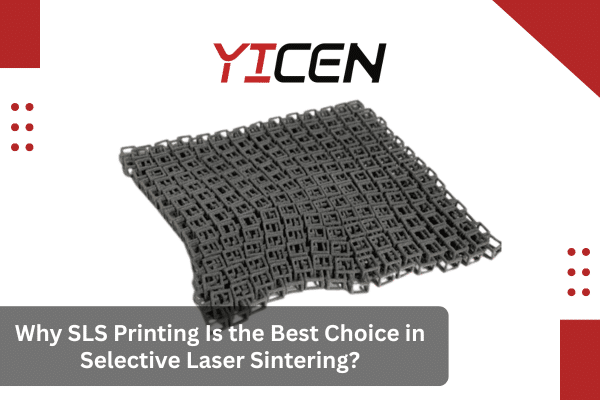
What Is SLS Printing and Why Does It Matter?
Impressão SLS represents a revolutionary 3d printing process that uses a high-powered laser to selectively fuse powdered materials into functional objects. This sinterização selectiva por laser processo de fabrico aditivo creates prototypes and end-use parts without traditional tooling requirements.
O processo de sinterização works when a laser traces each layer of powder while heating particles to their melting point. These particles bond together forming solid 3d printed parts. This powder bed fusion approach eliminates design constraints found in conventional manufacturing methods.
Precisão Yicen specializes in advanced sls impressão 3d alongside comprehensive precision manufacturing services. Their serviço de impressão 3d covers multiple sls materials for various industrial 3d printing applications.
How SLS Printing Technology Works?
The Complete SLS Process
Impressão SLS begins with 3d models converted into printable layers through specialized software. Sls machines maintain precise temperatures between 80°C and 200°C depending on material de impressão requirements. The co₂ laser system delivers 25-100 watts of power while varrimento laser at speeds reaching 12 meters per second.
Sls systems achieve precise beam diameters around 0.4 millimeters for detailed work. Sls post-processing removes unsintered powder, with recovery systems recycling up to 95% of unused material, making this additive manufacturing method economically sustainable.
Key Components of SLS Systems
| Componente | Função | Quality Impact |
| High-power laser | Uses a laser to fuse particles | Controls resolution and strength |
| Powder Handling | Distributes powdered material | Affects acabamento da superfície |
| Temperature Control | Maintains thermal stability | Prevents warping |
| Powder bed | Supports construction | Ensures accuracy |
Why SLS Printing Excels Over Other Methods?
Superior Design Freedom
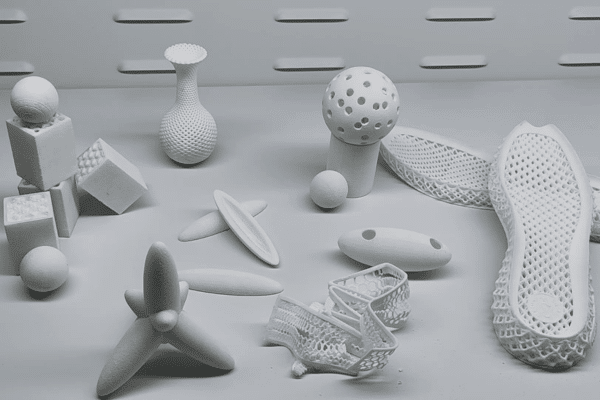
Impressão SLS creates complex internal channels and interlocking assemblies within single builds. Unlike moldado por injeção parts, sls technology enables wall thickness down to 0.8 millimeters while maintaining structural integrity and optimal strength-to-weight ratios.
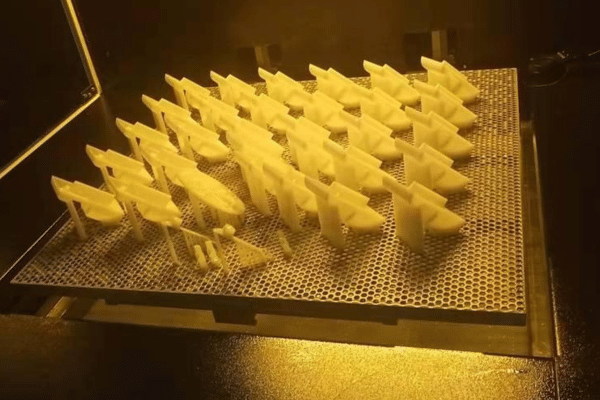
Impressão 3d por sinterização selectiva a laser produces uniform propriedades mecânicas in all directions, unlike 3d printing technologies like fdm that show weakness between layers. The vantagens da sls include eliminating support structures for most geometries.
Material Versatility and Performance
Tecnologias de fabrico aditivo através de sls impressão 3d accommodate engineering-grade thermoplastics, elastomers, and metal 3d printing materials. Precisão Yicen maintains extensive libraries of sls materials including certified aerospace and medical-grade options for prototipagem rápida applications.
Materials Available for SLS Printing
Polymer Materials
Sls nylon dominates applications with 45 MPa tensile strength and 20% elongation at break. Glass-filled nylon variants increase stiffness by 300% while maintaining impact resistance for demanding end-use parts.
TPU enables flexible sls 3d printed parts with Shore A hardness from 80 to 95. These materials withstand over 100,000 flexing cycles, proving ideal for functional protótipos and production components.
Metal Materials
Sinterização direta de metais por laser with stainless steel 316L achieves 99% density and 570 MPa tensile strength after heat treatment. Aluminum alloys offer excellent thermal conductivity while maintaining competitive strength-to-weight ratios for metal 3d applications.
Advantages of SLS Printing Technology
Cost-Effective Production
Impressão SLS eliminates expensive tooling with break-even points around 1,000 units compared to other 3d printing methods and traditional manufacturing. This printing technology reduces waste while enabling part consolidation.
Precisão Yicen offers competitive sls impressão 3d pricing through efficient production planning alongside serviços de maquinagem cnc for hybrid manufacturing processes.
Quality and Precision Benefits
| Método | Tempo de configuração | Design Changes | Complexity |
| Traditional | 4-12 weeks | Expensive | Limitada |
| Impressão 3D SLS | 1-3 days | Software only | Unlimited |
Powder bed fusion 3d printing achieves ±0.3% dimensional tolerances with acabamento da superfície quality from Ra 6-12 micrometers. This processo de sinterização selectiva por laser delivers consistent results across a variety of materials.
Applications Across Industries
Aerospace and Defense
Boeing and Airbus have certified numerous sls parts for commercial aircraft applications. Impressão 3d industrial creates lightweight brackets and complex manifolds meeting stringent aerospace requirements through this advanced processo de fabrico.
Precisão Yicen serves aerospace clients with AS9100-certified precision manufacturing e quality control systems for critical 3d printed components.
Fabrico de dispositivos médicos
Medical applications utilizar sls for patient-specific implants and surgical instruments using biocompatible sls materials. Dental applications achieve 50-micrometer accuracy for crowns and orthodontic appliances through this precise processo de fabrico aditivo.
Indústria automóvel
Ford Motor Company uses fabrico aditivo for over 500,000 prototyping applications, reducing development costs by 75%. Sls technology produces air intake manifolds and electrical housings leveraging complex geometries impossible with traditional methods.
SLS vs Other 3D Printing Technologies
SLS vs FDM Printing
Impressão SLS eliminates support structures while achieving superior acabamento da superfície e propriedades mecânicas compared to modelação por deposição fundida. Selective laser sintering creates isotropic 3d printed parts with consistent strength regardless of orientation.
Fdm systems cost less initially but sls offers better functionality for end-use parts requiring engineering-grade performance.
SLS vs SLA Printing
Impressão SLS produces ready-to-use parts immediately after powder removal, while sla requires extensive washing and UV curing. Laser sintering materials offer better temperature resistance and durability for functional applications.
Quality Control in SLS Printing
Process Monitoring
Moderno sls printers incorporate thermal imaging and laser power monitoring during production cycles. Statistical process control tracks dimensional variation across batches of sls 3d printed parts.
Precisão Yicen implements comprehensive quality control including first article inspection and periodic verification exceeding industry requirements for Tecnologias de impressão 3d.
Testing and Validation
Material certification involves mechanical testing of specimens built alongside production sls parts. Non-destructive methods including CT scanning verify internal quality for critical fabrico aditivo applications.
Future Trends in SLS Printing
Technology Advancements
Multi-laser configurations increase sls production speeds while maintaining quality standards. Machine learning optimizes sinterização selectiva por laser parameters automatically, reducing setup time and improving yield rates for 3d printing methods.
New materials including continuous fiber reinforcement expand metal 3d printing into markets previously dominated by traditional manufacturing methods.
Market Growth Projections
Powder bed fusion technology shows compound annual growth exceeding 15% through 2030. According to NIST research, fabrico aditivo adoption accelerates as design tools improve and workforce training programs expand [^1].
Choosing the Right SLS Service Provider
Key Selection Criteria
Evaluate sls impressão 3d providers based on equipment capabilities, material certifications, and ISO 9001 quality systems. Technical support determines successful outcomes for complex industrial 3d printing applications.
Precisão Yicen provides comprehensive 3d printing services backed by manufacturing experience and certified quality systems supporting both prototipagem and production needs.
Indicadores de qualidade do serviço
Material traceability ensures sls materials meet specifications for regulatory compliance. Dimensional inspection reports demonstrate process capability with statistical analysis across production batches of 3d printed parts.
Conclusão
Impressão SLS delivers unmatched capabilities for complex, functional components across industries. This sinterização selectiva por laser technology combines design freedom with production-ready materials, making it essential for modern fabrico aditivo.
Precisão Yicen fornece especialistas sls impressão 3d with comprehensive quality control e precision manufacturing capabilities. The technology’s advancement promises broader adoption reshaping manufacturing processes.
What materials work best for SLS printing?
How accurate is SLS printing technology?
What are the size limitations for SLS printing?
How long does SLS printing take?
What industries benefit most from SLS printing?
Citações
[^1]: National Institute of Standards and Technology. “Additive Manufacturing: Status and Opportunities.” NIST Special Publication 1176. https://www.nist.gov/publications/additive-manufacturing-status-and-opportunities
Additional References:
- Gibson, I., Rosen, D., Stucker, B., & Khorasani, M. (2021). Additive Manufacturing Technologies. Springer International Publishing.
- ASTM International. “Standard Terminology for Additive Manufacturing Technologies.” ASTM F2792-12a.
- Wikipedia Contributors. “Selective Laser Sintering.” Wikipedia, The Free Encyclopedia. https://en.wikipedia.org/wiki/Selective_laser_sintering
- International Organization for Standardization. “Additive Manufacturing – General Principles.” ISO/ASTM 52900:2015.
- U.S. Department of Energy. “Additive Manufacturing: Pursuing the Promise.” DOE Advanced Manufacturing Office, 2023.
 Portuguese
  English
  French
  Spanish
  Japanese
  German