Two bars sit side by side on a rack. Same silver finish, same diameter, same magnetic behavior when you touch a magnet to them. One costs noticeably more. Which one belongs in your part? The 304 vs 316 stainless steel decision looks minor on paper, yet it affects what you pay for material, how fast tools wear and how long the finished part survives in service. This article walks through the choice from the machine shop’s side of the table, so your drawing goes out with the right grade already named.
The Chemistry Behind the Price Tag
Both grades come from the austenitic family, which explains why they behave so similarly in daily use. They form well, they weld well and they stay non-magnetic when annealed. The recipe is where they part ways.
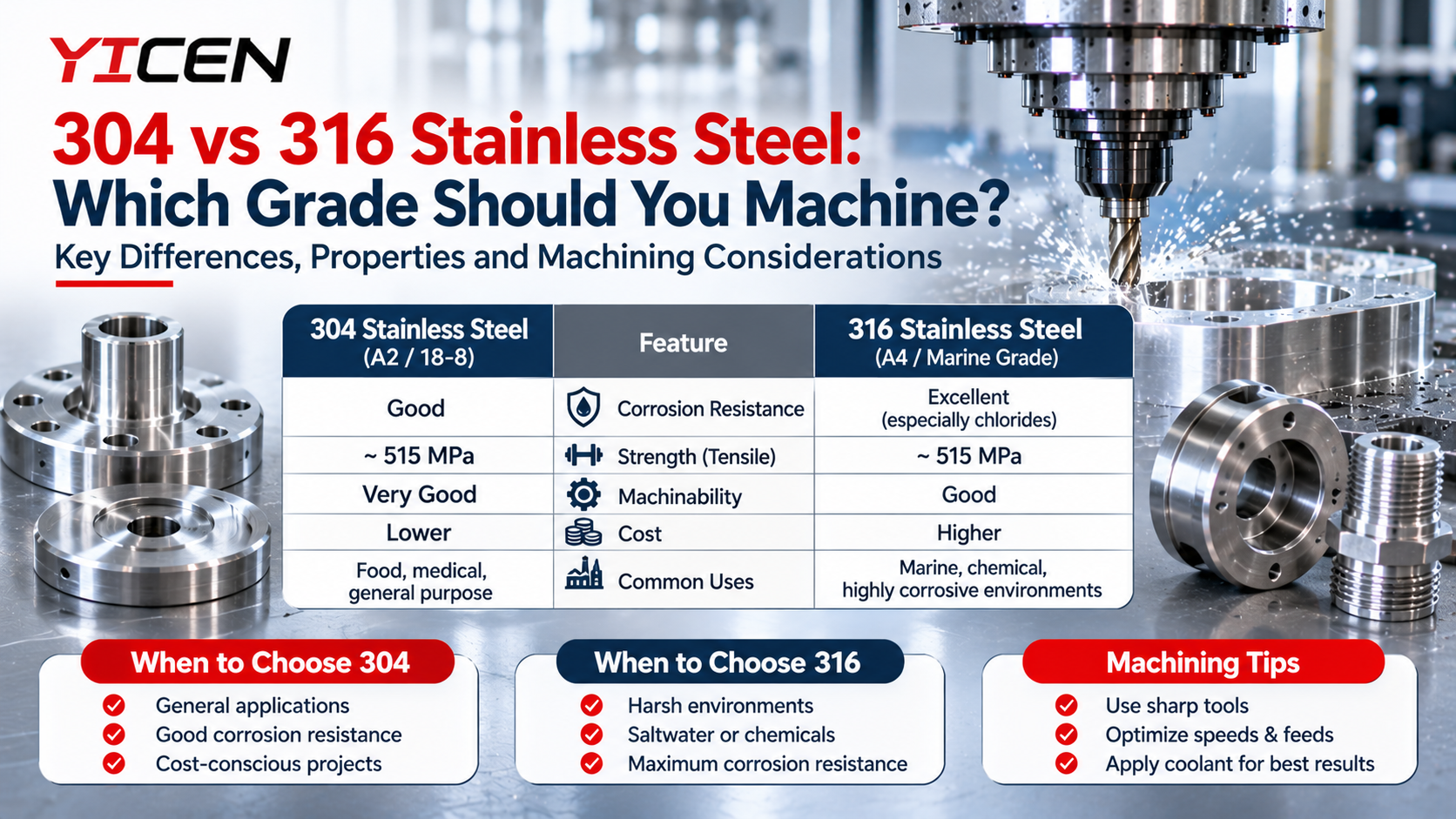
| Element (typical range) | 304 | 316 |
|---|---|---|
| Chromium | 18–20% | 16–18% |
| Nickel | 8–10.5% | 10–14% |
| Molybdenum | None | 2–3% |
That small molybdenum addition is the whole story. It strengthens the protective surface film against chlorides, which are the salts and cleaners that attack ordinary stainless. Mechanical strength lands in a similar range for both grades in the annealed state, so nobody should pick 316 expecting a tougher part. You pay for chemistry, not muscle.
Stainless Steel Grades Worth Knowing Before You Decide
Plenty of buyers treat the choice as 304 or 316 and nothing else. The family is wider than that. Low-carbon versions, 304L and 316L, lower the risk of problems near welds. Grade 303 adds sulfur so it cuts faster, though it gives up some corrosion performance. Duplex and precipitation-hardening types chase higher strength.
Among all the stainless steel grades a buyer can choose from, 304 and 316 remain the workhorses because they are easy to source and easy to form at fair prices. Before you commit, look through our material options to see what else might fit the job.
Corrosion Resistant Steel Is Not Rustproof Steel
People say “rustproof” about stainless all the time, and it causes expensive surprises. What you actually have is corrosion resistant steel. Chromium builds a thin invisible oxide layer that repairs itself when oxygen is around. Strip that layer with chlorides, harsh acids or stagnant, salty water, and the metal starts to pit.
304 handles kitchens, food contact, indoor hardware and ordinary weather without complaint. 316 earns its reputation near the coast, in chemical lines, in pool equipment and anywhere cleaning solutions get aggressive. One caution: 316 is not invincible. Warm seawater and hot chloride exposure can still pit it, and 304 fares worse. If a part will live in genuinely punishing conditions, tell your machinist early so you can talk about a higher alloy.
316 Stainless Steel Machining at the Spindle
On the machine, 316 stainless steel machining asks for more patience than 304. Both grades work-harden quickly, and both hold heat right at the cutting edge because stainless carries it away poorly. 316 does this a little more, and its tough, gummy chips like to cling to the insert.
These habits help on either grade, and they matter more on 316:
- Use sharp carbide with positive geometry and a light edge hone.
- Keep the feed firm. A tool that rubs hardens the surface and burns itself out.
- Avoid dwelling in the cut. A pause leaves a hard ring that the next pass has to fight.
- Aim coolant at the cutting zone, not just at the general area.
- Lower the surface speed slightly compared with 304 and watch the chip color.
Round parts such as shafts, pins and fittings run well through our CNC turning services, where insert grade and coolant get matched to the steel on the machine. Parts that need a truly flat, clean face often finish on surface grinding, which reaches flatness and finish targets that milling alone struggles to hold.
Paying for Molybdenum: The 304 vs 316 Stainless Steel Cost Question
316 usually costs more per pound, and some suppliers quote a premium in the range of 20 to 40 percent. The gap moves with nickel and molybdenum markets, so check current pricing instead of trusting last year’s quote. Machining widens it further. Slower speeds and quicker tool wear stretch cycle time, which means the difference on a finished part can exceed the difference in bar price.
So how do you decide whether it’s worth it? Ask what a failure would cost you. A rusty bracket on a garden fixture is an irritation. A pitted fitting in a chemical line or a seawater pump is a shutdown. When corrosion threatens safety, uptime or your reputation, 316 acts as cheap insurance. When it doesn’t, 304 saves real money and nobody ever notices the difference.
Our rough guide: pick 304 for enclosures, brackets, dry food equipment and indoor hardware. Pick 316 for marine, coastal, chemical and heavy washdown conditions. If the environment is unclear, ask before cutting, because a five-minute conversation costs less than a scrapped batch.
Where Each Grade Usually Ends Up
Certain industries settle the question before cost even enters. Teams building medical devices often specify 316 or 316L for surgical instruments, housings and parts that face repeated sterilization and contact with body fluids. Food and beverage lines split: 304 covers most dry and mild jobs, while 316 takes over for acidic or salty products. Offshore and marine buyers rarely compromise, because seawater punishes weak choices fast.
Getting a Quote That Matches the Part
A good quote starts with simple facts: the drawing, the quantity, where the part will live and any certification you need. With those in hand, we can tell you quickly whether 304 is enough or 316 pays for itself. For more material breakdowns like this one, read our blog. And if you already know what you’re building, contact our team with your drawing and your 304 vs 316 stainless steel question, and we’ll reply with a clear quote and honest material advice. Want to know who you’d be working with? Here’s about our company.
Frequently Asked Questions
What is the main difference between 304 and 316 stainless?
Molybdenum. 316 contains roughly 2 to 3 percent of it, which gives much better resistance to pitting in salty and chemical settings. Strength stays in a similar range.
Which grade is easier to CNC machine?
- It cuts more cleanly and wears tools more slowly. 316 still machines well with sharp carbide, firm feeds and good coolant, but it needs slightly lower speeds.
Is 316 worth the extra cost over 304?
Only when corrosion carries real risk. For marine, chemical or washdown use, it pays off. In the 304 vs 316 stainless steel choice, mild indoor parts rarely justify the higher price.
Can you use 304 stainless in saltwater?
It’s a poor idea. Chlorides attack the protective film on 304 and cause pitting over time. Coastal or submerged parts do better in 316, and warm seawater may call for something stronger still.
Do both grades need coolant when machining?
Yes. Stainless traps heat at the cutting edge, so coolant aimed at the cut protects both tool life and surface quality. Flood or through-tool delivery works best, especially on 316.