 Skip to content
As a senior manufacturing engineer with over 25 years on the shop floor, I’ve seen aluminum CNC turning evolve from basic lathe operations to sophisticated processes integrated with real-time monitoring and adaptive controls. This article dives deep into the subject, covering everything from material science basics to troubleshooting production issues, trade-offs in parameter selection, and decision-making frameworks for engineers, OEM buyers, and procurement managers. We’ll explore how aluminum’s properties influence machining strategies, why certain alloys dominate specific industries, and what goes wrong when setups fail under production pressure. By the end, you’ll have the tools to optimize your own operations or evaluate suppliers effectively. For complex projects, requesting a quote from a reliable CNC turning service can reveal practical insights tailored to your specifications.
Material Science of Aluminum in CNC Turning
Aluminum stands out in CNC turning because of its low density, high thermal conductivity, and excellent machinability compared to steels or titanium. At 2.7 g/cm³, it’s about one-third the weight of steel, which directly impacts part performance in weight-sensitive applications. But aluminum isn’t a single entity; its alloys vary widely in composition, affecting everything from chip formation to tool life.
The base metal is alloyed with elements like copper, magnesium, silicon, zinc, or manganese to enhance properties. For instance, copper additions in the 2000 series improve strength but reduce corrosion resistance, while magnesium and silicon in the 6000 series create precipitates that harden the material during heat treatment. In turning, these alloys behave differently: softer ones like 1100 form long, stringy chips that tangle in the turret, while harder ones like 7075 produce shorter chips but accelerate insert wear.
Heat treatment tempers play a critical role. T6 designation means solution heat-treated and artificially aged, boosting yield strength but potentially introducing residual stresses that cause warping post-machining. I’ve dealt with batches where improper annealing led to 0.005-inch bows in long shafts—fixable with stress-relief operations, but adding cycle time and cost. O-temper (annealed) offers maximum ductility for forming but lacks strength for load-bearing parts.
Procurement managers should specify alloy and temper early, as sourcing affects lead times. For example, 6061-T651 plate is readily available and machines predictably, while 7075-T7351 might require mill orders for aerospace certifications. Always verify material certificates; I’ve caught suppliers substituting 6063 for 6061, leading to failures under fatigue loading.
Key Properties Influencing Machinability
Machinability in aluminum turning hinges on thermal conductivity (around 120-200 W/m·K), which dissipates heat quickly but can cause built-up edge (BUE) if coolant isn’t optimized. Low modulus of elasticity (70 GPa) means parts deflect under cutting forces, demanding rigid fixturing. Coefficient of thermal expansion (23.6 × 10^-6 /°C) exacerbates dimensional issues; a 10°C rise can expand a 100mm part by 0.0236mm, exceeding tight tolerances.
Strength varies: 6061-T6 has tensile strength of 310 MPa and yield of 275 MPa, suitable for general use, while 7075-T6 reaches 570 MPa tensile and 505 MPa yield, rivaling some steels but with 1/3 the weight. Fatigue strength is crucial; 2024-T3 excels here at 138 MPa endurance limit, ideal for cyclic loads in aircraft fittings.
Corrosion resistance depends on alloy: 5052-H32 offers superior protection in marine environments due to its magnesium content, forming a stable oxide layer. In turning, surface finishes below Ra 0.8 μm help maintain this layer intact.
Trade-Offs in Alloy Selection
Choosing an alloy involves balancing strength, cost, and machinability. 2011-T3 machines fastest thanks to lead and bismuth additions that promote chip breaking, but it’s banned in food-contact applications due to toxicity. 6082-T6, common in Europe, provides slightly higher strength than 6061 (tensile 310 MPa vs. 290 MPa) with similar corrosion resistance, but availability in the US can increase costs.
High-strength alloys like 7075 demand slower feeds to avoid chatter, extending cycle times by 20-30%. Softer 5052-H32 (tensile 230 MPa) turns quicker but deforms easily in thin sections. Engineers must model these trade-offs using FEA software to predict deflections and stresses before committing to production.
In procurement, factor in raw material costs: aluminum averages $1.17 per pound in 2026, but alloys vary—7075 can hit $3-4 per pound due to zinc content. Bulk buying reduces this, but overstocking ties up capital.
The CNC Turning Process: From Setup to Finish
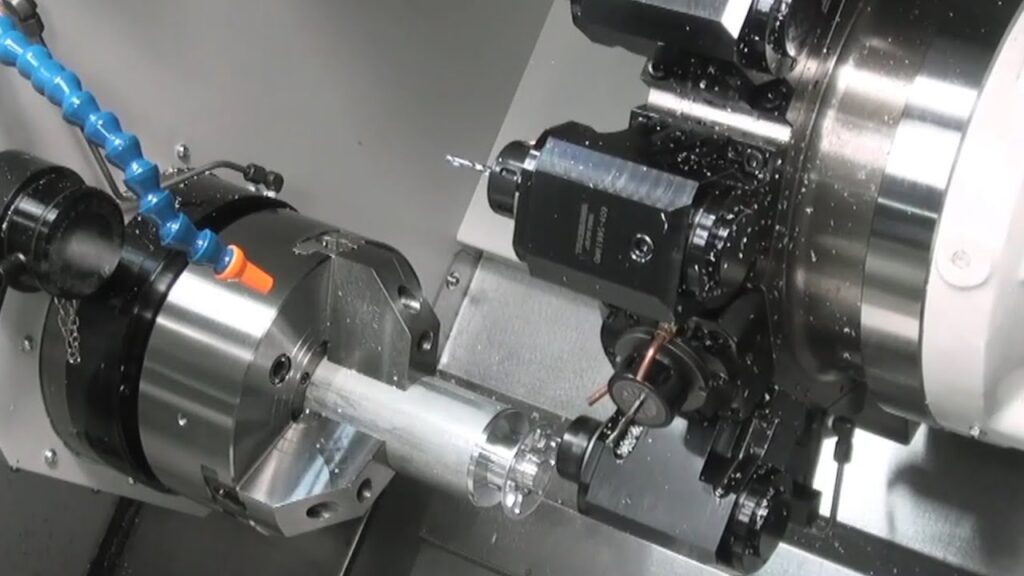
CNC turning aluminum starts with workpiece preparation. Bar stock or billets are loaded into the chuck, often using soft jaws to prevent marring. For high-volume runs, bar feeders automate loading, reducing downtime from 5 minutes per part to seconds.
Programming begins in CAM software like Mastercam or Fusion 360. G-code defines toolpaths: roughing removes bulk material at high feeds (0.3-0.5 mm/rev), while finishing uses lighter cuts (0.05-0.1 mm/rev) for surface quality. Adaptive toolpaths adjust dynamically to maintain constant chip load, preventing overload in varying geometries.
Machine setup involves aligning the turret, setting offsets, and calibrating probes. In production, I’ve seen misaligned tailstocks cause taper errors up to 0.002 inches over 6 inches—traceable to thermal growth if not monitored.
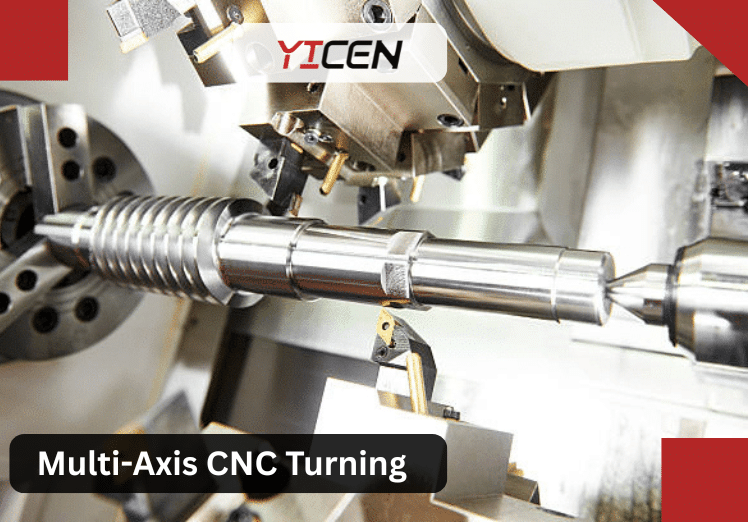
During operation, the spindle rotates the part (500-4000 RPM for aluminum), and tools engage. Facing squares the end, OD turning shapes exteriors, ID boring hollows interiors, threading cuts helices, and grooving adds undercuts. Multi-axis machines with live tooling add milling capabilities, like drilling cross-holes without secondary ops.
Post-processing includes deburring (vibratory or tumbling), anodizing for corrosion protection, or heat treating if needed. Inspection uses CMMs or gauges; skip this, and rejects pile up.
Parameter Optimization: Speeds, Feeds, and Depths
Speeds for aluminum range 1000-8000 SFM, calculated as V = (π * D * N)/12, where D is diameter and N is RPM. High speeds exploit aluminum’s low melting point but risk melting if coolant fails.
Feeds (IPR) of 0.004-0.020 balance productivity and finish; too high causes rough surfaces, too low wastes time. Depth of cut (DOC) 0.5-3mm for roughing; shallow passes (0.1-0.5mm) for finishing minimize deflection.
Chip load per tooth (f_z = f / (N * Z)) should stay 0.1-0.3mm to avoid rubbing. In practice, I adjust based on sound—chatter means reduce feed or increase rigidity.
Coolant is non-negotiable: flood at 10-20 gpm prevents BUE, while MQL (minimum quantity lubrication) suits eco-focused shops, reducing fluid use by 90% but requiring precise delivery.
Tooling Selection and Management
Carbide inserts dominate, with grades like ISO K10-K20 for aluminum’s abrasiveness. Positive rake angles (15-25°) shear cleanly; negative rakes add strength but increase forces.
Geometries: Wiper inserts for Ra <0.4 μm finishes, chipbreakers for control. Coatings like TiAlN reduce friction, extending life 2-3x.
Tool life equation: T = (C / V)^n * (1/f)^m, where C is constant, n/m exponents. For 6061, expect 200-500 minutes per edge; 7075 halves that due to hardness.
In shops, I track wear with micrometers; flank wear >0.3mm signals change. Predictive maintenance via vibration sensors prevents breakage, saving $500+ per incident.
Common Challenges in Aluminum CNC Turning
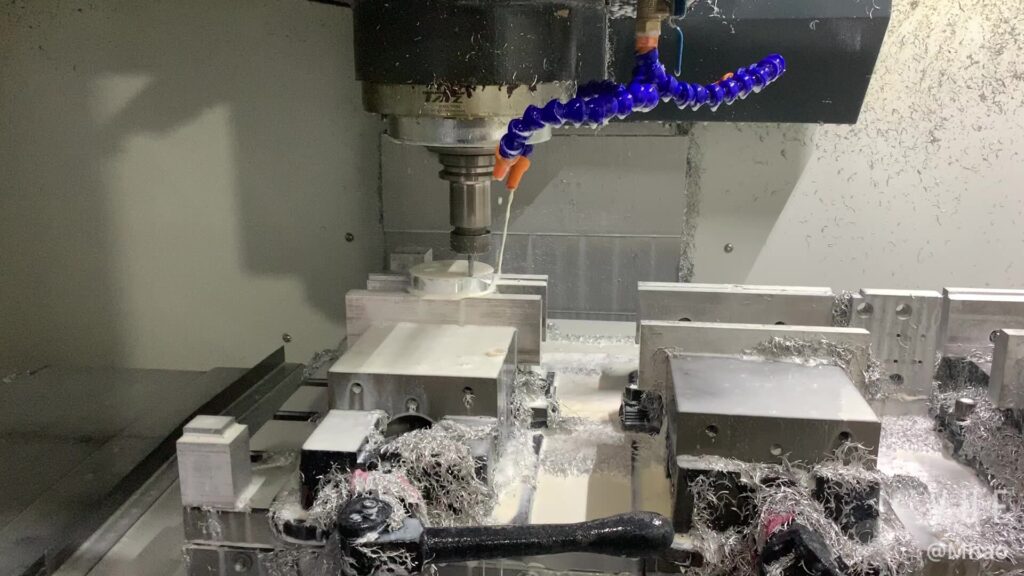
Aluminum’s softness brings unique issues. Chip management tops the list: long chips wrap around tools, causing jams and scratches. Solutions include high-helix tools, peck cycles, or air blasts.
Thermal buildup warps thin walls; aluminum expands twice as fast as steel. Use through-tool coolant and monitor temperatures—exceed 200°C, and BUE forms. I’ve fixed this by reducing DOC 50% in final passes.
Tool wear accelerates from abrasiveness; silicon in 6000 series grinds edges. Carbide lasts, but diamond-coated tools extend life 5x for high-silicon alloys.
Vibration in slender parts causes chatter marks. Dampen with steady rests or tune parameters—drop speed 10% or add mass.
Dimensional instability from residual stresses: parts bow after unclamping. Pre-machining stress relief (vibratory or thermal) mitigates, but adds 1-2 hours per batch.
Burr formation at exits: sharp tools and climb cutting minimize, but deburring is often manual, eating 10-20% of labor.
Troubleshooting Real-World Failures
In one run, 7075 shafts showed taper: root cause was chuck jaw wear allowing slippage under torque. Fixed with new jaws and torque checks.
Another: surface tears on 5052 from dull inserts. Solution: edge hone of 0.01mm and higher rake.
When things go wrong, use fishbone diagrams to isolate—machine, method, material, man, measurement, environment. 80% trace to parameters or setup.
Quality Control and Inspection Strategies
Quality starts with in-process gaging: touch probes measure mid-cycle, adjusting offsets for thermal drift. Target Cpk >1.33 for critical dimensions.
Post-turning: CMMs check form (roundness <0.005mm typical), calipers for diameters. Surface profilometers verify Ra; aluminum often achieves 0.2-0.8 μm with polished inserts.
For aerospace, AS9100 requires traceability—lot numbers, process records. I’ve implemented SPC charts to catch drifts early, preventing scrap.
Tolerances: ±0.005mm possible, but ±0.01mm standard for cost. Tighter needs 5-axis or grinding secondary.
Industrial Applications and Case Studies
Aerospace relies on aluminum turning for fittings, bushings, and impellers. In one case, a large 6061 impeller (500mm diameter) for engines required 5-axis turning to hold ±0.02mm on blades, using EDM for slots—cycle time 8 hours, but met thrust requirements.
Automotive: brake discs from 6061 hats and 420 steel rings, turned on multi-spindle lathes for balance. A project optimized weight by 15% via pocketing, improving fuel efficiency.
Medical: titanium-aluminum alloys for implants, but pure aluminum housings turned for devices. Precision to ±0.002mm ensures fit; one batch failed sterilization due to burrs, leading to ultrasonic deburring adoption.
Electronics: heat sinks from 6063, turned with fins for airflow. High-volume runs use Swiss lathes for sub-1mm features.
Decision Logic for Applications
Engineers weigh load vs. weight: aerospace favors 7075 for 570 MPa strength, automotive 6061 for cost. Procurement assesses volume—high for bar turning, low for billet.
Limitations: aluminum fatigues faster than titanium in extreme cycles; coat or alloy accordingly.
Cost Analysis and Optimization
Costs break down: material 20-30% ($5-15/kg for alloys), labor 10-20%, machine time 40-50% ($35-75/hour), tooling 10%. Setup $50-200, volume discounts drop per-part from $100 (prototypes) to $10 (thousands).
Optimize by batching similar parts, using near-net forgings to cut material waste 30%, or multi-tasking machines reducing ops from 3 to 1.
In 2026, global CNC market reaches $108.58 billion, driven by aluminum demand in EVs and aerospace.
Selecting a CNC Turning Service Provider
Evaluate experience: 10+ years with aluminum, references from your industry. Equipment: Swiss or multi-axis for complexity. Certifications: ISO 9001, AS9100.
Quote process: Provide STEP files, specify tolerances—expect responses in 24-48 hours. For aluminum CNC turning needs, a service like [SERVICE NAME] offers RFQ tools for quick estimates, ensuring alignment with your timelines.
Audit facilities: check for coolant recycling, tool crib organization—signs of efficiency.
Future Trends in Aluminum CNC Turning
By 2026, AI integrates for adaptive machining, adjusting feeds in real-time to cut waste 20%. Hybrid turning-additive builds complex features, like internal cooling channels.
Sustainability: recycled aluminum (75% energy savings), MQL over flood. Advanced alloys like Al-Li for 10% lighter aerospace parts.
Automation: cobots handle loading, freeing operators for oversight. Expect market growth to $251 billion by 2034.
Conclusion
Aluminum CNC turning stands as one of the most efficient and versatile subtractive processes available to modern manufacturing. Its combination of excellent machinability, low weight, good strength-to-weight ratios, and cost-effective raw material continues to make it the material of choice for countless cylindrical and rotationally symmetric components across aerospace, automotive, medical, electronics, and general industrial applications.
FAQs
What factors determine the best aluminum alloy for a specific CNC turning application?
Alloy selection depends on required strength, corrosion resistance, and machinability. For high-stress parts like aerospace fittings, 7075-T6 provides 570 MPa tensile strength but requires careful parameter control to avoid tool wear. In contrast, 6061-T6 offers 310 MPa with better weldability for general automotive components. Consider environmental exposure—5052-H32 excels in salty conditions due to its magnesium content. Always balance cost: 7075 can be 1.5x pricier than 6061. Test prototypes to validate performance under load.
How do machining parameters affect surface finish in aluminum CNC turning?
Parameters like spindle speed (2000-4000 RPM), feed rate (0.1-0.3 mm/rev), and depth of cut (0.2-1mm) directly influence finish. High speeds with light feeds achieve Ra 0.4-0.8 μm by minimizing heat buildup and BUE. Excessive feed causes tears, while insufficient coolant leads to thermal marks. Tool geometry—positive rake and polished edges—reduces roughness. In production, monitor via profilometers; adjustments can improve finish 50% without secondary polishing. For medical parts, aim below Ra 0.2 μm to prevent bacterial adhesion.
What are the most common causes of dimensional inaccuracies in turned aluminum parts?
Inaccuracies stem from thermal expansion, residual stresses, and deflection. Aluminum’s high CTE causes 0.02mm growth per 100mm at 10°C rise—common in long runs without temperature control. Stresses from forging release post-clamping, bowing parts 0.005-0.01 inches. Slender features deflect under 100-200N forces. Solutions include stress-relief annealing, segmented roughing, and tailstock support. Use in-process probing to compensate; I’ve reduced rejects 40% this way. Tight tolerances demand climate-controlled shops.
How can tool life be extended when turning high-strength aluminum alloys like 7075?
Extend life with carbide inserts (K10 grade), TiAlN coatings for friction reduction, and optimized parameters—feeds 0.15mm/rev max to avoid overload. Coolant pressure at 50-100 psi prevents BUE. Monitor flank wear; change at 0.2mm to prevent breakage. For 7075, diamond tools last 3-5x longer but cost more upfront. In batches, I’ve achieved 300 minutes per edge by alternating rough/finish tools. Predictive software analyzes vibration data to flag wear early, saving 20% on tooling budgets.
What role does coolant play in preventing defects during aluminum CNC turning?
Coolant lubricates, cools, and evacuates chips, preventing melting at 660°C and BUE that scratches surfaces. Flood systems at 15 gpm handle heat in deep cuts; MQL uses 50ml/hour for eco benefits but requires precise nozzles. Without it, warping increases 2-3x from heat. In gummy alloys like 5052, it breaks chips to avoid tangles. Choose water-soluble types with EP additives for aluminum to avoid staining. I’ve switched to synthetic coolants, reducing dermatitis issues and extending sump life 2x.
 English
  French
  Spanish
  Japanese
  German
  Portuguese