 Aller au contenu

Introduction
The complexity and precision required in modern manufacturing processes often demand the use of specialized jigs to ensure both accuracy and efficiency. In particular, welding jigs and assembly jigs play critical roles in maintaining quality and improving cycle times across various industries.
While both jigs are designed to hold parts securely and accurately, they serve very distinct purposes and are used in different production contexts. This guide will explore the key differences between welding jigs and assembly jigs, highlighting their specific functions, features, and applications.
Why Specialized Jigs Are Essential in Modern Manufacturing
Specialized jigs are indispensable in modern manufacturing because they increase operational efficiency, reduce human error, and improve part repeatability. Whether guiding cutting tools in welding or assisting with part alignment during assembly, these tools help ensure consistency and precision, enabling faster production cycles and better-quality products.
Role of Welding Jigs and Assembly Jigs in Accuracy, Repeatability & Cycle Time
Both welding and assembly jigs play a crucial role in improving production accuracy and repeatability. Welding jigs are specifically designed to ensure that components remain in alignment during the high-temperature processes of welding, preventing distortion. On the other hand, assembly jigs provide support and help position parts during assembly, ensuring correct alignment and dimensional consistency. By reducing the need for manual adjustments, both jigs help reduce cycle times and enhance overall productivity.
What Are Welding Jigs?
Welding Jig Definition
A welding jig is a specialized device used to hold and align parts during the welding process. The jig ensures that components are accurately positioned, preventing movement during welding that could cause misalignment or distortion. It can be used in various welding methods, including MIG, TIG, and arc welding.
Purpose in Fabrication
- Holding Components During Welding: Welding jigs are designed to secure multiple components together, allowing welders to perform precise welds without worrying about repositioning parts.
- Prevent Heat Distortion: By securing parts firmly in place, welding jigs minimize the risk of thermal distortion that could affect the final part dimensions.
- Maintain Squareness & Alignment: Welding jigs ensure that parts are held square and aligned to the correct angles, improving weld integrity and dimensional accuracy.
Key Features of Welding Jigs
- High Heat Resistance: Welding jigs are built to withstand high temperatures generated during welding processes.
- Heavy-Duty Clamping: They are equipped with robust clamping mechanisms to hold the workpieces securely even under the stresses of welding.
- Rigid Framework: Welding jigs are constructed from matériaux that offer strength and stability, ensuring minimal deflection during welding.
- Adjustable Locating Stops: Many welding jigs feature adjustable stops to allow for flexibility in part sizes and configurations.
Typical Use-Cases
- Fabricated Frames: Used in the production of metal frames, welding jigs ensure that parts are welded in the correct orientation.
- Automotive Chassis Components: Welding jigs are employed to maintain alignment and accuracy when welding the frame or chassis components in the automotive industry.
- Metal Furniture: They are used to keep furniture parts in place during the welding of metal frames, ensuring correct fit and function.
- Industrial Structures: Welding jigs assist in the fabrication of large metal structures, where precise alignment is crucial for overall integrity.
What Are Assembly Jigs?
Assembly Jig Definition
Assembly jigs are tools used to hold and align parts during the assembly process. Unlike welding jigs, they do not deal with high heat or heavy stresses but focus instead on precision alignment and positioning for the efficient assembly of multiple parts into a final product.
Their Role in Production
- Support Part Positioning: Assembly jigs ensure that parts are positioned in the correct orientation for efficient assembly, reducing errors and assembly time.
- Assist Manual or Semi-Automatic Assembly: They are used in both manual and semi-automatic assembly lines, ensuring that components are assembled accurately and consistently.
- Help Ensure Dimensional Consistency: By aligning components with high precision, assembly jigs ensure that parts meet the required tolerances.
Key Features of Assembly Jigs
- Ergonomic Design: Assembly jigs are often designed with ergonomics in mind to reduce operator fatigue during repetitive tasks.
- Lightweight Structure: Typically lighter than welding jigs, assembly jigs are easy to handle, making them suitable for high-volume production environments.
- Quick-Release Clamps: These jigs often feature clamps that can be easily released for fast loading and unloading of parts.
- Positioning Pins & Guides: Assembly jigs utilize pins and guides to ensure that parts are positioned correctly, making the assembly process faster and more accurate.
Typical Use-Cases
- Electronics Assembly: Assembly jigs are used to hold components like circuit boards, positioning them for soldering, component insertion, or inspection.
- Appliance Components: In the manufacturing of appliances, assembly jigs help position and hold parts for assembly, ensuring proper fit and functionality.
- Plastic/Metal Sub-Assemblies: These jigs are often employed in the production of sub-assemblies, where precision and repeatability are essential.
- Automotive Interior Parts: Assembly jigs help in the assembly of components like dashboards, door panels, and seat frames, ensuring that they fit together with high accuracy.
Welding Jigs vs Assembly Jigs — The Core Differences

Objectif et fonction
- Welding Jigs: Focused on holding parts steady during high-heat welding processes, preventing movement and ensuring proper alignment and squareness.
- Assembly Jigs: Used primarily for positioning and aligning parts during assembly, ensuring consistent dimensional accuracy without the need for heat resistance.
Structural Strength Requirements
- Welding Jigs: Need to be robust and heat-resistant to withstand the forces and temperatures generated during welding.
- Assembly Jigs: While they still need to be strong, they do not require the same level of heat resistance, and their structural strength is focused on maintaining alignment rather than withstanding high stresses.
Heat Resistance
- Welding Jigs: Must be made from materials that can endure the high temperatures associated with welding processes.
- Assembly Jigs: Heat resistance is not a concern, as they are not exposed to the same high temperatures.
Accuracy & Tolerance Needs
- Welding Jigs: Precision is crucial, but the primary focus is on maintaining alignment under stress, especially during welding.
- Assembly Jigs: Require high accuracy to ensure parts fit together correctly, especially in automated or semi-automated production.
Types of Locating Devices Used
- Welding Jigs: Typically use pins, stops, and magnetic devices to secure parts during welding, with an emphasis on preventing distortion.
- Assembly Jigs: Often incorporate pins, guides, and positioning devices to ensure precise alignment of parts during assembly.
Clamping Devices & Force Requirements
- Welding Jigs: Need heavy-duty clamping to secure parts during welding, ensuring that the workpiece remains immobile during the process.
- Assembly Jigs: Require lighter clamping forces, as the parts are usually not subjected to the stresses of welding or cutting.
Materials & Construction
- Welding Jigs: Made from heavy-duty materials like steel and cast iron to withstand the stresses of welding and prevent distortion.
- Assembly Jigs: Typically constructed from lighter materials such as aluminum or composite materials to facilitate ease of use and reduce overall weight.
Operator Handling & Ergonomics
- Welding Jigs: Ergonomics are important but secondary to the need for stability and strength.
- Assembly Jigs: Often designed with ergonomics as a top priority to minimize operator fatigue during high-volume or repetitive tasks.
Key Elements of Both Jigs (with Differences)
Localisation des éléments
- Welding Jigs: Often use pins, blocks, and nests to hold parts in place during welding, with higher tolerance levels for heat resistance and structural strength.
- Assembly Jigs: Typically use precise locating pins and fixtures, with an emphasis on accuracy and alignment rather than heat resistance.
Dispositifs de serrage
- Welding Jigs: Incorporate heavy-duty toggle, hydraulic, or magnetic clamps to secure parts under high stress.
- Assembly Jigs: Use lighter, quick-release clamps for faster adjustments and better flexibility during assembly operations.
Supporting Structures
- Welding Jigs: Built from rigid steel or cast iron to ensure stability during welding operations.
- Assembly Jigs: Often made from lighter materials like aluminum, offering flexibility and portability for assembly tasks.
Types of Welding Jigs
- Modular Welding Jigs
- 3D Welding Tables
- V-block Welding Jigs
- Pipe/Tube Welding Jigs
- Automatic Welding Fixtures (Robotic Cells)
Types of Assembly Jigs
- Positioning Jigs
- Manual Assembly Jigs
- Pneumatic Assembly Fixtures
- Poka-Yoke Jigs (Mistake Proofing)
- Nesting & Holding Fixtures for Sub-Assemblies
Design Considerations for Welding vs Assembly Jigs
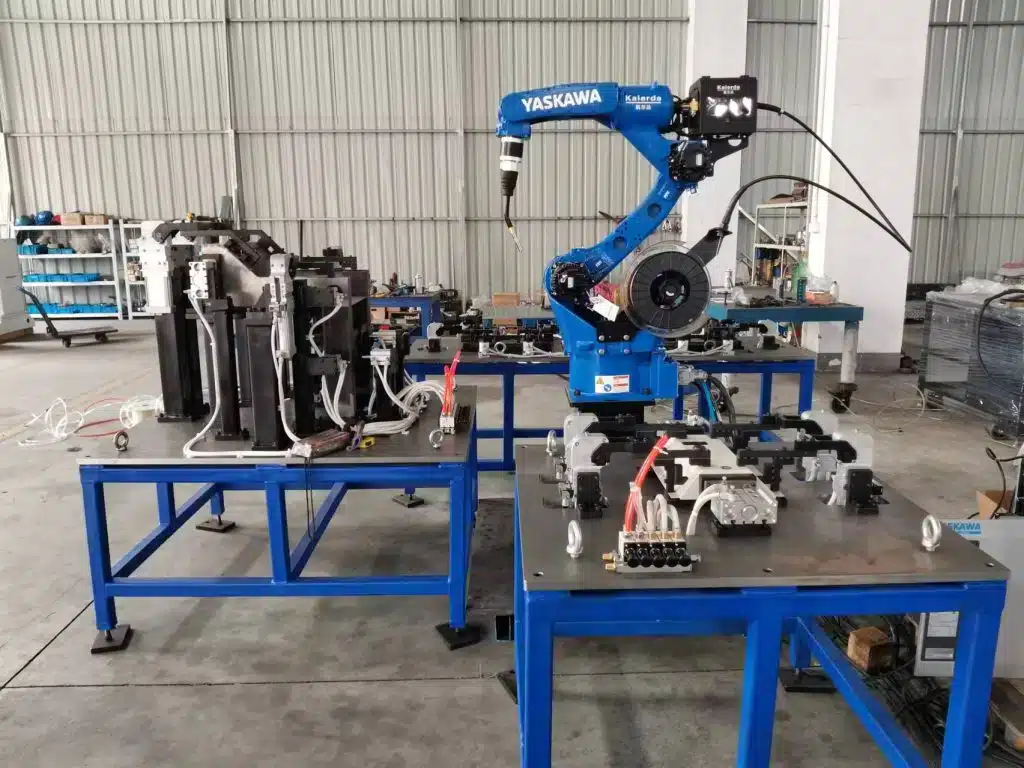
- Load & Stress: Welding jigs are designed to handle higher loads due to the forces generated during welding, while assembly jigs focus on precise alignment without significant stress.
- Heat Management (Welding Only): Welding jigs must account for heat distortion, while assembly jigs do not need such considerations.
- Ergonomics (Assembly Priority): Assembly jigs emphasize ergonomics for easier use in high-volume environments.
- Sélection des matériaux : Steel and cast iron are typically used for welding jigs, while aluminum and composites are favored for assembly jigs due to their lighter weight.
Applications Comparison
- Welding Applications: Used for fabricating metal frames, automotive chassis, industrial structures, and other high-stress components.
- Assembly Applications: Used in electronics assembly, appliance manufacturing, plastic/metal sub-assemblies, and automotive interior parts.
- When to Use Which Type: Welding jigs are ideal for metal fabrication involving high heat, while assembly jigs are better suited for aligning and assembling various parts without exposure to high temperatures.
Modern Trends & Advances
- Robotic Welding Fixtures
- Smart Assembly Jigs
- 3D Printed Assembly Jigs
- Modular Clamping & Locating Systems
Summary Table — Welding Jigs vs Assembly Jigs
| Fonctionnalité | Gabarits de soudage | Gabarits d'assemblage |
| Fonction principale | Hold parts during welding | Align parts during assembly |
| Exigences matérielles | Heat-resistant, heavy-duty | Lightweight, ergonomic |
| Clamping Force | Heavy-duty | Light, quick-release |
| Accuracy Requirement | High precision for alignment | High precision for fitment |
| Operator Ergonomics | Modéré | High priority |
| Applications typiques | Metal frames, automotive parts | Electronics, appliances |
Conclusion
Choosing the right jig for your application is crucial to improving productivity, quality, and safety in your manufacturing processes. Welding jigs and assembly jigs each have unique strengths and are designed to meet specific operational needs. Whether you are fabricating metal parts or assembling delicate components, selecting the appropriate jig ensures smoother operations and higher-quality results.
FAQ
What’s the primary purpose of each?
Welding jigs hold parts for precise welding and resist heat distortion. Assembly jigs position parts for bolting, riveting, gluing, or other non-welded joining.
Why are welding jigs usually much stronger?
They must withstand high heat, weld shrinkage, and spatter without warping the workpiece. Assembly jigs face minimal thermal stress, so they can be lighter and simpler.Can one jig be used for both welding and assembly?
Can one jig be used for both welding and assembly?
Rarely ideal. Welding jigs are overbuilt for heat; assembly jigs prioritize speed and easy access. Using the wrong type often reduces accuracy or efficiency.
How do the clamping designs differ?
Welding jigs use heavy-duty, heat-resistant clamps placed far from the weld zone. Assembly jigs favor quick-release or toggle clamps for fast loading/unloading.
Where are they most commonly used?
Welding jigs → automotive frames, aerospace structures, heavy machinery, metal fabrication. Assembly jigs → electronics, furniture, consumer products, final vehicle trim lines.
 French
  English
  Spanish
  Japanese
  German
  Portuguese