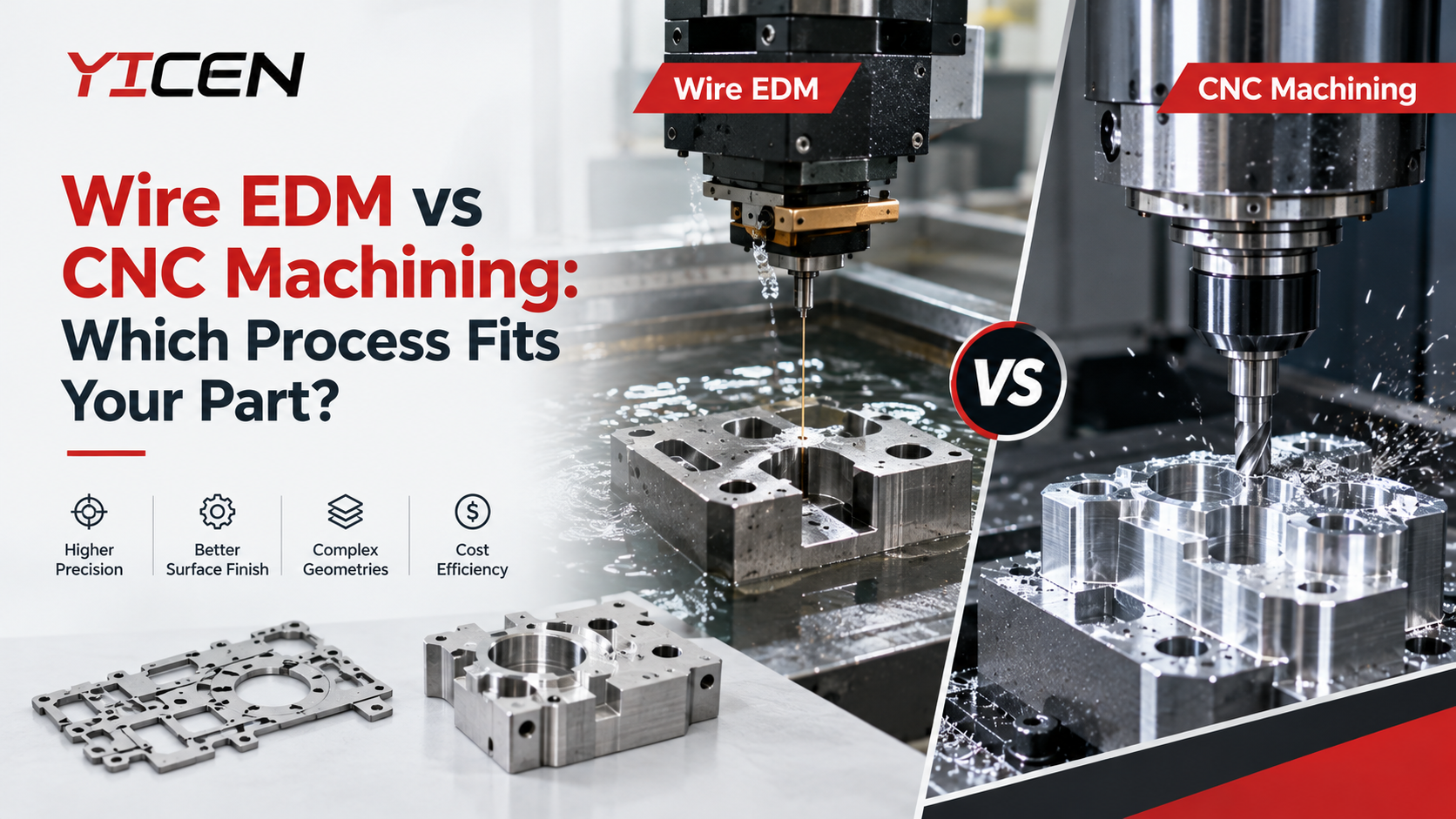
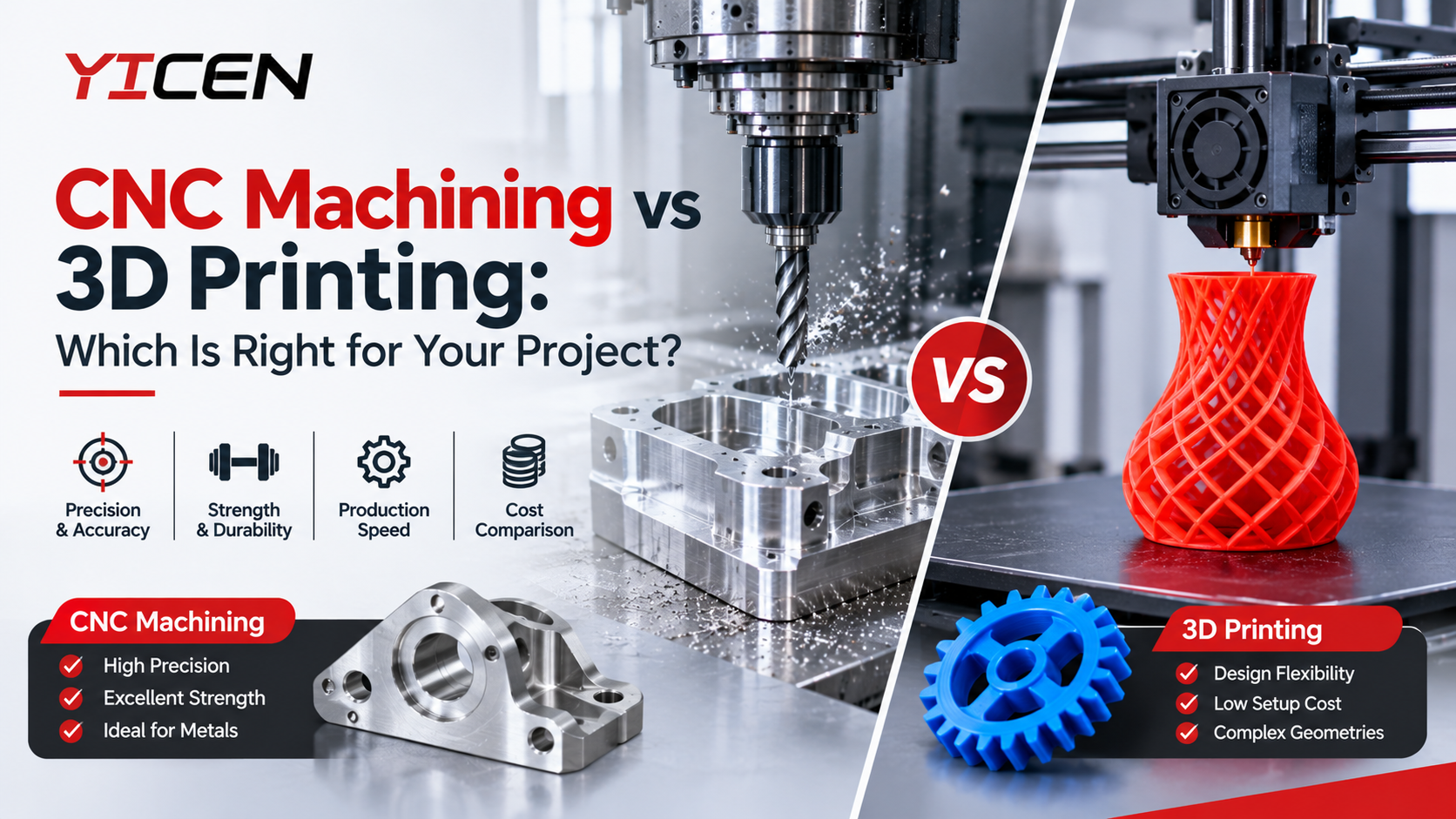
Almost every customer asks us the same thing before they send a drawing. Should this part be printed or cut? The CNC machining vs 3D printing decision shapes your budget, your lead time and how the part performs once it’s in use. Neither process wins every time. Printing is great for complex shapes and quick iterations. Machining is hard to beat for tight tolerances, strong parts and repeat orders. This guide walks through where each one fits, so you can choose before money gets spent.
What Each Process Actually Does
CNC machining is subtractive. A cutting tool removes material from a solid block of metal or plastic until the part matches the model. 3D printing is additive. A machine builds the part layer by layer from plastic resin, powder or metal.
That one difference explains most of what follows. Cutting starts with solid, uniform stock, so the finished part behaves predictably. Building layer by layer lets you make shapes no cutter could reach, but the layers leave their mark on strength and surface finish.
CNC vs Additive Manufacturing: Where Each Wins
Here’s the short version of CNC vs additive manufacturing, based on what we see on real jobs.
| Factor | CNC machining | 3D printing |
|---|---|---|
| Tolerances | Very tight, often ±0.025 mm or better | Looser, often ±0.1 to ±0.3 mm |
| Material strength | Uniform in every direction | Can vary by build direction |
| Complex internal shapes | Limited by tool access | Excellent |
| Surface finish | Smooth straight off the machine | Layer lines, usually needs finishing |
| Best run size | One part to thousands | One part to a few dozen |
Those numbers move with the machine, material and geometry, so treat them as typical ranges, not promises.
If you’re building a one-off concept model with an odd organic shape, printing will get it into your hands fast. If you need a bearing bore that holds tolerance, you’ll want a cutter.
Strength, Accuracy and Surface Finish
Strength is where machined parts pull ahead. A machined aluminum bracket carries the same properties through the whole part, because it started as a solid bar. A printed part can be weaker between layers, which matters when the load pulls in the wrong direction. Good print orientation helps, but it doesn’t erase the issue.
Accuracy follows the same pattern. A modern mill or lathe holds tolerances that most printers can’t match without extra finishing. Surfaces differ too. Machined faces come off smooth and ready for anodizing or plating. Printed faces usually need sanding, bead blasting or machining on critical features.
3D Printing vs Machining Cost, Part by Part
The 3D printing vs machining cost question has no single answer, and anyone who gives you one is guessing. Cost depends on the part.
Printing has almost no setup. You upload a file, the machine builds, and you pay mostly for material and machine time. That makes it cheaper for one-off parts, hollow designs and shapes that would need many setups on a mill.
Machining carries more setup work, including programming and fixturing. Once that’s done, each extra part gets cheaper. For simple, blocky geometry in aluminum or steel, machining can actually beat printing on price even for a single piece. And as quantities climb, machining pulls ahead almost every time.
Weight of the design matters too. A part with deep internal channels can cost a fortune to machine and very little to print. A part with flat faces and straight holes is the opposite.
Speed and Lead Time
Printing usually wins on raw speed for the first part. Many plastic parts finish in a day or two, with no tooling or fixtures. Machining takes a bit longer to set up, but it runs faster once it’s going, and it’s often quicker for multiple identical parts.
If you need a quick design check, a Custom Online Rapid prototyping workflow lets you upload a model and compare options without a long back-and-forth. Teams often print a first version to check fit, then machine the final version for strength and finish.
Metal 3D Printing vs CNC
Metal 3D printing vs CNC is the comparison that surprises people most. Printed metal has real strengths, and it isn’t just a novelty.
Metal 3D printing lets you make lattice structures, conformal cooling channels and consolidated assemblies that machining simply can’t produce. For lightweight brackets and complex flow parts, that freedom can save serious weight.
It also has limits. Printed metal parts usually need heat treatment, support removal and machining on mating surfaces to hit tight tolerances. The powder and machine time also keep costs high. For plain geometry, CNC is usually cheaper, faster and more accurate.
Many strong designs use both. Print the complex body, then machine the critical faces, holes and threads.
Choosing the Right Process for Your Part
Material availability matters here too. Machining handles nearly any commercial alloy or engineering plastic, including grades that printers can’t run. Printing offers a smaller but growing list.
Use this as a quick gut check:
- Lean toward printing for complex geometry, one-off parts, early design checks and hollow or organic shapes.
- Lean toward machining for tight tolerances, load-bearing parts, smooth finishes and production runs.
- Use both when a printed part needs machined features, or when you want to test a shape before committing to metal.
Our 3D printing services cover the early-stage side, and our Custom CNC machining services cover precision parts and production. Having both under one roof means nobody pushes you toward a process just because it’s the one they sell.
Ready to Pick a Process?
Still weighing the CNC machining vs 3D printing choice for your own part? Send us your CAD file, material and quantity, and we’ll tell you which process makes sense, and what it’ll cost. We review every file for manufacturability first, so you hear about problems before they cost you anything. You can also contact our team with questions about tolerances, finishes or lead times.
Frequently Asked Questions
CNC machining vs 3D printing: which should I choose?
Choose machining for tight tolerances, strong parts and larger runs. Choose printing for complex shapes, one-off parts and fast design checks. When you’re unsure, send us the file and we’ll recommend one.
Is CNC machining stronger than 3D printing?
Usually, yes. Machined parts start as solid stock, so strength stays even in every direction. Printed parts can be weaker between layers, though good orientation and post-processing narrow the gap.
Which is cheaper for prototypes, CNC or 3D printing?
For complex or hollow shapes, printing is usually cheaper. For simple, blocky parts in metal, machining can cost less even for one piece. Quantity changes the answer fast.
When should I switch from 3D printing to CNC?
Switch when you need tighter tolerances, smoother surfaces or real load strength. Quantity matters too. Once you need dozens of identical parts, machining often costs less per piece.
Can metal 3D printing replace CNC machining?
Not fully. Metal printing makes shapes cutters can’t, but it often needs machining on critical features. Many parts use both processes together.