
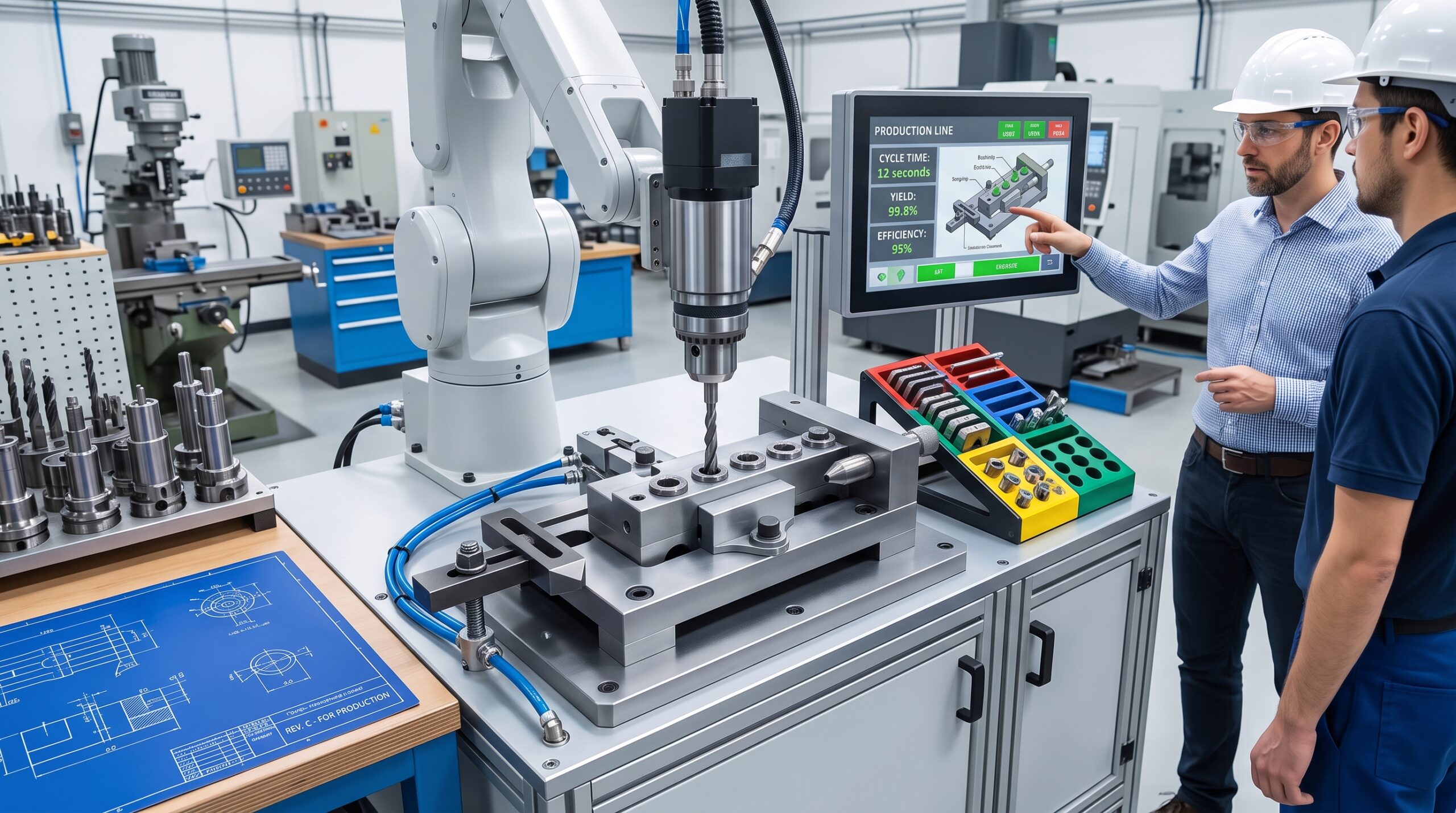
How does drilling jig design improve hole accuracy? What design factors affect drilling repeatability? How can a drilling jig reduce setup time, operator error, and production costs? What role do drill bushings, locating pins, clamps, and the 3-2-1 locating principle play in accurate hole production?
A properly designed drilling jig improves hole accuracy and production efficiency by controlling tool alignment, workpiece location, and repeatability. It guides the drill to the required position while holding the part securely, reducing misalignment, setup variation, and unnecessary operator adjustments. For production applications, a well-engineered jig can also make repetitive drilling faster and more consistent. Yicen Precision provides custom Plantillas y accesorios designed around part geometry, machining requirements, production volume, and tolerance requirements.
What Is Drilling Jig Design?
Drilling jig design is the engineering process of creating a tool that positions and secures a workpiece while guiding the drill to produce holes at specified locations, angles, and depths. Unlike a basic fixture that primarily holds a component, a drilling jig also guides the cutting tool through features such as drill bushings.
The design has to account for the part geometry, hole pattern, material, drilling forces, required tolerance, tool dimensions, chip evacuation, clamping method, and production volume. These factors determine whether the jig will remain accurate after repeated loading and machining cycles.
The objective is not simply to make a part easier to drill. The objective is to create a repeatable manufacturing process in which every workpiece is positioned in a predictable relationship to the drilling tool.
This becomes especially important when the same hole pattern must be produced on hundreds or thousands of components. Without suitable workholding and guidance, small positioning differences can accumulate into rejected parts, rework, and inconsistent assembly.
Why Hole Accuracy Depends on the Jig
Hole accuracy is influenced by several variables. The drill itself must be suitable for the material and required hole size, but even a high-quality cutting tool cannot compensate for poor workholding.
During drilling, axial and radial forces act on the tool and workpiece. If the component shifts, vibrates, or tilts, the hole may not remain on its intended centerline. The result can be positional error, oversize holes, poor surface quality, or difficulty during assembly.
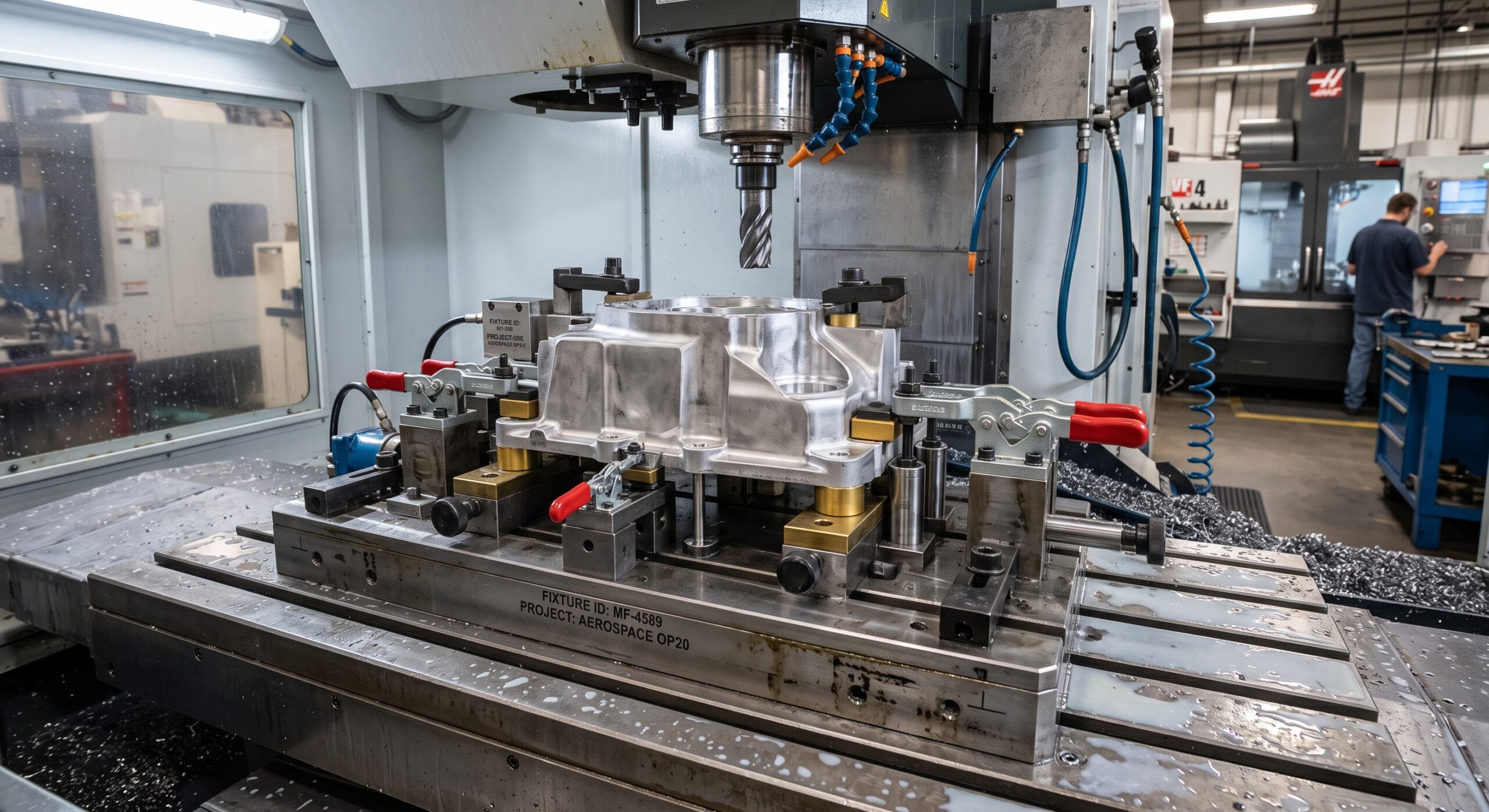
A drilling jig addresses this problem by creating a controlled relationship between the workpiece and the cutting tool. Locating elements establish the part position, clamps maintain contact, and guide bushings help control the drill path.
This is closely connected to CNC workholding. Yicen Precision explains that effective workholding should locate the part according to the 3-2-1 principle, transfer cutting forces into solid support, and place clamps over supported areas rather than unsupported spans.
Key Elements of an Accurate Drilling Jig
A drilling jig normally combines several mechanical elements. Each one has a specific purpose, and the overall accuracy depends on how well these elements work together.
| Jig Element | Main Function | Accuracy Contribution |
| Drill bushing | Guides the drill | Controls tool alignment |
| Pasadores de posicionamiento | Establishes part position | Improves repeatability |
| Abrazaderas | Secures the workpiece | Prevents movement and vibration |
| Base/body | Supports jig components | Maintains structural rigidity |
| Stops | Controls part orientation | Prevents incorrect loading |
| Relief areas | Provides chip clearance | Keeps locating surfaces clean |
| Indexing mechanism | Positions multiple hole patterns | Supports repeatable angular drilling |
Drill Bushings
Drill bushings are one of the most important components in drilling jig design. They guide the drill toward the intended hole location and help maintain alignment during repeated operations.
For high-volume production, bushing wear must also be considered. A worn bushing can gradually introduce positional variation even when the rest of the jig remains accurate. Renewable bushings can be useful because the worn guiding element can be replaced without rebuilding the entire jig.
The bushing should also be selected according to the drill diameter, required clearance, material, operating conditions, and expected production volume.
Locating Pins and Stops
Locating pins establish the position of the workpiece relative to the jig. Stops can define the orientation and prevent incorrect loading.
The locating system should reference functional surfaces or appropriate datums rather than relying on random external features. This helps maintain the relationship between the hole pattern and the part’s design requirements.
The 3-2-1 principle is particularly useful here. Three points establish the primary plane, two points establish the secondary plane, and one point establishes the tertiary plane, controlling the six degrees of freedom of the workpiece.
Clamping System
Clamping must hold the workpiece firmly without deforming it. Excessive clamping force can distort thin components, while insufficient force can allow movement during drilling.
Clamp placement should therefore support the workpiece and direct forces toward the locating surfaces. For production work, quick-acting, toggle, pneumatic, or hydraulic clamps can reduce loading time and improve operator consistency.
How the 3-2-1 Principle Improves Jig Accuracy
The 3-2-1 principle is a fundamental method for locating a workpiece. It works by restricting six degrees of freedom using six strategically positioned contact points.
The three primary points establish the main plane. Two secondary points control movement against the next reference surface, and one tertiary point controls the remaining movement. This creates a stable and repeatable position without unnecessarily constraining the component.
The important point is that more locating points do not automatically mean greater accuracy. Excessive or redundant locating can introduce stress, make loading difficult, and potentially distort the part.
For drilling applications, the locating system should be designed around the actual datums specified by the engineering drawing. This ensures that the jig supports the same dimensional relationships used to define the finished component.
Yicen Precision’s detailed explanation of the 3-2-1 Principle of Location provides additional guidance on complete positioning, under-positioning, over-positioning, and locator selection.
Design Factors That Affect Hole Accuracy
A drilling jig should be designed around the hole requirements before the physical tooling is developed. Diameter, depth, positional tolerance, true position, hole angle, and relationship to other features all influence the design.
Material is another consideration. Aluminum, stainless steel, titanium, plastics, and other materials respond differently to drilling forces and heat. The jig may need different support, clamping, bushing, or chip-clearance arrangements depending on the workpiece.
Part geometry also matters. Thin walls and unsupported sections can deform under clamping or drilling forces. Deep holes may require better chip evacuation and additional support. Angled holes may require specialized guiding features or an indexed jig arrangement.
For CNC-machined components, design-for-manufacturing considerations should be addressed before production. Yicen Precision’s CNC machining guidelines, for example, identify hole diameter, hole depth, tool stability, and chip evacuation as important considerations when preparing parts for machining.
Drilling Jig Design for Production Efficiency
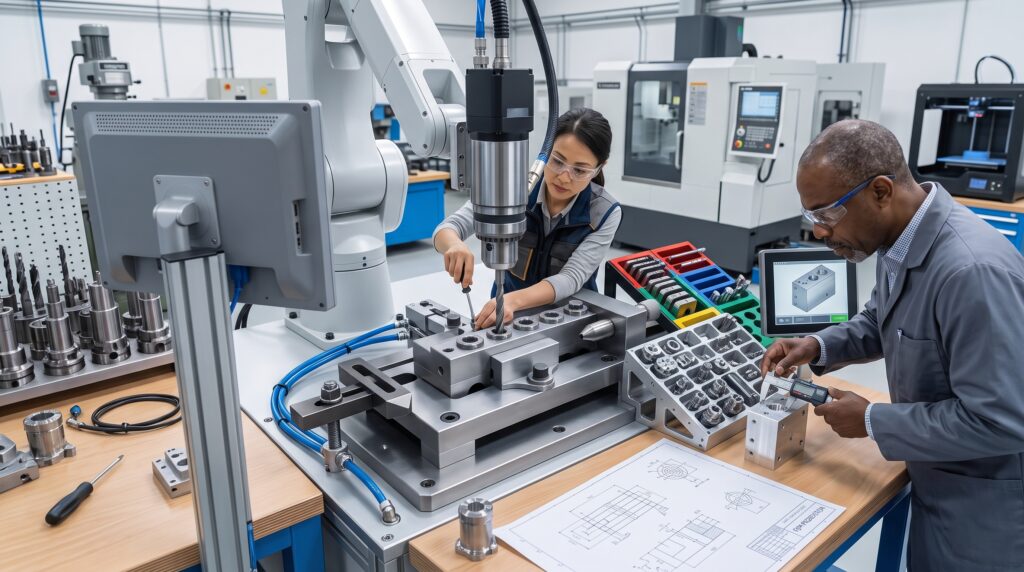
Accuracy is only one part of jig performance. A production jig should also make the manufacturing process faster and easier to repeat.
An operator should be able to load the workpiece quickly, locate it correctly, clamp it securely, perform the drilling operation, release the component, and repeat the cycle without unnecessary adjustments.
A well-designed jig can reduce setup variation because the operator does not need to manually measure and mark every hole. The jig establishes the intended relationship between the part and tool.
Production efficiency can also improve when the jig prevents incorrect loading. A foolproof design may use asymmetric locating pins, stops, or shaped contact surfaces so the component can only be installed in the correct orientation.
| Production Requirement | Jig Design Approach | Expected Benefit |
| Fast loading | Quick-acting clamps and accessible loading area | Reduced cycle time |
| Repeatable positioning | Precision locators and stops | Consistent hole placement |
| Alto volumen de producción | Hardened or renewable bushings | Longer tooling life |
| Multiple hole patterns | Indexing mechanism | Fewer setups |
| Thin components | Distributed support and controlled clamping | Reduced deformation |
| Chip-heavy operation | Relief channels and clearance pockets | Cleaner locating surfaces |
| Operator consistency | Foolproof loading features | Fewer setup errors |
Reducing Setup Time With Better Jig Design
Setup time can become a significant manufacturing cost when parts require repeated drilling operations. If every workpiece requires manual alignment, measurement, and adjustment, the production process becomes slower and more dependent on operator skill.
A dedicated drilling jig changes this process. Once the jig has been properly designed and installed, the operator can use the locating system to position the part consistently.
For high-volume production, the time saved on every cycle can become substantial. Even a small reduction in loading or alignment time becomes meaningful when multiplied across thousands of parts.
This is one reason custom workholding becomes more valuable as production volume increases. Yicen Precision notes that dedicated fixtures generally provide the fastest production setup and strongest repeatability compared with standard or modular workholding.
Chip Clearance and Cooling Should Not Be Overlooked
Chip accumulation can gradually affect accuracy if chips become trapped between the workpiece and locating surfaces.
A drilling jig should therefore include appropriate relief areas around locating points and cutting zones. These spaces allow chips and coolant to move away from critical contact surfaces.
Cooling can also help manage heat and tool wear. The exact approach depends on the material, hole depth, cutting parameters, machine configuration, and tooling.
A clean locating surface is essential. Even a small chip trapped beneath a component can change its position and cause variation in hole location.
Choosing the Right Jig for the Application
Not every drilling operation requires the same jig configuration. A simple template or plate jig may be suitable for straightforward hole patterns, while channel, leaf, box, or indexing jigs can be more appropriate for complex components.
For example, a plate jig can work well for flat or relatively accessible components. A channel jig can provide support for longer rectangular parts. A leaf jig can improve loading and unloading speed when frequent access is required. An indexing jig is useful when multiple holes must be produced at different angular positions.
The correct choice depends on part geometry, hole pattern, tolerances, production quantity, machine setup, and operator requirements.
For applications that combine drilling with other machining operations, custom workholding may provide a better solution than a drilling-only jig. Yicen Precision offers custom jig and fixture design for production requirements where repeatability and setup efficiency are important.
Drilling Jig Materials and Durability
Material selection affects jig weight, rigidity, wear resistance, and service life.
Steel and tool steel are commonly considered for production jigs because they can provide strong structural support and good wear resistance. Aluminum can be useful when low weight and easy handling are priorities, particularly for lower-volume applications.
The material of the jig body is not the only consideration. High-wear areas such as bushings and locating components may require harder materials or replaceable inserts.
A production jig should be designed for its expected service life. If a component will be loaded thousands of times, replacing a small wear component should ideally be easier and less expensive than replacing the complete jig.
Common Drilling Jig Design Mistakes
One common mistake is focusing only on hole location while ignoring workpiece stability. A drill can be accurately guided, but if the component moves during cutting, the finished hole may still be incorrect.
Another issue is excessive clamping force. This is especially problematic for thin or flexible parts because the component may be accurately positioned while clamped but move after the clamp is released.
Poor chip clearance is another frequent problem. Chips trapped around locating surfaces can progressively change part position.
Bushing selection and maintenance are also important. A worn guide can affect tool alignment and create variation across a production batch.
Finally, the jig should not be unnecessarily complicated. Every additional component can increase cost, maintenance requirements, and potential failure points. The best design provides the required accuracy and production performance without adding unnecessary complexity.
Drilling Jigs vs CNC Drilling Without a Jig
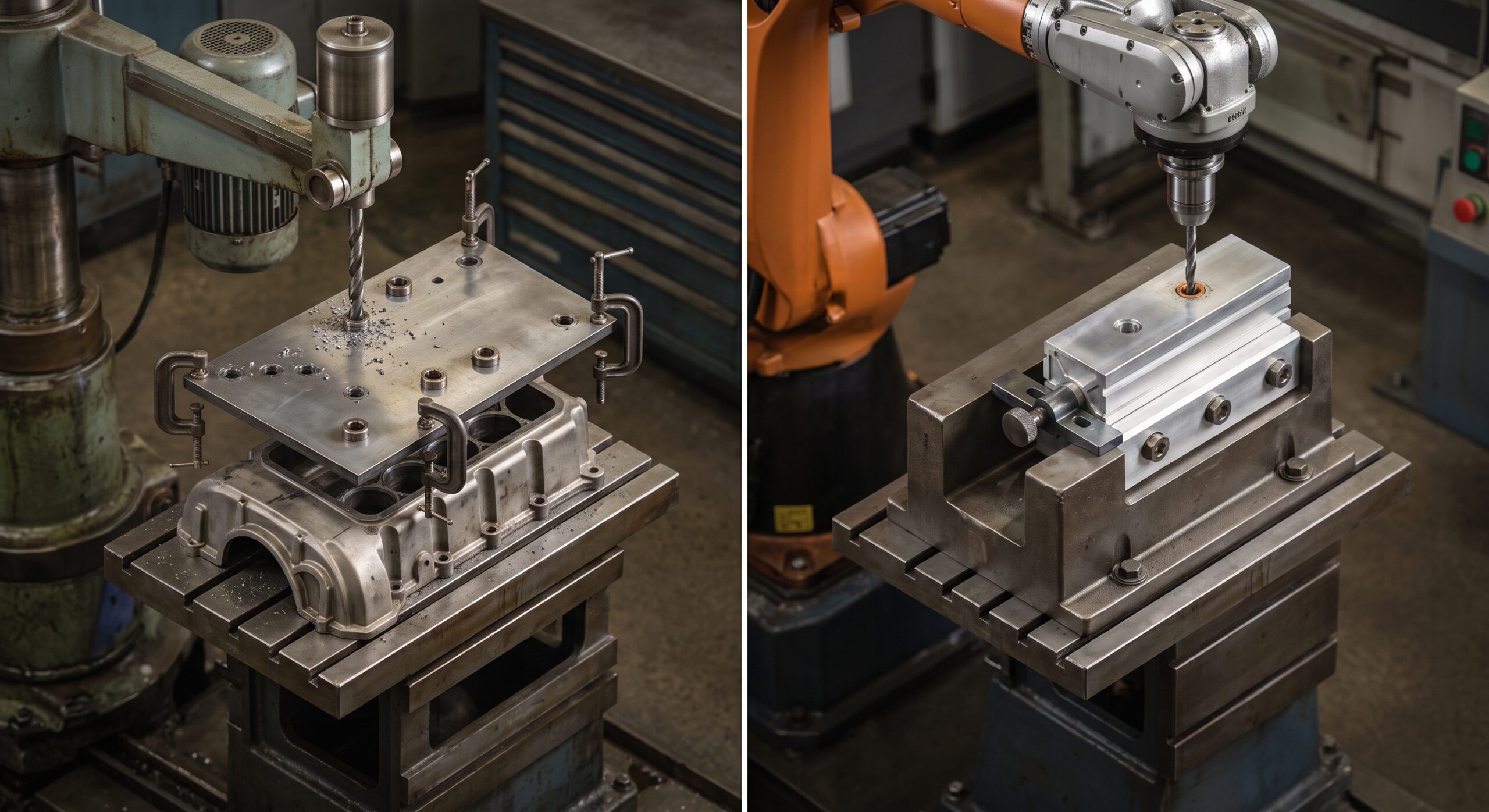
Modern CNC machines can position drilling tools with high precision, so a dedicated drilling jig is not always necessary. The decision depends on the part, operation, production volume, and workholding strategy.
For low-volume parts with uncomplicated geometry, standard CNC workholding may be sufficient. The machine controls the tool path, while the fixture only needs to position and secure the part.
A drilling jig becomes more attractive when the same hole pattern must be repeated frequently, when manual drilling is involved, when multiple parts need consistent positioning, or when reducing setup time has a meaningful production benefit.
Yicen Precision provides Servicios de taladrado CNC for high-accuracy hole machining and also supports custom workholding solutions where the application requires dedicated positioning or clamping.
When Should You Use a Custom Drilling Jig?
A custom drilling jig is generally worth considering when the production process has repeated positioning problems, high setup time, significant operator variation, or a large number of identical components.
It can also be valuable when the hole pattern is difficult to access with standard workholding or when multiple operations need to be performed from controlled datums.
The economic decision should consider more than the initial jig cost. Tooling investment should be compared with expected production volume, labor savings, scrap reduction, setup-time reduction, and the value of consistent part quality.
For prototypes or very small quantities, a dedicated jig may not provide enough return. Standard workholding or soft jaws may be more practical. As volume increases, however, repeatability and cycle-time improvements can justify purpose-built tooling.
How Yicen Precision Supports Jig and Fixture Applications
Yicen Precision provides CNC machining, custom jig and fixture design, and related manufacturing capabilities for prototype and production applications. Its manufacturing services cover CNC milling and turning, 3D printing, sheet metal fabrication, and value-added processes.
The company’s custom jig and fixture service can be used when a standard workholding solution does not provide the required combination of accuracy, repeatability, and production efficiency. The engineering approach can be matched to the component geometry, machining process, tolerance requirements, and expected production volume.
For manufacturers that need both tooling and finished precision components, this integrated approach can simplify the transition from jig design to production.
Reflexiones finales
Drilling jig design directly affects hole accuracy, repeatability, operator efficiency, and production cost. The most effective design starts with the required hole specifications and then builds a controlled system around workpiece location, tool guidance, clamping, rigidity, chip clearance, and maintainability.
The 3-2-1 locating principle provides a strong foundation for repeatable positioning, while properly selected drill bushings help maintain tool alignment. Clamping should secure the component without creating distortion, and production-focused features such as quick loading, indexing, and foolproof positioning can reduce cycle time.
For low-volume work, standard CNC workholding may be enough. For repetitive production with tight positional requirements, a custom drilling jig can provide a more consistent and efficient manufacturing process.
When hole accuracy and production efficiency both matter, jig design should be treated as part of the manufacturing process rather than as an afterthought.
Preguntas frecuentes
How does drilling jig design improve hole accuracy?
A drilling jig improves hole accuracy by precisely locating and securing the workpiece while guiding the drill through a controlled path. Drill bushings, locating pins, stops, and clamps reduce movement, misalignment, vibration, and operator variation during drilling.
What are the key elements of an accurate drilling jig?
The main elements include drill bushings, locating pins, stops, clamps, a rigid jig body, and appropriate chip-clearance areas. Each component helps control workpiece position, drill alignment, stability, and repeatability during production.
How does the 3-2-1 principle improve drilling jig accuracy?
The 3-2-1 principle controls the six degrees of freedom of a workpiece using three primary locating points, two secondary points, and one tertiary point. This creates a stable and repeatable position while avoiding unnecessary or excessive locating.
How can a drilling jig improve production efficiency?
A properly designed drilling jig reduces manual alignment, setup time, operator adjustments, and loading errors. Quick-acting clamps, foolproof locating features, indexing mechanisms, and repeatable positioning can make repetitive drilling operations faster and more consistent.
When should you use a custom drilling jig?
A custom drilling jig is most useful when the same hole pattern must be produced repeatedly, tight positional accuracy is required, setup time is high, or operator variation is causing inconsistent results. For very low-volume work, standard CNC workholding may be more economical.
Escrito por el equipo de ingeniería de precisión de Yicen. Entre todos, llevamos más de diez años dedicados al control de tolerancias y a la ingeniería de calidad, fabricando piezas de precisión para clientes de los sectores de la automoción, médico y de semiconductores. Yicen Precision cuenta con más de 300 máquinas en Shenzhen, posee las certificaciones ISO 9001:2015, ISO 13485, ISO 14001 e IATF 16949, y realiza inspecciones con CMM y XRF. Descubre nuestra Servicios de mecanizado CNC de alta precisión o ponte en contacto con nuestros ingenieros.
 Spanish
  English
  French
  Japanese
  German
  Portuguese