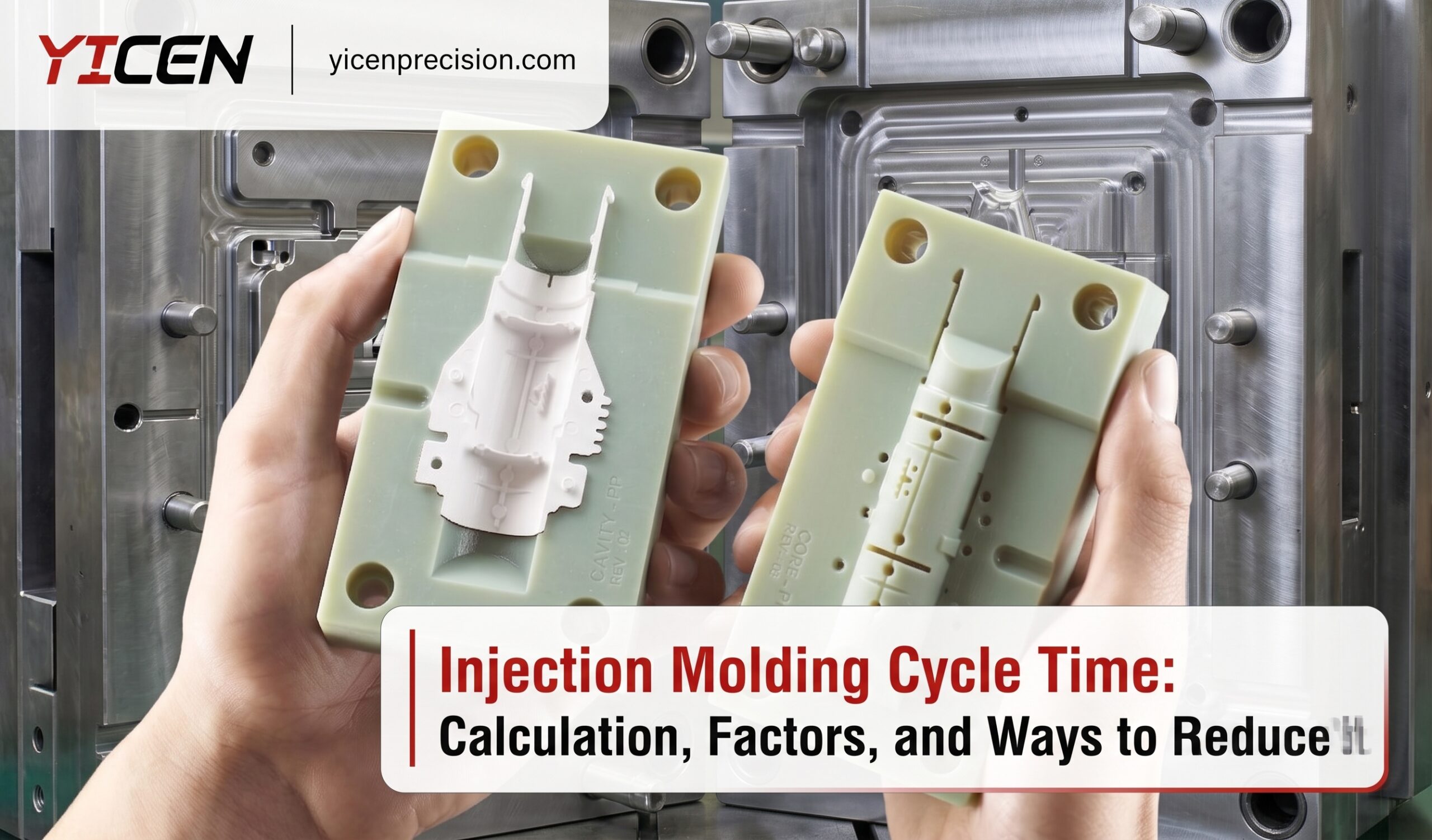
What is injection molding cycle time? How is injection molding cycle time calculated? Why does injection molding cooling time affect total production speed? What factors increase or reduce injection molding cycle time? How can manufacturers reduce cycle time without affecting part quality?
Injection molding cycle time is the total time required to complete one complete molding cycle, starting from mold closing and injection until part ejection and the mold is ready for the next cycle. It is calculated by adding injection time, cooling time, mold opening time, and ejection time. Reducing unnecessary cycle time helps manufacturers increase production efficiency, lower costs, and maintain consistent part quality.
The injection molding process is widely used for producing plastic parts in automotive, electronics, medical, consumer products, and industrial applications. While material selection and mold design are important, cycle time plays a major role in determining manufacturing speed and overall production cost. A well optimized cycle allows manufacturers to produce more parts while maintaining accuracy and durability.
What Is Injection Molding Cycle Time?
Injection molding cycle time refers to the complete duration required to manufacture one plastic part. Each cycle begins when the mold closes and ends when the finished part is removed and the machine starts the next production cycle.
A typical injection molding cycle includes four major stages:
| Cycle Stage | Descrição | Impact on Cycle Time |
| Mold Closing | Mold halves move together before injection | Short closing time improves efficiency |
| Injection | Molten plastic fills the mold cavity | Depends on material and part design |
| Arrefecimento | Plastic solidifies inside the mold | Usually the longest stage |
| Ejection | Finished part is removed from mold | Affects overall production speed |
Among these stages, cooling time usually takes the largest portion of the total injection molding cycle time because the plastic material needs enough time to solidify and maintain its shape.
How Is Injection Molding Cycle Time Calculated?
The injection molding cycle time calculation is based on adding the duration of every stage involved in producing one part.
The basic formula is:
Injection Molding Cycle Time = Injection Time + Cooling Time + Mold Opening Time + Ejection Time + Mold Closing Time
For example, if a production cycle includes:
- Injection time: 5 seconds
- Cooling time: 20 seconds
- Mold opening: 3 seconds
- Ejection: 2 seconds
- Mold closing: 3 seconds
The total cycle time would be:
5 + 20 + 3 + 2 + 3 = 33 seconds per cycle
Accurate cycle time calculation helps manufacturers estimate production capacity, labor requirements, and manufacturing costs before starting production.
Injection Molding Cooling Time and Its Importance
Injection molding cooling time is one of the most important factors affecting total cycle duration. During cooling, molten plastic changes from a liquid state into a solid component inside the mold cavity.
If cooling time is too short, the part may experience:
- Deformação
- Retração
- Defeitos superficiais
- Dimensional problems
If cooling time is longer than necessary, production becomes slower and manufacturing costs increase.
The ideal cooling time depends on:
- Plastic material type
- Espessura da peça
- Temperatura do molde
- Cooling channel design
- Required part quality
Professional mold design and proper cooling systems help manufacturers achieve a balance between speed and quality.
Factors That Affect Injection Molding Cycle Time
Several technical and design factors influence how quickly an injection molding machine can complete a cycle.
Part Design and Wall Thickness
Part geometry has a direct effect on cycle time. Thick sections require more cooling because more heat needs to leave the material before ejection.
Designing parts with consistent wall thickness can help reduce cooling requirements and improve production efficiency.
Seleção de materiais
Different plastics have different melting temperatures, cooling characteristics, and processing requirements.
For example, some engineering plastics require longer cooling periods compared with common thermoplastics. Choosing the right material for the application can improve production speed.
Mold Design Quality
A well designed mold improves cycle efficiency. Poor mold design can increase filling problems, cooling delays, and production downtime.
Important mold factors include:
- Cooling channel placement
- Gate design
- Mold material
- Venting system
Companies working on production projects can benefit from professional injection molding services that focus on optimized mold design and manufacturing performance.
Machine Settings
Injection molding machine parameters also influence cycle time.
Important settings include:
- Pressão de injeção
- Velocidade de injeção
- Holding pressure
- Temperatura do molde
- Cooling temperature
Incorrect settings may increase cycle duration or create quality problems.
Ways to Reduce Injection Molding Cycle Time
Manufacturers continuously look for ways to reduce injection molding cycle time because even small improvements can create significant cost savings in high volume production.
Optimize Cooling System Design
Since cooling is usually the longest stage, improving mold cooling efficiency is one of the best ways to reduce cycle time.
Better cooling channels allow heat to leave the mold faster. Advanced cooling methods such as conformal cooling can improve temperature control and shorten production cycles.
Improve Mold Design
A well engineered mold reduces unnecessary delays during filling, cooling, and ejection.
Professional mold designers analyze:
- Material flow
- Cooling performance
- Part removal process
- Mold durability
A properly designed mold provides faster production and fewer manufacturing issues.
Use Proper Processing Parameters
Optimizing machine settings helps reduce wasted time during production.
Manufacturers should test different settings to find the best balance between speed, quality, and material performance.
Reduce Part Thickness Where Possible
Thinner walls usually cool faster than thick sections. However, reducing thickness must be done carefully because structural strength requirements still need to be maintained.
Engineers should review designs before production to identify areas where material reduction is possible.
Maintain Injection Molding Equipment
Regular machine maintenance prevents unexpected downtime and keeps production cycles consistent.
Maintenance activities include:
- Checking hydraulic systems
- Cleaning molds
- Inspecting machine components
- Replacing worn tools
Reliable equipment performance supports stable cycle times.
Injection Molding Cycle Time Comparison
Different factors can create major differences in production speed. The table below shows how common improvements affect cycle efficiency.
| Improvement Method | Effect on Cycle Time | Additional Benefit |
| Better Cooling Channels | Faster cooling stage | Improved part consistency |
| Optimized Mold Design | Reduces delays | Better product quality |
| Correct Material Selection | Easier processing | Lower production issues |
| Machine Parameter Adjustment | Faster cycles | Reduced waste |
Relationship Between Cycle Time and Production Cost
Injection molding cycle time directly affects manufacturing expenses. A shorter cycle means more parts can be produced within the same operating period.
For high volume manufacturing, reducing only a few seconds from each cycle can create significant savings over thousands of production cycles.
Manufacturers should focus on improving efficiency without reducing quality. A faster cycle that creates defective parts can increase costs due to waste and rework.
How Yicen Precision Helps Improve Injection Molding Efficiency
Yicen Precision supports businesses with professional manufacturing solutions focused on quality, accuracy, and efficient production.
From prototype development to production manufacturing, experienced engineers help optimize designs, materials, and processes.
You can explore more about plastic injection molding solutions to understand how professional manufacturing support improves product development.
Businesses can also review related manufacturing topics through our manufacturing process guides for additional information about production methods and design considerations.
Injection Molding Cycle Time Optimization for Different Industries
Different industries have different requirements for cycle time optimization.
Indústria automóvel
Automotive manufacturers require fast production cycles because many plastic components are produced in large quantities.
Setor Médico
Medical parts require strict quality control, meaning cycle time improvements must maintain safety and accuracy.
Consumer Products
Consumer goods companies focus on reducing production costs while maintaining attractive designs and reliable performance.
Conclusão
Injection molding cycle time is a key factor that determines manufacturing efficiency, production capacity, and overall cost. Understanding injection molding cycle time calculation and the factors affecting cooling and processing helps manufacturers improve their operations.
By optimizing mold design, selecting suitable materials, improving cooling systems, and maintaining equipment, businesses can reduce injection molding cycle time while maintaining high quality standards.
Yicen Precision provides professional injection molding and manufacturing solutions to help companies produce reliable plastic components with efficient production workflows.
Perguntas mais frequentes
What is injection molding cycle time?
Injection molding cycle time is the total time required to complete one production cycle. It includes mold closing, injection, cooling, opening, ejection, and preparation for the next cycle.
How do you calculate injection molding cycle time?
Injection molding cycle time calculation is done by adding injection time, cooling time, mold opening time, ejection time, and mold closing time. This gives the total production time for one part.
Why is injection molding cooling time important?
Cooling time allows molten plastic to solidify properly inside the mold. Incorrect cooling can cause defects, while optimized cooling improves production speed and part quality.
How can manufacturers reduce injection molding cycle time?
Manufacturers can reduce cycle time by improving mold cooling systems, optimizing machine settings, selecting suitable materials, and improving part design.
Does part thickness affect injection molding cycle time?
Yes, thicker parts usually require longer cooling periods because more heat must be removed before the part can be safely ejected.
Escrito pela equipa de engenharia de precisão da Yicen. Entre nós, acumulámos mais de dez anos de experiência em controlo de tolerâncias e engenharia da qualidade, na maquinação de peças de precisão para clientes dos setores automóvel, médico e dos semicondutores. A Yicen Precision opera mais de 300 máquinas em Shenzhen, possui as certificações ISO 9001:2015, ISO 13485, ISO 14001 e IATF 16949, e realiza inspeções com CMM e XRF. Explore a nossa serviços de maquinagem CNC de alta precisão ou contacte os nossos engenheiros.