Coste del mecanizado CNC de 5 ejes en 2026: cuando los ejes adicionales merecen la pena
Autor: Eric Lin, Ingeniero Superior de Procesos, Yicen Precision
Eric Lin lleva 11 años dedicándose a la validación y optimización Mecanizado CNC procesos en Shenzhen y Dongguan para clientes del sector aeroespacial y de primer nivel del sector de la automoción de toda Europa y Norteamérica.
Para los responsables de desarrollo de nuevos productos (NPI) que presupuestan una carcasa compleja o un soporte para turbinas, aceptar un upselling al mecanizado de 5 ejes cuando el fresado indexado 3+2 habría garantizado la misma tolerancia y el mismo acabado superficial es un sobrecoste que no deberían asumir. A las tarifas habituales en EE. UU. de $125–$200/h para el mecanizado de 5 ejes frente a $75–$130/h para el de 3 ejes, la diferencia en un trabajo de 10 horas es de $500–$700. En una tirada piloto de 50 piezas, eso supone entre 25 000 y 35 000 dólares en costes innecesarios. El error inverso —especificar un mecanizado de 3 ejes en una pieza que geométricamente requiere 5 ejes— produce una pieza con errores de acumulación de tolerancias inducidos por el dispositivo de sujeción que no superan la inspección del primer artículo y provocan repeticiones de entre $3,000–15 000 por iteración.
El mecanizado CNC de 5 ejes no es superior en todos los casos al mecanizado de 3 ejes o al mecanizado indexado 3+2. Es el proceso adecuado para un conjunto específico de condiciones geométricas y de tolerancia, y el proceso inadecuado para todo lo demás. La diferencia con respecto al mecanizado de 3 ejes es real: tarifas por hora entre un 30 % y un 60 % más elevadas, tiempos de preparación más largos y portaherramientas más caros. Saber con precisión cuándo se justifica esa diferencia es el objetivo de esta guía.
Esta guía le ofrece una comparación de costes entre el mecanizado de 5 ejes y el de 3 ejes con tarifas horarias reales para 2026, las cuatro condiciones geométricas que realmente requieren el mecanizado de 5 ejes, un análisis del umbral de rentabilidad en función del número de piezas y una lista de verificación de DFM para determinar el proceso adecuado antes de enviar una solicitud de presupuesto.
Fórmula para calcular el coste del mecanizado CNC de 5 ejes
Coste total del mecanizado en 5 ejes = Coste de preparación + (horas de máquina × tarifa por hora) + utillaje + posprocesamiento
La configuración de un trabajo de 5 ejes suele ser entre un 40 % y un 80 % más cara que la de 3 ejes: las trayectorias de las herramientas son más complejas, el tiempo de simulación es mayor y los requisitos de calibración de la máquina son más estrictos. Este componente de coste fijo hace que 5 ejes desproporcionadamente caro cuando se trata de cantidades inferiores a 5 unidades.
Tarifas por hora de las máquinas de 5 ejes frente a las de 3 ejes en 2026: EE. UU., UE y Yicen Precision
| Tipo de máquina / Región | Tarifa por hora (USD) | Coste de instalación | Plazo de entrega (prototipo) | Tolerancia |
|---|---|---|---|---|
| CNC de 3 ejes — Taller de subcontratación de EE. UU. | $75–$130/h | $200–$500 | 1–3 semanas | ±0,01–0,025 mm |
| CNC de 5 ejes — Taller de subcontratación de EE. UU. | $125–$200/h | 1:00–9:00 | 2–5 semanas | ±0,005–0,01 mm |
| CNC de 3 ejes — UE (Alemania) | $80–$140/h | $220–$550 | 2–4 semanas | ±0,01–0,025 mm |
| CNC de 5 ejes — UE (Alemania) | $130–$210/h | $450–$950 | 3–6 semanas | ±0,005–0,01 mm |
| 3 ejes — Yicen Precision | $25-$38/hora | $120–$280 | 5-7 días | ±0,005 mm |
| 5 ejes — Yicen Precision | $38–$55/h | $200–$450 | 5-10 días | ±0,002–0,005 mm |
Las 4 condiciones geométricas que realmente requieren un mecanizado de 5 ejes
1. Elementos con socavado a los que no se puede acceder desde ninguna dirección de aproximación en tres ejes
Si su pieza presenta un socavado interno, un hueco detrás de una brida o un canal al que no se puede acceder con ningún ángulo de aproximación de 3 ejes sin un dispositivo de sujeción especializado, el contorneado continuo de 5 ejes es la solución. Volver a fijar la pieza en una máquina de 3 ejes para aproximarse a esto añade entre $300 y $600 por cada operación de reajuste e introduce una acumulación de tolerancias de ±0,03–0,08 mm por cada configuración adicional.
2. Superficies complejas con ángulos compuestos (impulsor, turbina, geometría orgánica)
Los impulsores, los álabes de turbina y las superficies de productos de consumo orgánicos requieren un movimiento simultáneo en 5 ejes: la herramienta y la pieza deben moverse en rotación coordinada para mantener un ángulo de corte constante y evitar que se produzcan hendiduras. El fresado indexado 3+2 no permite obtener una calidad de superficie continua en geometrías de ángulos compuestos; produce facetas planas entre las posiciones de indexación que requieren un acabado manual exhaustivo (lo que añade un tiempo de pulido de $80–$200/h).
3. Acumulación de tolerancias ajustadas a partir de múltiples configuraciones de 3 ejes
Una pieza que requiere cuatro configuraciones en una máquina de tres ejes acumula errores de transferencia de referencia en cada cambio de fijación. A ±0,01–0,02 mm por punto de referencia de fijación, una pieza con 4 configuraciones puede acumular un error posicional total de ±0,04–0,08 mm, lo cual es inaceptable para ensamblajes de precisión. Una única configuración de 5 ejes elimina estas transferencias. Si su margen de tolerancia es más ajustado que el error acumulado de múltiples configuraciones de 3 ejes, el 5 ejes no es un lujo.
4. Mecanizado de cavidades profundas de gran alcance en paredes inclinadas
Los cavidades con paredes inclinadas cuya profundidad supere 4 veces la anchura de la cavidad requieren que la herramienta se incline para mantener un contacto perpendicular con la superficie de la pared. En una máquina de 3 ejes, esto implica el uso de herramientas de gran alcance con una rigidez reducida y un alto riesgo de flexión. Una máquina de 5 ejes inclina la pieza, lo que permite utilizar herramientas cortas y rígidas y mantener una carga de viruta constante —por lo general, un corte entre un 25 % y un 40 % más rápido y un mejor acabado superficial en paredes de cavidades inclinadas de más de 30°—.
Cuándo la opción adecuada es, en cambio, la de 3 ejes (o 3+2)
| Escenario | Proceso correcto | Por qué el mecanizado de 5 ejes es excesivo |
|---|---|---|
| Soporte prismático sencillo, ≤3 configuraciones | 3 ejes | Sin socavados ni superficies compuestas: el mecanizado de 3 ejes mantiene una precisión de ±0,01 mm con el 40% a un coste menor |
| Superficies inclinadas a las que se puede acceder inclinando la pieza una vez | 3+2 indexado | Un solo índice del eje B elimina la necesidad de un mecanizado continuo de 5 ejes; $25–$40/h más económico |
| Producción a gran escala (más de 500 piezas) | 3 ejes con accesorio específico | El dispositivo amortiza los costes de configuración; el sistema de 3 ejes funciona más rápido en la producción en serie |
| Carcasa de chapa metálica o de paredes delgadas | 3 ejes + chapa | Un proceso totalmente erróneo: el mecanizado en 5 ejes no aporta ningún valor añadido a la fabricación de piezas de geometría plana |
| Prueba de prototipo de un diseño conceptual (previo al DFM) | 3 ejes | Reserva el mecanizado de 5 ejes para el diseño validado; realiza las iteraciones de forma económica en 3 ejes |
Análisis del umbral de rentabilidad: 5 ejes frente a 3 ejes en función del número de piezas
| Cantidad | Coste del torno de 3 ejes (taller en EE. UU.) | Coste del mecanizado de 5 ejes (taller en EE. UU.) | Coste del sistema de 5 ejes (Yicen Precision) |
|---|---|---|---|
| 1 parte | 1:00–9:00 | $700–$1.400 | $260–$520 |
| 5 partes | $1.800–$3.500 | $2.800–$5.500 | $1.050–$2.100 |
| 25 piezas | $7.000–$14.000 | $11 000–$22 000 | $4.200–$8.500 |
| 100 unidades | $22 000–$44 000 | $35 000–$70 000 | $13 000–$27 000 |
Nota: Estimaciones basadas en una pieza de complejidad media que requiere 3 configuraciones en 3 ejes o 1 configuración en 5 ejes. Los presupuestos reales variarán en función de la geometría.
Lista de verificación de DFM: ¿Tu pieza requiere mecanizado de 5 ejes?
- ¿Hay alguna pieza que requiera el acceso de la herramienta desde más de tres direcciones ortogonales? → En caso afirmativo, se requiere un sistema de 5 ejes o un cambio de fijación
- ¿Hay socavados internos o elementos situados detrás de la brida? → Se requiere mecanizado de 5 ejes
- ¿Presenta la pieza superficies con ángulos compuestos (no planos)? → Se requieren 5 ejes para obtener un acabado superficial uniforme
- ¿La suma de las tolerancias de tres o más configuraciones supera la tolerancia posicional? → Se recomienda el mecanizado de 5 ejes
- ¿La profundidad del hueco es superior a 4 veces su anchura y las paredes son inclinadas? → Se recomienda el mecanizado de 5 ejes
- ¿La geometría es totalmente prismática con direcciones de aproximación claras en los tres ejes? → 3 ejes o 3+2 — ahórrate el sobreprecio
Preguntas frecuentes
¿Cuánto más cuesta el mecanizado CNC de 5 ejes que el de 3 ejes?
Mecanizado CNC de 5 ejes suele costar entre un 30 % y un 60 % más por hora que el mecanizado de 3 ejes en talleres equivalentes. Las tarifas de 3 ejes en EE. UU. oscilan entre 1,75 y 1,30 dólares por hora; las tarifas de 5 ejes en EE. UU. oscilan entre 142,5 y 200 dólares por hora. Los costes de configuración también son entre 40 y 80 dólares más elevados en el mecanizado de 5 ejes debido a los requisitos más complejos de programación de la trayectoria de la herramienta y de simulación. En Yicen Precision, el mecanizado de 3 ejes cuesta entre 1,25 y 1,38 dólares por hora, y el de 5 ejes, entre 1,38 y 1,55 dólares por hora; la diferencia de precio es proporcionalmente similar, pero el coste absoluto es significativamente menor.
¿Qué piezas requieren realmente un mecanizado CNC de 5 ejes?
Entre las piezas que realmente requieren un mecanizado de 5 ejes se incluyen: impulsores y álabes de turbina con superficies de ángulos compuestos, piezas con socavados internos a los que no puede llegar ninguna dirección de aproximación de 3 ejes, carcasas complejas que requieren configuraciones de 4+3 ejes en las que el error de transferencia de referencia supera el margen de tolerancia, y piezas con cavidades profundas en ángulo en las que el uso de herramientas de alcance extendido en una máquina de 3 ejes produciría una deflexión y una vibración inaceptables. Las piezas prismáticas, los soportes simples y las carcasas con características planas casi nunca requieren mecanizado de 5 ejes.
¿El fresado indexado 3+2 es lo mismo que el mecanizado de 5 ejes?
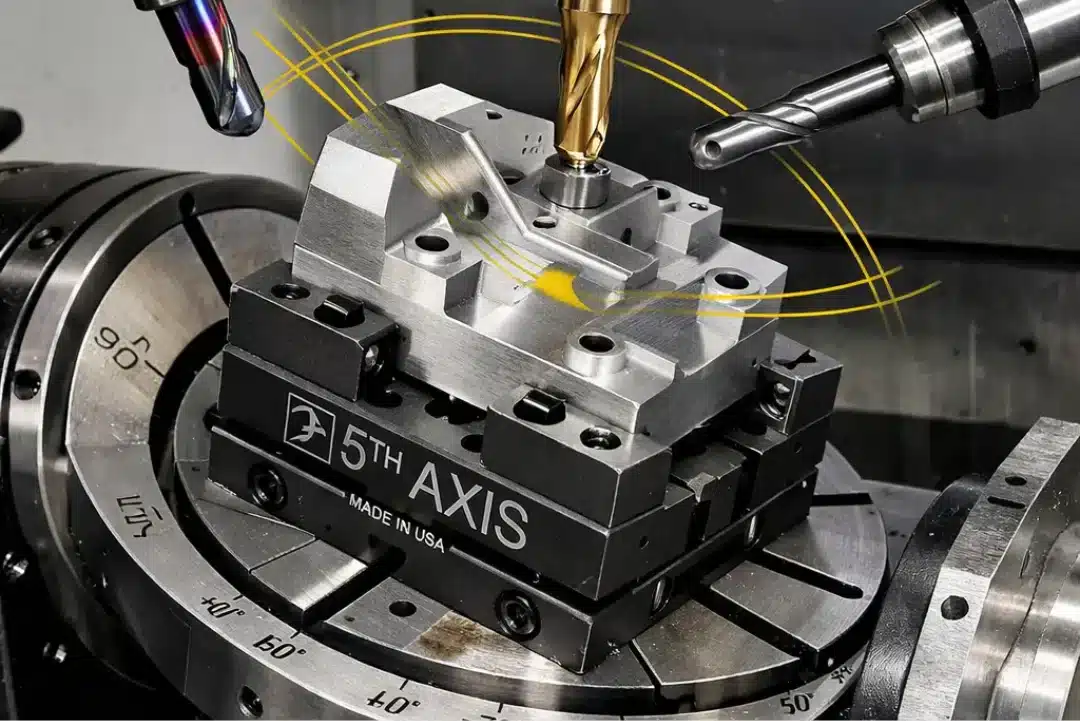
El fresado indexado 3+2 (también denominado «5 ejes posicionales») inclina la pieza o el husillo a un ángulo fijo y, a continuación, mecaniza con movimiento de 3 ejes; se trata, en esencia, de una operación de 3 ejes con una orientación no estándar. El verdadero mecanizado simultáneo de 5 ejes mueve los 5 ejes de forma continua durante el corte. El 3+2 es adecuado para superficies planas en ángulo y cavidades a las que se puede acceder desde un enfoque inclinado fijo; el 5 ejes simultáneo es necesario para superficies con curvas compuestas, como impulsores y álabes de turbina. El 3+2 suele ser entre $25 y $50/h más barato que el 5 ejes simultáneo.
¿Qué tolerancias se consiguen con el mecanizado CNC de 5 ejes?
El mecanizado CNC de 5 ejes alcanza una precisión de ±0,005–0,01 mm en talleres estándar estadounidenses y europeos con geometrías bien fijadas. El mecanizado de alta precisión de 5 ejes con inspección a temperatura controlada alcanza una precisión de ±0,002–0,005 mm. La ventaja de la configuración única del mecanizado de 5 ejes —que elimina el error de transferencia de puntos de referencia entre configuraciones— suele ser más valiosa que la precisión inherente de la máquina, especialmente en carcasas complejas en las que el mecanizado de 3 ejes requeriría más de cuatro reajustes de la fijación.
Conclusión: paga el recargo por el mecanizado de 5 ejes solo cuando la geometría lo requiera
- El mecanizado de 5 ejes cuesta entre 30 y 60 dólares más por hora que el de 3 ejes; en un trabajo de 20 horas en un taller estadounidense, eso supone un coste adicional de entre 1 000 y 1 400 dólares.
- El mecanizado de 5 ejes está justificado cuando: hay socavados, las superficies con ángulos compuestos requieren un contorneado continuo o el error de transferencia del punto de referencia en el mecanizado de 3 ejes supera el margen de tolerancia.
- La productividad de 5 ejes de Yicen Precision, de $38–$55 unidades por hora, frente a la de los talleres estadounidenses, de $125–$200 unidades por hora, supone un ahorro de $1,740–4.500 en un trabajo de 25 horas
Envíe sus archivos STEP para obtener una recomendación gratuita sobre el proceso de mecanizado de 5 ejes frente al de 3 ejes, así como un presupuesto, en yicenprecision.com. Nuestro equipo de ingeniería revisa cada archivo antes de elaborar el presupuesto.