
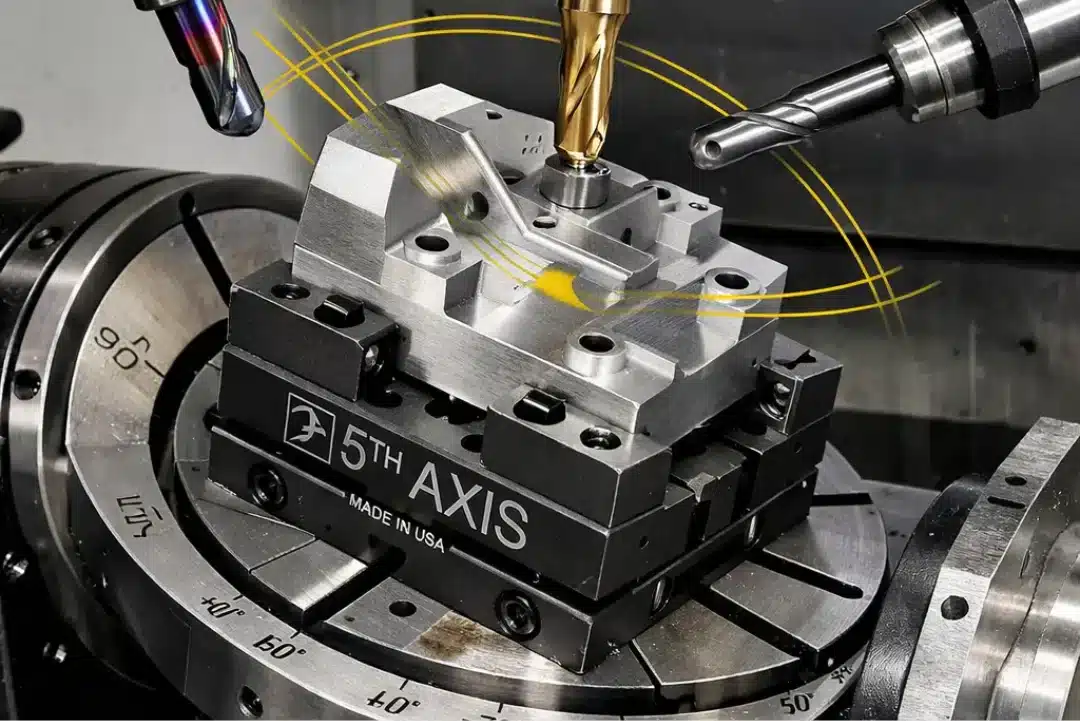
5-Axis CNC Machining Cost in 2026: When the Extra Axes Are Worth It
Author: Eric Lin, Senior Process Engineer, Yicen Precision
Eric Lin has spent 11 years qualifying and optimising CNC machining processes in Shenzhen and Dongguan for automotive Tier 1 and aerospace clients across Europe and North America.
For NPI managers quoting a complex housing or turbine-adjacent bracket, being upsold to 5-axis machining when 3+2 indexed milling would have held the same tolerance to the same surface finish is a premium you shouldn’t pay. At US shop rates of $125–$200/hr for 5-axis vs $75–$130/hr for 3-axis, the difference on a 10-hour job is $500–$700. On a 50-part pilot run, that is $25,000–$35,000 in unnecessary cost. The inverse error — specifying 3-axis machining on a part that geometrically requires 5-axis — produces a part with fixture-induced tolerance stack-up errors that fail first-article inspection and cause re-runs at $3,000–$15,000 per iteration.
5-axis CNC machining is not universally superior to 3-axis or 3+2 indexed machining. It is the right process for a specific set of geometric and tolerance conditions — and the wrong process for everything else. The premium over 3-axis is real: 30–60% higher hourly rates, longer setup times, and more expensive toolholding. Knowing precisely when that premium is justified is the decision this guide is written for.
This guide gives you the 5-axis vs 3-axis cost comparison with real 2026 hourly rates, the four geometric conditions that genuinely require 5-axis, a break-even analysis across part quantities, and a DFM checklist to determine the right process before sending an RFQ.
5-Axis CNC Machining Cost Formula
Total 5-Axis Cost = Setup Cost + (Machine Hours × Hourly Rate) + Tooling + Post-Processing
Setup on a 5-axis job is typically 40–80% more expensive than 3-axis setup — the tool paths are more complex, the simulation time is longer, and the machine calibration requirements are stricter. This fixed cost component makes 5-axis disproportionately expensive at quantities under 5 parts.
5-Axis vs 3-Axis Hourly Rates in 2026: US, EU, and Yicen Precision
| Machine Type / Region | Hourly Rate (USD) | Coût de la mise en place | Lead Time (Prototype) | Tolérance |
|---|---|---|---|---|
| 3-axis CNC — US job shop | $75–$130/hr | $200–$500 | 1–3 weeks | ±0.01–0.025 mm |
| 5-axis CNC — US job shop | $125–$200/hr | $400–$900 | 2–5 weeks | ±0.005–0.01 mm |
| 3-axis CNC — EU (Germany) | $80–$140/hr | $220–$550 | 2–4 weeks | ±0.01–0.025 mm |
| 5-axis CNC — EU (Germany) | $130–$210/hr | $450–$950 | 3–6 weeks | ±0.005–0.01 mm |
| 3-axis — Yicen Precision | $25–$38/hr | $120–$280 | 5–7 days | ±0,005 mm |
| 5-axis — Yicen Precision | $38–$55/hr | $200–$450 | 5-10 jours | ±0.002–0.005 mm |
The 4 Geometric Conditions That Actually Require 5-Axis Machining
1. Undercut Features That Cannot Be Reached from Any 3-Axis Approach Direction
If your part has an internal undercut, a pocket behind a flange, or a channel that no 3-axis approach angle can reach without a specialised fixture, 5-axis continuous contouring is the answer. Re-fixturing on a 3-axis machine to approximate this adds $300–$600 per re-fixturing event and introduces tolerance stack-up of ±0.03–0.08 mm per additional setup.
2. Complex Compound-Angle Surfaces (Impeller, Turbine, Organic Geometry)
Impellers, turbine blades, and organic consumer product surfaces require simultaneous 5-axis motion — the tool and part must move in coordinated rotation to maintain a consistent cutting angle and prevent gouging. 3+2 indexed milling cannot achieve continuous surface quality on compound-angle geometry; it produces flat facets between index positions that require extensive manual finishing (adding $80–$200/hr polishing time).
3. Tight Tolerance Stack-Up From Multiple 3-Axis Setups
A part that requires 4 setups on a 3-axis machine accumulates datum transfer errors at each re-fixturing. At ±0.01–0.02 mm per fixture datum, a 4-setup part can accumulate ±0.04–0.08 mm total positional error — unacceptable for precision assemblies. A single 5-axis setup eliminates these transfers. If your tolerance budget is tighter than the accumulated error from multiple 3-axis setups, 5-axis is not a luxury.
4. Long-Reach Deep Pocket Machining on Angled Walls
Pockets with angled walls deeper than 4× the pocket width require the tool to tilt to maintain perpendicular engagement with the wall surface. On a 3-axis machine, this means extended-reach tooling with reduced stiffness and high deflection risk. A 5-axis machine tilts the part, allowing short, stiff tooling and maintaining consistent chip load — typically 25–40% faster cutting and better surface finish on angled pocket walls above 30°.
When 3-Axis (or 3+2) Is the Right Choice Instead
| Scénario | Correct Process | Why 5-Axis Is Overkill |
|---|---|---|
| Simple prismatic bracket, ≤3 setups | 3 axes | No undercuts, no compound surfaces — 3-axis holds ±0.01 mm at 40% lower cost |
| Angled faces reachable by tilting the part once | 3+2 indexed | One B-axis index eliminates the need for continuous 5-axis; $25–$40/hr cheaper |
| High-volume production (>500 parts) | 3-axis with dedicated fixture | Fixture amortises setup cost; 3-axis runs faster at volume |
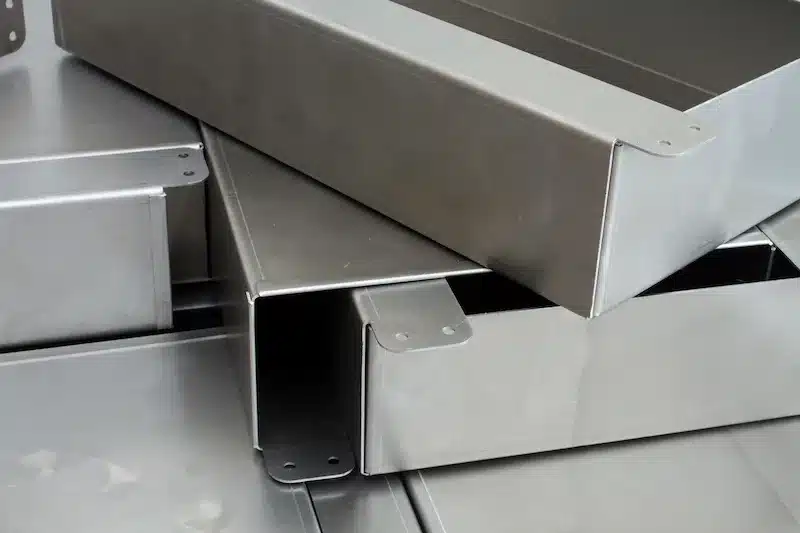
| Sheet metal or thin walled enclosure | 3-axis + sheet metal | Wrong process entirely — 5-axis adds no value to flat-geometry fabrication |
| Prototype test of a conceptual design (pre-DFM) | 3 axes | Save 5-axis for the validated design; iterate cheap on 3-axis |
Break-Even Analysis: 5-Axis vs 3-Axis Across Part Quantities
| Quantité | 3-Axis Cost (US shop) | 5-Axis Cost (US shop) | 5-Axis Cost (Yicen Precision) |
|---|---|---|---|
| 1 part | $450–$900 | $700–$1,400 | $260–$520 |
| 5 parts | $1,800–$3,500 | $2,800–$5,500 | $1,050–$2,100 |
| 25 parts | $7,000–$14,000 | $11,000–$22,000 | $4,200–$8,500 |
| 100 parts | $22,000–$44,000 | $35,000–$70,000 | $13,000–$27,000 |
Note: Estimates based on a medium-complexity housing requiring 3 setups on 3-axis or 1 setup on 5-axis. Actual quotes will vary with geometry.
DFM Checklist: Does Your Part Require 5-Axis?
- Does any feature require tool access from more than 3 orthogonal directions? → If yes, 5-axis or re-fixturing required
- Are there internal undercuts or behind-flange features? → 5-axis required
- Does the part have compound-angle surfaces (not flat planes)? → 5-axis required for consistent surface finish
- Does tolerance stack-up from 3+ setups exceed your positional tolerance? → 5-axis recommended
- Is the pocket depth > 4× pocket width with angled walls? → 5-axis recommended
- Is the geometry entirely prismatic with clear 3-axis approach directions? → 3-axis or 3+2 — save the premium
Questions fréquemment posées
How much more does 5-axis CNC machining cost than 3-axis?
5-axis CNC machining typically costs 30–60% more per hour than 3-axis machining at equivalent shops. US 3-axis rates run $75–$130/hr; US 5-axis rates run $125–$200/hr. Setup costs are also 40–80% higher on 5-axis due to more complex tool path programming and simulation requirements. At Yicen Precision, 3-axis runs $25–$38/hr and 5-axis runs $38–$55/hr — the premium is proportionally similar but the absolute cost is significantly lower.
What parts actually need 5-axis CNC machining?
Parts that genuinely require 5-axis machining include: impellers and turbine blades with compound-angle surfaces, parts with internal undercuts that no 3-axis approach direction can reach, complex housings requiring 4+ 3-axis setups where datum transfer error exceeds tolerance budget, and parts with deep angled pockets where extended-reach tooling on a 3-axis machine would produce unacceptable deflection and chatter. Prismatic parts, simple brackets, and enclosures with flat features almost never require 5-axis.
Is 3+2 indexed milling the same as 5-axis machining?
No. 3+2 indexed milling (also called positional 5-axis) tilts the part or spindle to a fixed angle and then machines with 3-axis motion — essentially a 3-axis operation at a non-standard orientation. True simultaneous 5-axis machining moves all 5 axes continuously during cutting. 3+2 is appropriate for angled flat surfaces and pockets reachable from a fixed tilted approach; simultaneous 5-axis is required for compound-curved surfaces like impellers and turbine blades. 3+2 is typically $25–$50/hr cheaper than simultaneous 5-axis.
What tolerances does 5-axis CNC machining achieve?
5-axis CNC machining achieves ±0.005–0.01 mm at standard US and European shops on well-fixtered geometry. High-precision 5-axis machining with temperature-controlled inspection achieves ±0.002–0.005 mm. The single-setup advantage of 5-axis — eliminating datum transfer error between setups — is often more valuable than the inherent machine accuracy, particularly on complex housings where 3-axis would require 4+ re-fixturings.
Conclusion: Pay the 5-Axis Premium Only When the Geometry Demands It
- 5-axis costs 30–60% more per hour than 3-axis — on a 20-hour job at a US shop, that is $1,000–$1,400 in additional cost
- 5-axis is justified when: undercuts exist, compound-angle surfaces require continuous contouring, or 3-axis datum transfer error exceeds tolerance budget
- Yicen Precision’s 5-axis rate of $38–$55/hr vs US shop rates of $125–$200/hr represents $1,740–$4,500 in savings on a 25-hour job
Submit your STEP files for a free 5-axis vs 3-axis process recommendation and quote at yicenprecision.com. Our engineering team reviews every file before quoting.

 French
  English
  Spanish
  Japanese
  German
  Portuguese