Fabrication de tôles : Guide des matériaux et règles DFM 2026
Auteur : Eric Lin, ingénieur principal des procédés, Yicen Precision
Eric Lin a 11 ans d'expérience dans l'ingénierie des processus CNC et de tôlerie, avec une expertise spécifique dans la sélection des matériaux et l'optimisation DFM pour les boîtiers électroniques, les supports automobiles et les assemblages de tôlerie de précision.
Pour les ingénieurs concepteurs qui spécifient les matériaux de tôlerie pour une première conception de boîtier, la décision la plus coûteuse en aval n'est pas le choix du matériau lui-même - c'est la combinaison du matériau et du calibre qui détermine si le rayon de courbure minimum, la compensation du retour élastique et les contraintes de longueur de la bride sont gérables dans le cadre de l'intention de la conception. Spécifier de l'acier inoxydable 304 de 1,5 mm pour un boîtier qui a des brides de 6 mm et des coudes à 90° produit une pièce qui nécessite un outillage spécial, des ajustements répétés de la presse plieuse pour le retour élastique, et un coût de fabrication 15-25% plus élevé que la même conception en aluminium 5052-H32 de 1,5 mm.
Le choix des matériaux de tôlerie n'affecte pas seulement le coût de la matière première (qui représente généralement 30 à 50% du coût total de fabrication), mais aussi le comportement de l'usinage : l'angle de retour élastique, le rayon de courbure minimal, la limite de ductilité avant fissuration et la dureté de la surface déterminent tous ce que la presse plieuse peut effectivement réaliser au premier coup et le degré d'ajustement dont l'opérateur a besoin pour atteindre la tolérance. Une bonne sélection des matériaux avant la mise en plan permet d'éliminer ces problèmes en aval du processus.
Comparaison des matériaux de tôlerie pour la fabrication
| Matériau | Limite d'élasticité | Résistance à la traction | Retour par ressort (coude à 90°) | Rayon de courbure minimal | Usinabilité | Indice des coûts | Meilleures applications |
|---|---|---|---|---|---|---|---|
| Acier laminé à froid 1008 | 210 MPa | 340 MPa | Faible (~2°) | 0,5× l'épaisseur | Excellent | 1,0x (base de référence) | Boîtiers généraux, supports, châssis |
| Acier galvanisé (G90) | 230 MPa | 310 MPa | Faible (~2°) | 0,5-0,8× l'épaisseur | Excellent | 1.1x | Applications extérieures, CVC, soumises à la corrosion |
| Aluminium 5052-H32 | 193 MPa | 228 MPa | Modéré (~4°) | 1,0× épaisseur | Très bon | 1.4-1.6x | Marine, électronique, structure légère |
| Aluminium 6061-T6 | 275 MPa | 310 MPa | Modérée-élevée (~5-7°) | 1,5-2,0× l'épaisseur | Très bon | 1.4-1.6x | Supports structuraux - moins bonne formabilité que le 5052 |
| Inox 304/304L | 215 MPa | 505 MPa | Haut (~6-8°) | 0,8-1,0× l'épaisseur | Défi | 2.8-3.5x | Restauration, médecine, environnements corrosifs |
| Inox 316L | 210 MPa | 515 MPa | Haut (~6-8°) | 0,8-1,0× l'épaisseur | Défi | 3.2-4.0x | Milieux marins, pharmaceutiques, riches en chlorures |
| Cuivre (C110) | 69 MPa | 220 MPa | Très faible (~1°) | 0,5× l'épaisseur | Bon | 6.0-8.0x | Barres électriques, blindage RF, échangeurs de chaleur |
| Laiton C260 | 340 MPa | 470 MPa | Faible (~2°) | 0,5× l'épaisseur | Excellent | 4.0-5.0x | Connecteurs décoratifs, de plomberie et d'électricité |
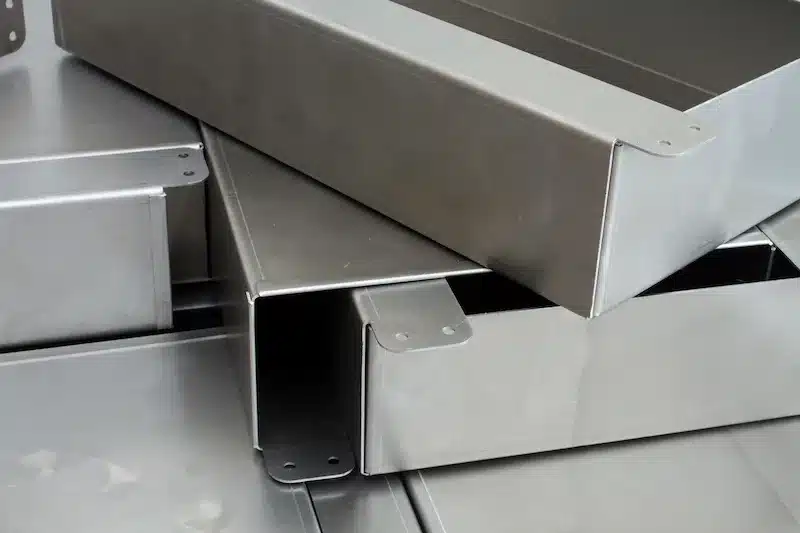
Yicen Precision's service de fabrication de tôles couvre l'acier laminé à froid, l'acier galvanisé, l'aluminium 5052 et 6061, l'acier inoxydable 304/316L et le cuivre à partir de notre installation de découpe laser à fibre et de presse plieuse à commande numérique. Tous les matériaux sont accompagnés de certificats d'usine ; l'aluminium et l'acier inoxydable sont accompagnés d'une documentation sur la traçabilité des matériaux.
Sélection de la jauge : Comment l'épaisseur influe sur le coût et la formabilité
L'épaisseur de la tôle est le principal facteur déterminant à la fois le coût du matériau et la force nécessaire à l'utilisation de la presse plieuse. Un matériau plus épais coûte plus cher par kg et nécessite un outillage de plus fort tonnage, mais il offre une plus grande rigidité structurelle sans caractéristiques supplémentaires. L'approche technique standard consiste à sélectionner l'épaisseur minimale qui répond aux exigences de rigidité, de portance et d'assemblage, puis à vérifier que l'épaisseur sélectionnée est compatible avec la capacité de la presse plieuse et la gamme d'outillage standard de votre fournisseur de services de fabrication.
| Jauge (mm) | Coût du SIR (relatif) | Tonnage requis pour la presse plieuse | Vitesse de découpe laser (relative) | Applications standard |
|---|---|---|---|---|
| 0,5-0,8 mm | 0.6x | Faible - 4-8 T/m | Très rapide - 200% de la ligne de base | Protections électroniques, couvertures minces, panneaux décoratifs |
| 1,0-1,5 mm | 1,0x (base de référence) | Standard - 8-16 T/m | Rapide - 130-150% | Boîtiers généraux, châssis, supports (gamme la plus courante) |
| 2,0-3,0 mm | 1.8-2.5x | Moyen - 16-35 T/m | Standard - 100% | Supports structurels, boîtiers lourds, plaques de montage |
| 4,0-6,0 mm | 3.5-5.5x | Élevée - 35-80 T/m | Lent - 50-70% | Cadres de machines, bases structurelles, couvercles résistants |
| >6,0 mm | 5.5x+ | Très élevé - 80+ T/m | Très lent - 30-50% | Composants structurels industriels, construction navale, exploitation minière |
Le retour de printemps : Le problème le plus sous-estimé dans la conception des tôles
Lorsqu'une pièce de tôle est pliée à 90° sur une presse plieuse, la partie élastique de la déformation du matériau revient lorsque la matrice est relâchée - produisant un angle supérieur à 90° qui doit être corrigé par un surpliage ou une compensation de l'outillage. Les caractéristiques du retour élastique varient considérablement d'un matériau à l'autre :
- Acier laminé à froid 1008 (1,5 mm) : retour élastique ~2° - surcintrage à 92° pour obtenir un angle final de 90°.
- Aluminium 5052-H32 (1,5 mm) : retour élastique ~4° - surcintrage jusqu'à 94°.
- Aluminium 6061-T6 (1,5 mm) : retour élastique ~6°.
- Inox 304 (1,5 mm) : retour élastique ~7°.
Le retour élastique augmente avec la limite d'élasticité du matériau et diminue avec son épaisseur (les matériaux plus épais ont moins de reprise élastique par rapport à la déformation plastique). Pour les pièces comportant plusieurs coudes et dont la précision angulaire est critique (±1° ou plus), le retour élastique doit être mesuré et compensé dans le programme de la presse plieuse. Cela augmente le temps de réglage ($20-$50) et c'est l'une des raisons pour lesquelles la fabrication de tôles en acier inoxydable coûte 20-35% de plus qu'un travail équivalent en acier au carbone.
Rayon de courbure minimal : La règle de conception qui prévient les fissures
| Matériau | Rayon de courbure intérieur minimum | Ce qui se passe en cas de violation | Règle d'ingénierie |
|---|---|---|---|
| CRS 1008 (1,0 mm) | 0,5 mm (0,5× l'épaisseur) | Fissure sur la surface extérieure au niveau de la courbure | Utiliser un rayon interne minimum de 0,5 mm pour tous les coudes en acier. |
| Aluminium 5052-H32 (1,0 mm) | 1,0 mm (1,0× épaisseur) | Fissures dans l'aluminium - ductilité inférieure à celle de l'acier | Utiliser une épaisseur minimale de 1,0× pour le 5052 |
| Aluminium 6061-T6 (1,0 mm) | 1,5-2,0 mm (1,5-2,0×) | Fissuration importante - 6061 a une mauvaise aptitude à la mise en forme | Éviter le 6061-T6 dans la tôle ; utiliser plutôt le 5052 |
| Inox 304 (1,0 mm) | 0,8 mm (0,8× l'épaisseur) | Surface en peau d'orange ; craquelures sur les bords en état H | Utiliser 304L pour une meilleure formabilité que 304 à l'état H |
| Cuivre C110 (1,0 mm) | 0,5 mm (0,5× l'épaisseur) | Trempe par écrouissage au niveau de la courbure ; un recuit peut être nécessaire pour les rayons étroits. | Recuit entre plusieurs coudes pour restaurer la ductilité |
Le choix entre 5052 et 6061 pour la tôle
Le 6061-T6 est l'alliage dominant dans les pièces d'aluminium usinées par CNC, mais c'est un mauvais choix pour la fabrication de tôles. Son traitement thermique T6 produit une limite d'élasticité élevée (275 MPa) mais une mauvaise formabilité - rayon de courbure minimum de 1,5-2,0× l'épaisseur et une forte tendance à la fissuration dans les courbes, en particulier dans le sens du laminage. Le 5052-H32 est l'aluminium idéal pour la fabrication de tôles : une limite d'élasticité plus faible (193 MPa) signifie moins de retour élastique et plus de ductilité au niveau du pliage, avec un rayon de pliage minimum de 1,0× l'épaisseur. Pour les boîtiers et les supports en tôle, il faut toujours spécifier 5052-H32 et non 6061-T6.
Règles DFM pour la fabrication de tôles
- Toutes les brides ≥ 4× l'épaisseur du matériau (8 mm sur un matériau de 2 mm) - les brides plus courtes ne peuvent pas être formées avec l'outillage standard en V.
- Utilisez 5052-H32 pour les tôles d'aluminium - et non 6061-T6. Le 6061 se fissure dans les rayons de courbure étroits ; le 5052 est l'alliage de qualité correcte pour la fabrication.
- Fentes d'allègement de la flexion aux intersections des brides : 1,5 fois l'épaisseur du matériau, s'étendant au-delà de la ligne de pliage - empêchent l'arrachement des coins sur les coudes en L et en U
- Caractéristiques des languettes et des fentes pour l'auto-ajustement : la conception de languettes sur une pièce qui s'emboîtent dans les pièces correspondantes élimine les fixations de positionnement et réduit le temps d'assemblage de 30-60%
- Distance entre les trous et la ligne de pliage : tous les trous doivent se trouver à une distance ≥ 2,5× l'épaisseur du matériau par rapport à la ligne de pliage la plus proche - les trous plus proches se déforment pendant le pliage.
Questions fréquemment posées
Quel est le meilleur matériau pour les boîtiers en tôle ?
Le matériau le plus approprié dépend de l'application. Pour les boîtiers électroniques intérieurs généraux : Acier laminé à froid de 1,0-1,5 mm avec revêtement en poudre - coût le plus bas, excellente formabilité. Pour les équipements portables légers : Aluminium 5052-H32 de 1,5 à 2,0 mm avec anodisation - gain de poids de 35% par rapport à l'acier. Pour la restauration, le secteur médical ou les environnements corrosifs : Inox 304L ou 316L de 1,5 à 2,0 mm - meilleure résistance à la corrosion. Pour les environnements marins ou à forte teneur en chlorure : Inox 316L de 1,5 à 2,0 mm. L'aluminium 6061-T6 n'est pas recommandé pour les boîtiers en tôle en raison de sa mauvaise formabilité.
Quel calibre dois-je utiliser pour un boîtier électronique en tôle ?
Pour un boîtier électronique standard abritant des circuits imprimés ou des modules : L'acier laminé à froid de 1,0-1,5 mm ou l'aluminium 5052-H32 conviennent à la plupart des applications. 1,5 mm assure une rigidité suffisante du panneau sans raidisseurs supplémentaires pour les panneaux jusqu'à 300 × 200 mm. Les panneaux de plus de 400 × 300 mm bénéficient généralement d'une épaisseur de 2,0 mm ou de l'ajout de nervures de raidissement usinées dans le panneau. Pour les équipements portables dont le poids est critique, l'aluminium 5052-H32 de 1,0 mm est le calibre minimum pratique pour les boîtiers structurels.
Pourquoi l'aluminium 5052 est-il meilleur que l'aluminium 6061 pour la fabrication de tôles ?
L'aluminium 5052-H32 a une limite d'élasticité plus faible (193 MPa contre 275 MPa pour le 6061-T6) et une ductilité plus élevée, ce qui permet d'obtenir : un rayon de courbure minimal de 1,0× l'épaisseur contre 1,5-2,0× pour le 6061 ; moins de retour élastique (4° contre 5-7°) ; et un risque de fissuration nettement plus faible au niveau des courbes, en particulier dans le sens du laminage. Le traitement thermique T6 du 6061-T6 optimise la résistance à la traction pour les applications d'usinage CNC, mais compromet la formabilité pour la tôlerie. Pour la fabrication de tôles, toujours spécifier 5052-H32 ou 3003-H14 pour l'aluminium - et non 6061-T6.
Conclusion : La sélection des matériaux est une décision de formabilité et de coût, et pas seulement une décision de résistance.
- Pour les armoires industrielles générales - acier laminé à froid 1,0-1,5 mm avec revêtement en poudre : coût le plus bas, meilleure formabilité
- Pour les applications légères ou électroniques - aluminium 5052-H32 1,5-2,0 mm : 35% économie de poids, bonne résistance à la corrosion, anodisable
- Pour les produits alimentaires/médicaux/corrosifs - acier inoxydable 304L ou 316L 1,5-2,0 mm : ne jamais spécifier 6061-T6 pour la tôle ; toujours utiliser 5052-H32 pour l'aluminium.
Yicen Precision propose la fabrication de tôles en CRS, 5052, 304/316L et cuivre avec découpe laser, formage à la presse et finition de surface. Soumettez vos dessins à yicenprecision.com.