
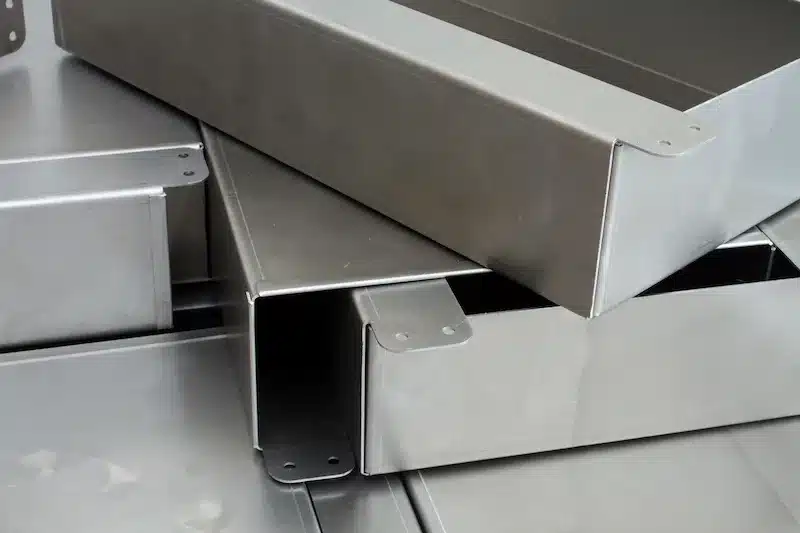
Sheet Metal Fabrication: Material Guide & DFM Rules 2026
Author: Eric Lin, Senior Process Engineer, Yicen Precision
Eric Lin has 11 years of CNC and sheet metal process engineering experience, with specific expertise in material selection and DFM optimisation for electronic enclosures, automotive brackets, and precision sheet metal assemblies.
For design engineers specifying sheet metal material on a first enclosure design, the decision that costs most money downstream is not the material choice itself — it is the combination of material and gauge that determines whether the minimum bend radius, spring-back compensation, and flange length constraints are manageable within the design intent. Specifying 1.5 mm 304 stainless steel for an enclosure that has 6 mm flanges and 90° bends produces a part that requires special tooling, repeated brake press adjustments for spring-back, and 15–25% higher fabrication cost than the same design in 1.5 mm aluminium 5052-H32.
Sheet metal material selection affects not just raw material cost (typically 30–50% of total fabrication cost) but machining behaviour: spring-back angle, minimum bend radius, ductility limit before cracking, and surface hardness all determine what the press brake can actually achieve on the first hit and how much adjustment the operator requires to hit tolerance. Getting material selection right before drawing release eliminates these downstream process problems.
Sheet Metal Material Comparison for Fabrication
| 素材 | Yield Strength | 引張強度 | Spring-back (90° bend) | Min Bend Radius | 加工性 | Cost Index | ベストアプリケーション |
|---|---|---|---|---|---|---|---|
| Cold rolled steel 1008 | 210 MPa | 340 MPa | Low (~2°) | 0.5× thickness | 素晴らしい | 1.0x (baseline) | General enclosures, brackets, chassis |
| Galvanised steel (G90) | 230 MPa | 310 MPa | Low (~2°) | 0.5–0.8× thickness | 素晴らしい | 1.1x | Outdoor, HVAC, corrosion-required applications |
| Aluminium 5052-H32 | 193 MPa | 228 MPa | Moderate (~4°) | 1.0× thickness | Very good | 1.4–1.6x | Marine, electronics, lightweight structural |
| Aluminium 6061-T6 | 275 MPa | 310 MPa | Moderate-high (~5–7°) | 1.5–2.0× thickness | Very good | 1.4–1.6x | Structural brackets — worse formability than 5052 |
| Stainless 304/304L | 215 MPa | 505 MPa | High (~6–8°) | 0.8–1.0× thickness | Challenging | 2.8–3.5x | Food service, medical, corrosive environments |
| ステンレス316L | 210 MPa | 515 MPa | High (~6–8°) | 0.8–1.0× thickness | Challenging | 3.2–4.0x | Marine, pharmaceutical, chloride-rich environments |
| Copper (C110) | 69 MPa | 220 MPa | Very low (~1°) | 0.5× thickness | グッド | 6.0–8.0x | Electrical busbars, RF shielding, heat exchangers |
| Brass C260 | 340 MPa | 470 MPa | Low (~2°) | 0.5× thickness | 素晴らしい | 4.0–5.0x | Decorative, plumbing, electrical connectors |
易岑精密の sheet metal fabrication service covers cold rolled steel, galvanised steel, aluminium 5052 and 6061, stainless 304/316L, and copper from our fibre laser cutting and CNC press brake facility. All materials are sourced with mill certificates; aluminium and stainless include material traceability documentation.
Gauge Selection: How Thickness Drives Cost and Formability
Sheet metal gauge is the primary driver of both material cost and press brake force requirements. Thicker material costs more per kg and requires higher tonnage tooling, but provides greater structural stiffness without additional features. The standard engineering approach is to select the minimum gauge that meets the stiffness, load-bearing, and assembly requirements — then verify that the selected gauge is within the press brake capability and standard tooling range of your fabrication supplier.
| Gauge (mm) | CRS Cost (relative) | Press Brake Tonnage Required | Laser Cutting Speed (relative) | Standard Applications |
|---|---|---|---|---|
| 0.5–0.8 mm | 0.6x | Low — 4–8 T/m | Very fast — 200% of baseline | Electronics shields, thin covers, decorative panels |
| 1.0–1.5 mm | 1.0x (baseline) | Standard — 8–16 T/m | Fast — 130–150% | General enclosures, chassis, brackets (most common range) |
| 2.0–3.0 mm | 1.8–2.5x | Medium — 16–35 T/m | Standard — 100% | Structural brackets, heavy enclosures, mounting plates |
| 4.0–6.0 mm | 3.5–5.5x | High — 35–80 T/m | Slow — 50–70% | Machine frames, structural bases, heavy-duty covers |
| >6.0 mm | 5.5x+ | Very high — 80+ T/m | Very slow — 30–50% | Industrial structural components, shipbuilding, mining |
Spring-Back: The Most Underestimated Problem in Sheet Metal Design
When a sheet metal part is bent to 90° on a press brake, the elastic portion of the material deformation springs back when the die is released — producing an angle greater than 90° that must be corrected by over-bending or tooling compensation. Different materials have very different spring-back characteristics:
- Cold rolled steel 1008 (1.5 mm): spring-back ~2° — overbend to 92° to achieve 90° final angle
- Aluminium 5052-H32 (1.5 mm): spring-back ~4° — overbend to 94°
- Aluminium 6061-T6 (1.5 mm): spring-back ~6°
- Stainless 304 (1.5 mm): spring-back ~7°
Spring-back increases with material yield strength and decreases with material thickness (thicker materials have less elastic recovery relative to plastic deformation). For parts with multiple bends where angular accuracy is critical (±1° or tighter), spring-back must be measured and compensated in the press brake program. This adds setup time ($20–$50) and is one reason stainless steel sheet metal fabrication costs 20–35% more than equivalent carbon steel work.
Minimum Bend Radius: The Design Rule That Prevents Cracks
| 素材 | Minimum Inside Bend Radius | What Happens If Violated | Engineering Rule |
|---|---|---|---|
| CRS 1008 (1.0 mm) | 0.5 mm (0.5× thickness) | Cracking on outer surface at bend | Use 0.5 mm minimum internal radius for all steel bends |
| Aluminium 5052-H32 (1.0 mm) | 1.0 mm (1.0× thickness) | Aluminium cracks — lower ductility than steel | Use 1.0× thickness minimum for 5052 |
| Aluminium 6061-T6 (1.0 mm) | 1.5–2.0 mm (1.5–2.0×) | Severe cracking — 6061 has poor formability | Avoid 6061-T6 in sheet metal; use 5052 instead |
| Stainless 304 (1.0 mm) | 0.8 mm (0.8× thickness) | Orange peel surface; edge cracking in H condition | Use 304L for better formability than 304 in H temper |
| Copper C110 (1.0 mm) | 0.5 mm (0.5× thickness) | Work hardening at bend; annealing may be required at tight radii | Anneal between multiple bends to restore ductility |
The 5052 vs 6061 Decision for Sheet Metal
6061-T6 is the dominant alloy in CNC machined aluminium parts but is a poor choice for sheet metal fabrication. Its T6 heat treatment produces high yield strength (275 MPa) but poor formability — minimum bend radius of 1.5–2.0× thickness and a strong tendency to crack at bends, particularly across the rolling direction. 5052-H32 is the correct aluminium for sheet metal fabrication: lower yield strength (193 MPa) means less spring-back and more ductility at the bend, with minimum bend radius of 1.0× thickness. For sheet metal enclosures and brackets, always specify 5052-H32, not 6061-T6.
DFM Rules for Sheet Metal Fabrication
- All flanges ≥ 4× material thickness (8 mm on 2 mm material) — shorter flanges cannot be formed with standard V-die tooling
- Use 5052-H32 for aluminium sheet metal — not 6061-T6. 6061 cracks at tight bend radii; 5052 is the correct fabrication-grade alloy
- Bend relief slots at flange intersections: 1.5× material thickness wide, extending past the bend line — prevents corner tearing on L and U bends
- Tab and slot features for self-jigging: designing tabs on one part that slot into mating parts eliminates positioning fixtures and reduces assembly time by 30–60%
- Hole clearance from bend line: all holes must be ≥ 2.5× material thickness from the nearest bend line — holes closer than this distort during bending
よくある質問
What is the best material for sheet metal enclosures?
The best material depends on the application. For general indoor electronics enclosures: 1.0–1.5 mm cold rolled steel with powder coating — lowest cost, excellent formability. For lightweight portable equipment: 1.5–2.0 mm aluminium 5052-H32 with anodising — 35% weight saving over steel. For food service, medical, or corrosive environments: 1.5–2.0 mm stainless 304L or 316L — best corrosion resistance. For marine or high-chloride environments: 1.5–2.0 mm stainless 316L. Aluminium 6061-T6 is not recommended for sheet metal enclosures due to poor formability.
What gauge should I use for a sheet metal electronics enclosure?
For a standard electronics enclosure housing PCBs or modules: 1.0–1.5 mm cold rolled steel or aluminium 5052-H32 is correct for most applications. 1.5 mm provides adequate panel rigidity without additional stiffening features for panels up to 300 × 200 mm. Panels above 400 × 300 mm typically benefit from 2.0 mm or the addition of formed stiffening ribs machined into the panel. For portable equipment where weight is critical, 1.0 mm 5052-H32 aluminium is the minimum practical gauge for structural enclosures.
Why is aluminium 5052 better than 6061 for sheet metal fabrication?
5052-H32 aluminium has lower yield strength (193 MPa vs 275 MPa for 6061-T6) and higher ductility, producing: minimum bend radius of 1.0× thickness vs 1.5–2.0× for 6061; less spring-back (4° vs 5–7°); and significantly lower cracking risk at bends, particularly across the rolling direction. 6061-T6’s T6 heat treatment optimises tensile strength for CNC machining applications but compromises formability for sheet metal. For sheet metal fabrication, always specify 5052-H32 or 3003-H14 for aluminium — not 6061-T6.
Conclusion: Material Selection Is a Formability and Cost Decision, Not Just a Strength Decision
- For general industrial enclosures — cold rolled steel 1.0–1.5 mm with powder coating: lowest cost, best formability
- For lightweight or electronics applications — aluminium 5052-H32 1.5–2.0 mm: 35% weight saving, good corrosion resistance, anodisable
- For food/medical/corrosive — stainless 304L or 316L 1.5–2.0 mm: never specify 6061-T6 for sheet metal; always use 5052-H32 for aluminium
Yicen Precision provides sheet metal fabrication in CRS, 5052, 304/316L, and copper with laser cutting, press brake forming, and surface finishing. Submit your drawings at yicenprecision.com.

 Japanese
  English
  French
  Spanish
  German
  Portuguese