
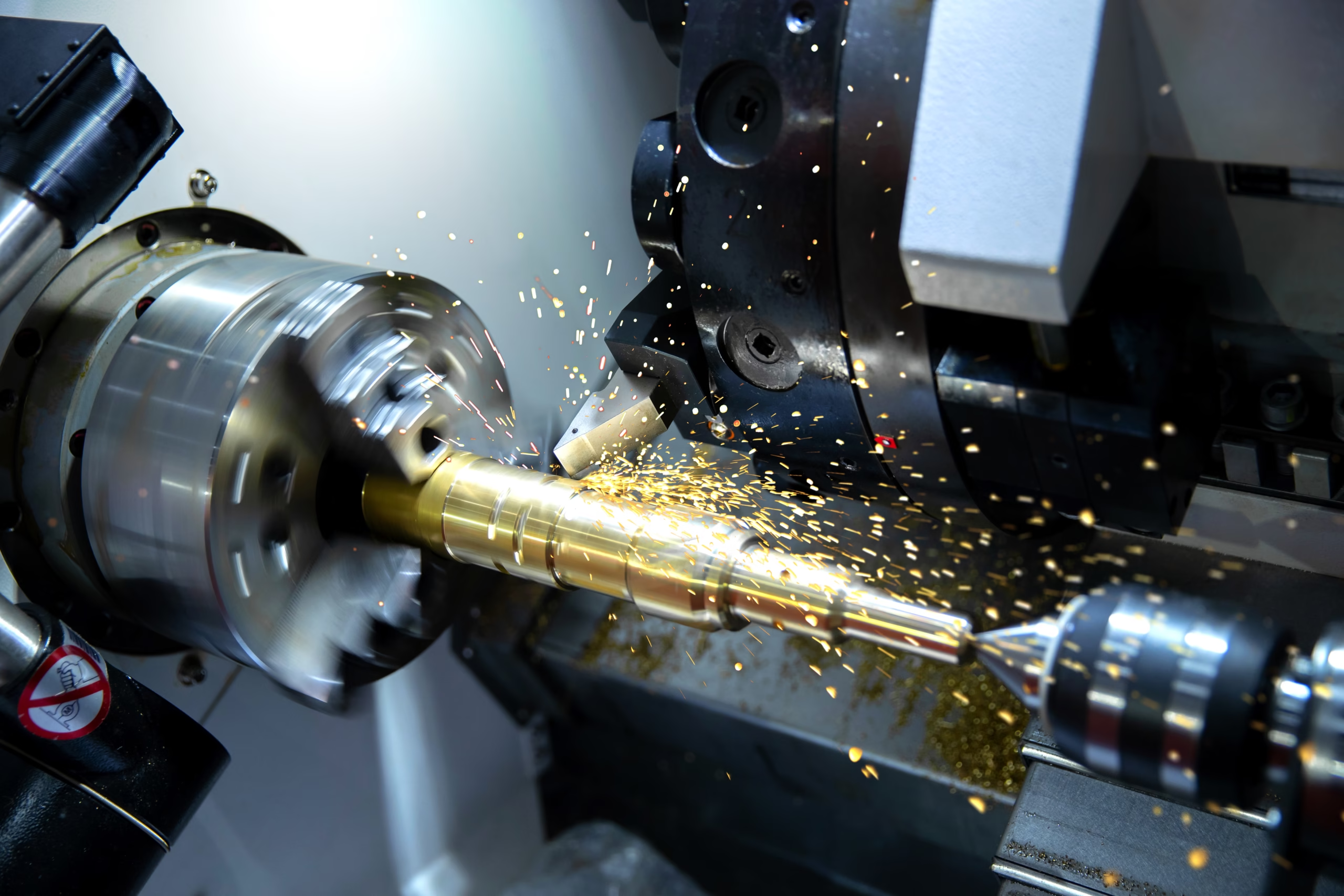
The Core Difference Between 3-Axis and 5-Axis Machining
A 3-axis CNC machine moves the cutting tool in three linear directions: X, Y, and Z. The workpiece sits still. To cut features on a different face, you stop the machine, unclamp the part, flip it, re-clamp, and re-zero the program. Every flip adds setup time and a small risk of dimensional error.
A 5-axis CNC machine adds two rotational axes — typically called A and C, or A and B. The workpiece itself tilts and rotates while the cutter moves. A part with features on five faces can be machined in one setup, with the cutter approaching from any angle. This is what makes Mecanizado en 5 ejes transformative for complex geometry — not the absolute precision, but the elimination of setups.
Quick Comparison: 3-Axis, 4-Axis, and 5-Axis
| Atributo | 3 ejes | 4-Axis | 5 ejes |
| Linear axes | X, Y, Z | X, Y, Z | X, Y, Z |
| Rotational axes | Ninguno | A (rotary table) | A + C (or A + B) |
| Setups for complex part | 3–6 | 2–3 | 1 |
| Hourly rate (China) | $25-$45 | $35-$60 | $50-$90 |
| Lo mejor para | Flat parts, plates | Indexed faces, rotational features | Aerospace, medical, complex 3D |
| Tolerance achievable | ±0,025 mm | ±0.015 mm | ±0,005 mm |
| Programming complexity | Bajo | Moderado | Alta |
When 3-Axis Is the Right Answer
Despite all the marketing around 5-axis, the truth is that 3-axis machining still produces the majority of all CNC parts globally. It is faster, simpler to program, and dramatically cheaper per hour. For the right part, 3-axis is the obvious choice.
Parts That Belong on a 3-Axis Machine
- Flat plates with features only on the top face
- Simple housings where a single flip handles top and bottom
- High-volume production parts with dedicated fixtures
- Prototypes where tolerance demands are loose (±0.1 mm or better)
- Cost-sensitive parts where machine time dominates the quote
A 3-axis machine running a well-designed part can outproduce a 5-axis machine 3:1 on volume. The 5-axis advantage only kicks in when geometry forces multiple setups on the simpler machine.
When 4-Axis Bridges the Gap
4-axis machining adds a rotary table to a 3-axis machine. The part rotates around one axis (usually horizontal), letting the cutter access multiple faces without unclamping. This is sometimes called “3+1 axis” machining — the rotary axis indexes between operations rather than moving simultaneously.
Where 4-Axis Wins
- Parts with features on four sides arranged around a central axis (manifolds, valve bodies)
- Cylindrical parts that need flats, slots, or cross-holes
- Engraving on curved surfaces
- Mid-volume production where 3-axis would need too many setups but 5-axis is overkill
4-axis sits in an awkward middle ground. For simple parts it costs more than 3-axis with no benefit. For complex parts it cannot match 5-axis. But for that specific class of rotational features, it is the right choice.
When 5-Axis Pays Off
5-axis machining is most valuable not for the precision it adds, but for the setups it eliminates. Each additional setup on a 3-axis machine adds 15–30 minutes of fixture time, plus the risk of accumulating tolerance error across re-datuming. A 5-axis machine that runs a complex part in one setup often beats a 3-axis machine that runs the same part in four setups — even though the hourly rate is double.
Geometry That Demands 5-Axis
- Aerospace impellers, turbine blades, and other curved 3D surfaces
- Medical implants and surgical instruments with organic shapes
- Mold cavities with deep undercut features
- Parts with features on five or six faces that all need tight tolerances relative to each other
- Thin-wall parts where re-clamping would deform the workpiece
The Cost Math: When Does 5-Axis Become Cheaper?
The honest answer is: when total setup count drops by enough to offset the higher hourly rate. Here is how that math plays out in practice.
| Escenario | 3-Axis Cost | 5-Axis Cost | Ganador |
| Simple bracket, 1 setup | $60 | $120 | 3-axis (50% less) |
| 4-side housing, 4 setups | $220 | $180 | 5-axis (18% less) |
| Aerospace impeller, 6 setups | Not feasible | $340 | 5-axis (only option) |
| Medical implant, organic | Not feasible | $580 | 5-axis (only option) |
| Production plate, qty 1,000 | $8.50/part | $15.50/part | 3-axis (45% less) |
The crossover happens at roughly 3 setups. Below that, 3-axis wins on cost. Above that, 5-axis usually wins. For high-volume work with simple geometry, 3-axis with dedicated fixtures almost always beats 5-axis on cost per part.
Programming and Setup Differences
5-axis programming is fundamentally harder than 3-axis programming. The CAM software has to manage tool axis vectors, collision avoidance with the rotary axes, and the kinematics of the specific machine. A simple 5-axis program takes 2–4x longer to write than its 3-axis equivalent.
This matters most for low-volume work. On a one-off part, programming time can equal or exceed cutting time. On a production part running thousands of pieces, programming amortizes to nothing — but the up-front engineering cost is real.
Common Mistakes When Choosing Between 3-Axis and 5-Axis
Mistake 1: Specifying 5-Axis Because It Sounds Better
Some engineers default to 5-axis on the assumption that it is always more accurate. It isn’t. Both processes hit ±0.005 mm with the right machine and operator. 5-axis is more accurate only because it eliminates re-clamping errors — and for parts that don’t require re-clamping anyway, 3-axis is the same precision at half the cost.
Mistake 2: Over-Specifying Tolerance to Justify 5-Axis
Tolerance specs of ±0.005 mm on every dimension cost real money regardless of process. If only three features actually need tight tolerance, specify them tight and let the rest run loose. This often makes a 3-axis solution viable on parts that looked like 5-axis territory.
Mistake 3: Ignoring 4-Axis as an Option
Many parts that “need” 5-axis actually need 4-axis. If your features are arranged around a central axis (typical for rotational parts), a 4-axis machine handles the geometry at 60–70% of 5-axis cost.
Frequently Asked Questions About 5-Axis vs 3-Axis Machining
Is 5-axis CNC always more accurate than 3-axis?
No. Both processes hit similar tolerances on a per-feature basis. 5-axis is more accurate on parts requiring multiple setups because it eliminates re-clamping error. For single-setup parts, 3-axis is equally accurate at lower cost.
How much more does 5-axis CNC cost than 3-axis?
Hourly rates run roughly 2x higher (e.g., $50–$90 vs $25–$45 in China). Per-part cost depends on setup count — for parts with 4+ setups, 5-axis often costs less total. For 1–2 setup parts, 3-axis is cheaper.
Can 5-axis machine everything a 3-axis can?
Yes, but slower and more expensively for simple geometry. 5-axis machines are universal — they handle 3-axis work too — but the higher hourly rate makes them uneconomical for parts that do not need the extra axes.
What is “3+2” axis machining?
3+2 axis is a 5-axis machine running with the two rotary axes locked in position during cutting. It is essentially a 3-axis cut at an angled orientation. It allows complex part orientations without the programming complexity of full simultaneous 5-axis motion.
When should I ask my supplier whether they’re using 3-axis or 5-axis?
When tolerance, cycle time, or surface finish matter. The supplier choice often follows from the geometry — a good shop will use the cheaper machine when it can hit the spec. If you want predictable cost, specify the process; if you want predictable quality, specify the tolerance and let the shop pick the machine.
Choose the Right Machine with Yicen Precision
Yicen Precision runs 3-axis, 4-axis, and 5-axis Fresado CNC equipment alongside Torneado CNC and mill-turn centers. We pick the right machine for each part, not the most expensive one — our DFM engineers review every quote and recommend the lowest-cost process that hits the spec. Send us your CAD file for a transparent, machine-by-machine cost breakdown within 24 hours.




 Spanish
  English
  French
  Japanese
  German
  Portuguese