
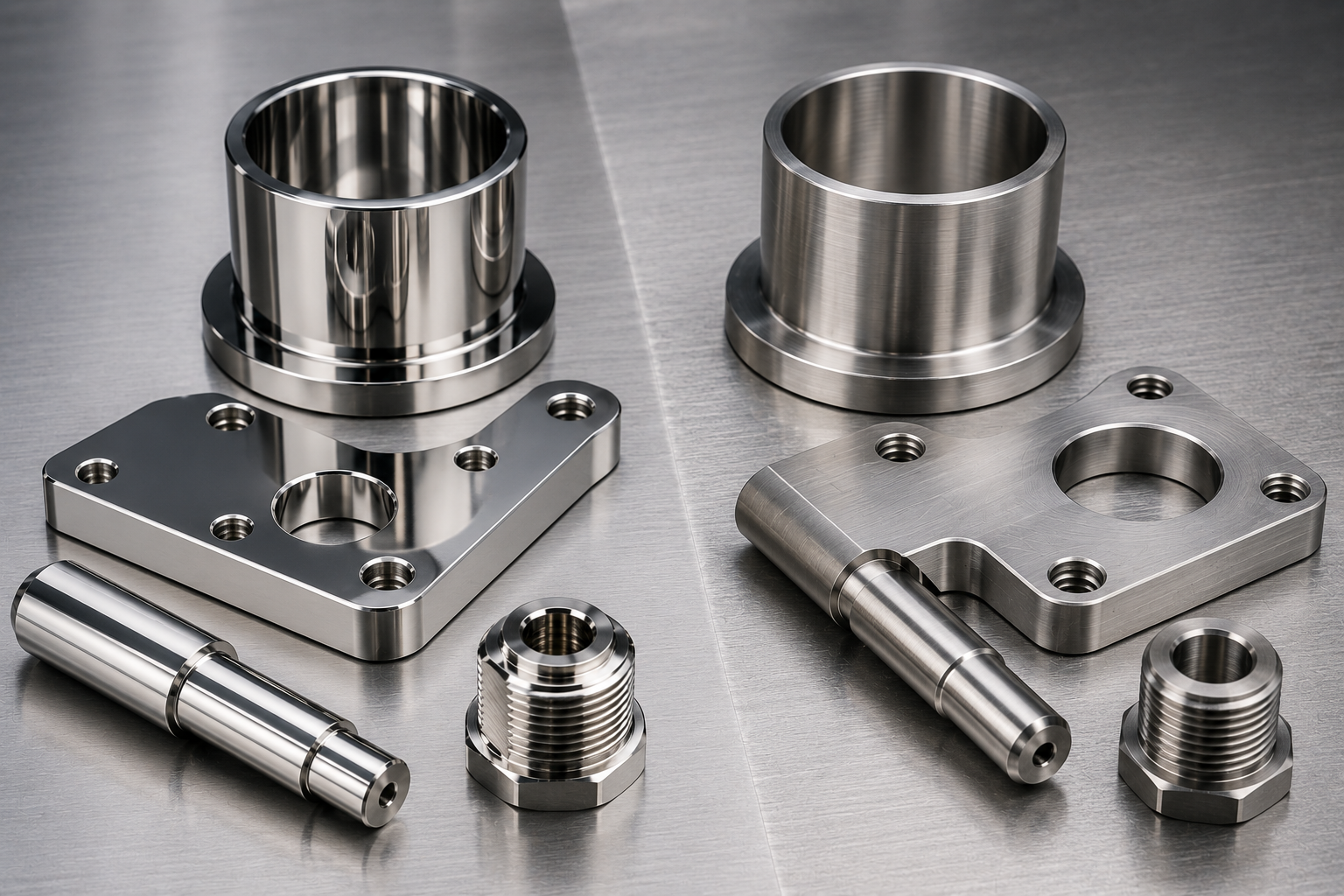
Electropolishing dissolves metal to leave a smooth, passive, ultra-clean surface. That is the right call for stainless in medical, food, and semiconductor work. Mechanical polishing rubs the surface smooth with abrasives instead, a bright cosmetic finish at lower cost. One wins on corrosion resistance and internal features. The other wins on cost and big flat cosmetic faces. Here is how to tell them apart for your part.
Two parts come off the same mill, same day, same operator. One clears a medical audit. The other pits and rusts inside a year. What changed? The finish. People treat polishing like paint, a thing you do at the end to make a part look nice. On a stainless surgical tool, or a gas fitting bound for a fab, it is nothing of the sort. The finish decides how well the part fights corrosion, how easily it cleans, whether contamination clings or rinses off. I have watched a buyer pay for a mirror polish when electropolishing would have been cheaper and better. Watched the reverse too, more than once.
What Is the Difference Between Electropolishing and Mechanical Polishing?
Electropolishing dissolves metal. Mechanical polishing rubs it off. First one melts the high points away in an acid bath and leaves a passive, contaminant-free surface. Second one drags finer and finer abrasives across the metal to smooth and brighten it. One changes the chemistry. The other only the texture.
Drop a part in the tank and it turns into the anode. Current flows. High spots go first, because that is where the current crowds, and they dissolve off until what is left reads smooth. Mechanical polishing? Never touches the chemistry. Belts, wheels, media, brute contact, that is all it is. So one changes what the top few microns are made of. The other, just how they feel. Everything after traces back to that split.
How Does Electropolishing Work on CNC Parts?
In the tank, the part is the anode, and the current eats the microscopic peaks first. Flattens things out. Pulls off maybe 10 to 40 microns, drops the roughness, and fattens the chromium oxide film on stainless, which is the layer really fighting corrosion.
So what does it buy you? Reach, mostly. Inside bores, down threads, spots a wheel will never see, because current does not care about tool access. It shears micro-burrs and rinses machining residue in the same dunk. Nothing left embedded, which is the whole game for medical and semiconductor parts. Two catches. It only really works on stainless and a few cousins. And it rounds a sharp edge a touch. Sometimes nobody cares. Sometimes that is your reject. For how different alloys behave under it, see our guide to CNC materials.
How Does Mechanical Polishing Work?
Mechanical polishing earns its keep elsewhere. Coarse to fine, each grit wiping out the last one scratches, until you hit a satin line or a full mirror. Material barely matters, aluminum, titanium, carbon steel, stainless, it eats all of them. Want a real mirror on a big cover a customer stares at? This is the process, and electropolishing cannot touch it on cost for a plain outside face. Keeps edges crisp too. Where it dies is geometry and cleanliness. A wheel cannot crawl into a deep bore, and abrasives can press grit in or leave a smeared, stressed skin you never wanted. For dimensional finishing on critical diameters we often pair it with rectificado de precisión before the final polish.
Electropolishing vs Mechanical Polishing: Side by Side
Neither wins clean, which is the answer nobody likes. Our full range of surface finishing options covers both routes plus blasting, anodizing, and passivation.
| Atributo | Electropulido | Mechanical Polishing |
| Mechanism | Electrochemical metal removal | Abrasive smoothing |
| Best materials | Stainless steel, some alloys | Nearly all metals |
| Typical Ra result | Down to ~0.1-0.4 µm | Mirror on flats, varies |
| Internal features | Excellent (reaches everywhere) | Poor (tool access limited) |
| Resistencia a la corrosión | Improves (passivates) | No chemical change |
| Edges | Slightly rounded | Stays sharp |
| Cleanliness | No embedded abrasive | Risk of embedded grit |
| Cost driver | Setup, bath chemistry | Labor, geometry |
Which Finish Should You Choose for Your Part?
Three things settle it. What the part is made of. What it looks like. What it has to survive. Stainless that has to fight corrosion, or hides a passage a tool cannot reach, or is headed into a body or a cleanroom? Electropolish it. Aluminum or titanium that just needs to look sharp, or an edge that must stay dead crisp? Polish it mechanically. Plenty of parts get both, mechanical first for the face people see, then a quick electropolish to passivate and clean up. One field note pays for itself: when a stainless drawing lists a roughness number and a corrosion spec together, electropolishing usually nails both at once, which quietly makes it the cheaper path even when the tank looks pricey.
If you want it as a quick lookup, here is how the common cases fall out.
| Part / Application | Recommended Finish | Por qué |
| Stainless surgical or implant part | Electropulido | Passive, clean, no embedded grit |
| Cosmetic aluminum cover | Mechanical (mirror) | Bright face, keeps edges crisp |
| Semiconductor gas line / internal bores | Electropulido | Current reaches inside passages |
| Bright + passive stainless part | Both (mechanical then EP) | Mirror face plus passivation |
| Sharp-edged cutting or tooling part | Mecánica | No edge rounding |
A quick real one. We had a stainless valve body, internal ports, a Ra callout, and a corrosion spec. The buyer first asked for a mechanical polish. Problem is, no wheel reaches those ports. It would have passed the outside and failed the inside. We switched it to electropolish, hit the roughness and the passivation together, and it cleared inspection on the first article. Cheaper, too, once you count the rework that did not happen.
Common Polishing Mistakes That Cost Money
Here is the thing though. Most finish problems are not finish problems. They are drawing problems, baked in weeks before anyone dunked a part. Classic one, nobody flagged the finish, machining left no allowance, and electropolishing ate 30 microns off a feature already at the bottom of tolerance. Gone. Another, a mirror on a face buried so deep no eye ever finds it. All cost, no return. Or a knife-sharp edge sent to the tank and rounded off. And the quiet killer, internal bores that had to be spotless sent out for a mechanical polish that physically cannot reach inside. Five minutes of finish review before release catches every one. A rushed drawing catches none.
The Bottom Line on Polishing CNC Parts
So, not swappable. Electropolishing rewrites the chemistry, which is why it owns stainless corrosion resistance, internal features, anything facing a cleanliness audit. Mechanical polishing rewrites texture, which is why it owns cosmetic mirrors, non-stainless metals, crisp edges, simple low-volume runs.
Three questions sort nearly every part. What is it made of. Does it need to fight corrosion or just look good. Can a tool physically reach every surface that has to end up smooth. Answer those straight and the process picks itself.
Not sure which finish your part needs? Request a quote and our finishing engineers will pick the process that meets your Ra and corrosion specs at the lowest cost, and confirm it before your parts hit the line.
Preguntas frecuentes
Is electropolishing better than mechanical polishing?
Neither, across the board. Electropolish stainless that needs corrosion resistance, cleanliness, or clean internal features, since it dissolves metal and passivates. Reach for mechanical on cosmetic mirrors, non-stainless metals, edges that stay sharp. Material and application call it, every time.
What surface roughness can electropolishing achieve?
On stainless, into the roughly 0.1 to 0.4 µm Ra range, depending where you start. It eats the microscopic peaks first, so it smooths evenly, including the inside of bores and threads a wheel or stone can never reach the same way.
Does electropolishing work on aluminum or titanium?
It shines on stainless and a few select alloys. Some aluminum and titanium grades take it, but results wander and the corrosion payoff shrinks. For a cosmetic finish on those, mechanical polishing or anodizing is the smarter call.
Does polishing change the dimensions of a CNC part?
Yes, a little, and it bites people. Electropolishing pulls off roughly 10 to 40 microns, so tight features plan for it. Mechanical takes less on flats but rounds edges. Tell the shop up front so machining leaves the right stock.
Why does electropolishing improve corrosion resistance?
On stainless it strips the outer machined layer and thickens the chromium oxide film protecting the metal. That passivation leaves the part far tougher against rust and pitting than a machined or buffed surface, which is why medical and food gear ask for it.
Can you mechanically polish and then electropolish the same part?
Yes, common on stainless that needs a bright face and a spotless, passive surface. Mechanical first to knock down tool marks and hit a base finish. Then a fast electropolish to smooth microscopically, deburr, and passivate in one last step.
About the Author
Escrito por el equipo de ingeniería de precisión de Yicen. Our finishing and quality engineers bring more than ten years of specifying surface treatments for medical, semiconductor, and food-grade stainless parts. Yicen Precision runs 300+ machines in Shenzhen, offers 30+ surface finishes, and holds ISO 9001:2015, ISO 13485, ISO 14001, and IATF 16949 certifications. Explore our Servicios de mecanizado CNC o request a finishing quote.


 Spanish
  English
  French
  Japanese
  German
  Portuguese