Guía de precios del anodizado 2026: precios según tipo, volumen y color
Si eres ingeniero mecánico y tienes que especificar el acabado de una carcasa de aluminio, un responsable de desarrollo de nuevos productos (NPI) que compara presupuestos de acabado que oscilan entre $0,85 y $4,20 por pie cuadrado para lo que parece ser el mismo proceso, o un comprador de material que intenta entender por qué una pieza anodizada en negro cuesta más que una transparente , esta guía es para ti. El anodizado es el acabado más presupuestado y menos comprendido en la fabricación de aluminio a medida. La estructura de precios tiene tres componentes —tipo de proceso, superficie y complementos— y la mayoría de los compradores solo ven la tarifa principal, pasan por alto el pedido mínimo y presupuestan un 30 % por debajo de la cifra real.
En Yicen Precision realizamos el anodizado en nuestras propias instalaciones como parte de nuestros servicios de chapistería y Acabado CNC Capacidad. Aproximadamente el 40 % de las piezas de aluminio que mecanizamos cada mes se someten a algún tipo de anodizado: tipo II transparente o negro en carcasas de productos de consumo, tipo III de recubrimiento duro en componentes aeroespaciales y de defensa, y, ocasionalmente, tipo I crómico en soportes aeroespaciales de ajuste preciso. Esta guía le ofrece los rangos de costes reales para 2026 en los tres tipos, la curva de cantidades que se aplica realmente (y no la regla empírica de números redondos que se suele ver) y las medidas de DFM que suelen reducir el gasto en anodizado entre un 20 % y un 35 % sin modificar las especificaciones de acabado.
La fórmula del coste del anodizado
Todos los presupuestos de anodizado —ya provengan de un taller especializado de California o de una línea de acabado interna en Shenzhen— se basan en los mismos tres conceptos. La tarifa principal acapara toda la atención, pero el recargo por lote y los suplementos son los que, de forma discreta, determinan el importe final de la factura.
Coste del anodizado = Tarifa por lote + (Superficie × Tarifa por pie cuadrado) + Conceptos adicionales
El recargo por lote es un importe mínimo por lote —que cubre la preparación del depósito, la mano de obra de trasiego, la preparación del tinte y el control de calidad—. En un taller de subcontratación estadounidense, los recargos por lote oscilan entre $75 y $200 por lote para el Tipo II, y entre $150 y $400 para el Tipo III. Por eso, el anodizado de una sola pieza pequeña puede costar más por unidad que el de 500 piezas: cuando se trata de una sola pieza, se paga el recargo por lote completo por esa única pieza.
La tarifa por pie cuadrado es el componente variable. Varía de forma lineal en función de la superficie mojada de la pieza (la superficie exterior total con la que entra en contacto el producto químico) y del tipo y espesor de recubrimiento elegidos. Los suplementos cubren el sellado, el teñido en colores no estándar, los pretratamientos —como el granallado— y las inspecciones que superen los requisitos mínimos del lote.
Los tres tipos de anodizado: coste y aplicaciones
Anodizado se divide en tres procesos comerciales, cada uno con un perfil de costes y un ámbito de aplicación distintos. Elegir el tipo equivocado es el error más costoso que observamos en las especificaciones de los clientes: el Tipo III en una pieza que solo necesita el Tipo II cuesta aproximadamente 2,5 veces más sin aportar ninguna ventaja funcional.
| Tipo | Nombre común | Espesor del revestimiento | Tarifa (USD/pie cuadrado) | Uso típico |
| Tipo I | Ácido crómico | 0,5–7,5 µm | $0,70–$3,00 | Ajuste con tolerancias estrictas y crítico desde el punto de vista de la fatiga en el sector aeroespacial |
| Tipo II | Ácido sulfúrico | 5–25 µm | $0,50–$2,00 | Artículos decorativos, productos electrónicos, productos de consumo |
| Tipo II transparente | Transparente estándar | 8–15 µm | $0,50–$1,40 | Cajas para componentes electrónicos de uso general |
| Negro tipo II | Negro estándar | 10-20 µm | $0,80–$2,00 | Óptica cosmética y antirreflejos |
| Tipo III | Anodizado duro | 25–100 µm | $2,00–$5,00 | Resistente al desgaste, de uso militar, para el transporte de fluidos |
| Tipo III negro | Negro con recubrimiento duro | 30-80 µm | $2,50–$5,50 | Sector aeroespacial, componentes de armas de fuego, hidráulica |
Dos observaciones sobre los precios que se desprenden de esta tabla. En primer lugar, el anodizado crómico de tipo I es más caro que el de tipo II a pesar de ser más fino, debido a la química controlada del ácido crómico y al número limitado de proveedores que aún lo realizan conforme a la normativa de la EPA. En segundo lugar, el tipo III tiene un sobreprecio de aproximadamente entre 2,5 y 3 veces el del tipo II, tanto porque el recubrimiento en sí es más grueso y más duro, como porque el tiempo de inmersión es mayor y se requiere capacidad de refrigeración para mantener el baño a una temperatura de entre 0 y 5 °C durante el proceso.
Qué factores influyen en el coste del anodizado: más allá de la tarifa por pie cuadrado
Cantidad y coste por lote
Aquí es donde los compradores se llevan más sorpresas. Un 50 cm² aluminio El soporte tiene una superficie en contacto con el líquido de aproximadamente 0,5 pies cuadrados. A una tarifa de Tipo II de $1,20 por pie cuadrado, el coste variable es de $0,60 por pieza. Pero el recargo por lote de $120 sigue aplicándose, por lo que una pieza cuesta $120,60, diez piezas cuestan $126 y 200 piezas cuestan un total de $240 ($1,20 por pieza). El coste unitario se reduce en un 99 % entre la cantidad 1 y la cantidad 200, y la mayor parte de esa reducción se debe simplemente al reparto del recargo por lote.
| Cantidad | Coste total (tipo II transparente) | Coste por unidad | frente a una sola unidad |
| 1 | $120.60 | $120.60 | — |
| 10 | $126.00 | $12.60 | −90% |
| 50 | $150.00 | $3.00 | −98% |
| 100 | $180.00 | $1.80 | −98,51 TP3T |
| 200 | $240.00 | $1.20 | −99% |
| 500 | $420.00 | $0.84 | −99,31 TP3T |
La lección práctica: no anodices los prototipos de uno en uno si puedes procesarlos por lotes. Encarga tres o cuatro iteraciones del diseño a la vez y anodízalas en una sola tanda. El coste del lote se amortiza de inmediato y el gasto en el anodizado de los prototipos se reduce a la mitad o incluso más.
Elección del color
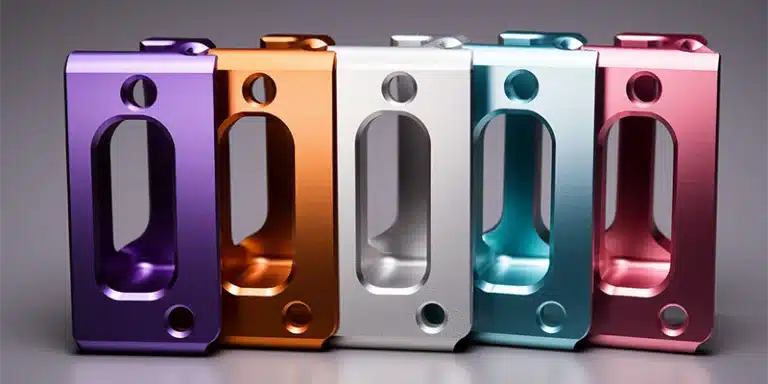
Los colores estándar, transparente y negro, son los más baratos porque la mayoría de los talleres de anodizado mantienen esos tanques de tinte en funcionamiento continuo. Si se especifica cualquier color no estándar —rojo, azul, dorado, bronce o mezclas personalizadas—, se añade un recargo de $2–$5 por pieza en concepto de preparación del lote de tintes, además de un incremento habitual del 20–40 por ciento sobre la tarifa base debido a la menor velocidad de producción de la línea. La coincidencia de colores entre lotes de producción también resulta más difícil en el caso de los colores personalizados, por lo que cabe esperar una mayor variación de un lote a otro.
Según nuestra experiencia en la elaboración de presupuestos: si el aspecto estético es más importante que el rendimiento mecánico, especifica el Tipo II en negro o transparente. Si necesitas imperativamente un color concreto, elige desde el principio un único proveedor y una muestra de referencia de color; cambiar de taller de anodizado a mitad de la producción casi siempre provoca una variación del color lo suficientemente notable como para que se aprecie.
Superficie, no peso por pieza
El precio del anodizado se calcula en función de la superficie mojada, no del peso ni del volumen de la pieza. Una carcasa de paredes delgadas con nervaduras internas puede tener entre 2 y 4 veces la superficie de una barra maciza de las mismas dimensiones exteriores, y su anodizado costará entre 2 y 4 veces más. Los diseñadores que calculan el coste del acabado a partir del peso de la pieza suelen subestimar entre un 50 % y un 70 % el coste de las geometrías huecas o con aletas.
Elección de la aleación
Las diferentes aleaciones de aluminio se anodizan de forma distinta. Las aleaciones 6061 y 6063 son las más económicas y las que ofrecen mejores resultados: un color limpio y uniforme, y un espesor de recubrimiento predecible. La aleación 7075 se anodiza bien, pero tiende a presentar un tono ligeramente más amarillento que la 6061 en los acabados transparentes debido a su contenido en zinc. La aleación 2024 contiene cobre y requiere una composición química especial del baño, lo que encarece el proceso entre un 25 % y un 40 %. El aluminio fundido a presión (A356, ADC12) se anodiza mal y de forma irregular, por lo que normalmente se recubre con pintura en polvo. Si solicitas el anodizado de piezas fundidas a presión, es probable que te lo denieguen o que te ofrezcan un presupuesto elevado con una cláusula de exención de garantía.
Requisitos previos al tratamiento
El granallado antes del anodizado es el pretratamiento más habitual y produce el acabado mate uniforme que se aprecia en los productos de Apple y en los dispositivos electrónicos de gama alta. El granallado suele añadir entre $0,30 y $1,00 por pie cuadrado y mejora significativamente la uniformidad estética. El abrillantado químico o pulido previo al anodizado produce un acabado similar al de un espejo, pero añade entre $1,50 y $3,00 por ft² y solo se justifica para trabajos decorativos en los que prima el aspecto visual.
Sellado
El sellado con agua caliente o con acetato de níquel mejora la resistencia a la corrosión y la solidez del color, pero añade un coste de $0,25–$1,00 por pie cuadrado. Para aplicaciones en exteriores o marinas, el sellado es imprescindible: el coste se justifica por la drástica reducción de la pérdida de color y la corrosión. En el caso de piezas para interiores o de corta duración, normalmente se puede prescindir del sellado.
EE. UU. frente a China: comparación del coste real del anodizado
El anodizado es uno de los pocos procesos en los que la ventaja de China en cuanto a costes es menor de lo que se suele pensar. Los costes de los productos químicos, la electricidad y la energía para la refrigeración son similares en todo el mundo. La diferencia se aprecia principalmente en la mano de obra destinada al montaje en bastidores y a la inspección, así como en la utilización de los depósitos. Esto es lo que observamos en nuestra cartera de clientes.
| Proceso / Complemento | EE. UU. | Alemania / UE | China (Nivel 1) | Precisión Yicen |
| Tipo II transparente, por pie cuadrado | $0,90–$1,80 | 1,00 € – 1,85 € | $0,50–$1,10 | $0,45–$1,00 |
| Negro tipo II, por pie cuadrado | $1.20–$2.10 | 1,30 € – 2,20 € | $0,70–$1,40 | $0,65–$1,30 |
| Tipo III duro, por pie cuadrado | $2,50–$4,80 | 2,60 € – 4,90 € | $1,50–$3,00 | $1,40–$2,80 |
| Cargo por lote — Tipo II | $75–$200 | 80–200 € | $30–$80 | $25–$70 |
| Cargo por lote — Tipo III | $150–$400 | 160–420 € | $60–$150 | $55–$140 |
| Sellado, por pie cuadrado | $0,40–$1,00 | 0,45 € – 1,00 € | $0,20–$0,60 | $0.18–$0.55 |
| Preparación mediante granallado, por pie cuadrado | $0,50–$1,00 | 0,55 € – 1,10 € | $0,20–$0,50 | $0.18–$0.45 |
El ahorro en la tarifa por pie cuadrado es de aproximadamente entre el 35 % y el 45 %: significativo, pero no enorme. El mayor ahorro proviene de los costes por lote, donde las líneas de producción internas chinas suelen cobrar entre un 60 % y un 70 % menos que los talleres de contratación estadounidenses, ya que la línea se encuentra en las mismas instalaciones que el taller de mecanizado y no hay gastos generales adicionales de transporte ni de preparación de lotes. Para cantidades de prototipos inferiores a 50 unidades, esta diferencia en los costes por lote es lo que hace que el abastecimiento en China resulte realmente más barato. Por encima de las 500 unidades, la diferencia se reduce.
Precios combinados de CNC + anodizado — Ejemplo real
A continuación se muestra un ejemplo práctico y realista que ilustra qué parte del coste total de una pieza acabada corresponde al anodizado. La pieza: una mecanizado con CNC Caja de aluminio 6061, de 100 mm × 60 mm × 25 mm, con paredes de 2,0 mm y nervaduras internas, anodizada en negro de tipo II.
| Escenario | Cantidad: 10 | Cantidad: 100 | Cantidad: 500 |
| Superficie en contacto con el líquido | 0,42 pies cuadrados cada uno | 0,42 pies cuadrados cada uno | 0,42 pies cuadrados cada uno |
| Coste del mecanizado CNC (Yicen) | $22,50 cada uno | $, 11,80 cada uno | $8, 20 cada uno |
| Preparación mediante granallado | $0,20 cada uno | $0,18 cada uno | $0,18 cada uno |
| Anodizado negro tipo II (tarifa) | 1 TP4T a 0,45 cada uno | $0,42 cada uno | $0,40 cada uno |
| Coste por lote — anodizado | 1 TP 4 T 4,50 cada uno (∕10) | $0,45 cada uno (∕100) | $0,10 cada uno (∕500) |
| Sellado | $0,18 cada uno | $0,16 cada uno | $0,16 cada uno |
| Pieza terminada completa | $27,83 cada uno | 1 TP4T13.01 cada uno | $9.04 cada uno |
| Porcentaje que representa el anodizado del coste total | 19% | 9% | 10% |
Dos observaciones que se desprenden de este ejemplo. En primer lugar, el anodizado supone un incremento de aproximadamente el 10 % en el coste de una pieza de aluminio mecanizada con CNC una vez terminada, en volúmenes de producción —y no el 30-50 % que suelen suponer los compradores—. En segundo lugar, el porcentaje correspondiente al anodizado es mucho mayor en cantidades de prototipo (19 % para 10 unidades) debido al coste fijo del lote. Si estás evaluando presupuestos en los que el anodizado supone el 30 % del coste del CNC en un pedido de 100 piezas, eso es una señal de alarma: o bien el precio del CNC es demasiado bajo, o bien la tasa de anodizado es demasiado alta, o bien el proveedor está facturando dos veces el recargo por lote.
Consejos de DFM para reducir el coste del anodizado
- Especifica el Tipo II, a menos que el desgaste funcional o la corrosión exijan imperativamente el Tipo III. El sobrecoste de 2,5 a 3 veces más que supone el recubrimiento duro resulta un derroche en la mayoría de las piezas de consumo y electrónicas.
- Utiliza el color estándar transparente o negro. Los colores personalizados añaden entre $2 y $5 por pieza y aumentan la variabilidad entre lotes. Si la uniformidad del color entre los distintos lotes de producción es importante, recurre siempre a la misma empresa de anodizado.
- Reduce la superficie en contacto con el líquido siempre que sea posible. Las carcasas huecas con nervaduras internas suponen un coste adicional de anodizado en todas las superficies internas; valora si realmente es necesario anodizar el interior y, en caso contrario, solicita que se enmascaren esas zonas.
- Agrupa las iteraciones de tu prototipo. Realiza el anodizado de tres o cuatro rondas de diseño a la vez, en lugar de una por una. El recargo por lote se aplica una vez por lote, no una vez por pieza.
- Utiliza 6061 o 6063 siempre que sea posible. Otras aleaciones (2024, 7075, fundidas a presión) aumentan la tasa entre un 15 % y un 40 % y producen una mayor variación de color.
- Especifica el pretratamiento solo donde se vea. El granallado es ideal para superficies visibles, pero innecesario en las caras internas ocultas; solicita un enmascaramiento selectivo para ahorrar entre $0,30 y $1,00 por pie cuadrado en aquellas zonas que el cliente nunca verá.
- No apliques sellado a las piezas que no vayan a estar expuestas a la humedad ni a los rayos UV. El sellado es necesario para uso marítimo y al aire libre; en el caso de las cajas de electrónica para interiores, supone un gasto innecesario.
Preguntas frecuentes — Coste del anodizado
¿Cuánto cuesta el anodizado por pieza?
Depende casi por completo de la cantidad, la superficie y el tipo. Para una carcasa típica de electrónica de consumo con aproximadamente 0,4 pies cuadrados de superficie mojada con anodizado negro de tipo II: entre $13 y $25 por pieza en EE. UU. para un pedido de 10 unidades, entre $1,50 y $3,00 por pieza para un pedido de 200 unidades, y entre $1,00 y $1,80 por pieza para un pedido de 1.000 unidades. En Yicen Precision, esas mismas cantidades oscilan entre $5 y $12, $0,70 y $1,40, y $0,50 y $1,00, respectivamente.
¿En qué se diferencia el anodizado del recubrimiento en polvo?
El anodizado es una conversión electroquímica de la superficie del aluminio en óxido de aluminio; el recubrimiento forma parte del sustrato. El recubrimiento en polvo consiste en una película de polímero pulverizada que se adhiere al metal mediante calor. Las piezas anodizadas son más finas, más duras, más resistentes a la abrasión y conducen mejor el calor; las piezas con recubrimiento en polvo son más gruesas, ocultan mejor las imperfecciones de la superficie y están disponibles en más colores, incluidas las texturas. En el caso del aluminio, el anodizado es el acabado más duradero para la mayoría de las aplicaciones; en el caso del acero o del acero galvanizado, el recubrimiento en polvo es la única opción.
¿Por qué el anodizado negro es más caro que el transparente?
Hay dos razones. En primer lugar, el tinte negro es el tinte de alta gama cuyo coste está mejor controlado y el que presenta un mayor control de calidad, ya que cualquier variación de color resulta evidente. En segundo lugar, para conseguir un negro intenso y uniforme se requiere una capa anódica más gruesa (normalmente de 15 a 20 µm, frente a los 8 a 12 µm del acabado transparente), lo que implica más tiempo en el tanque y un mayor consumo de energía eléctrica. El sobrecoste suele situarse entre el 15 y el 25 por ciento respecto al acabado transparente.
¿Se puede someter al proceso de anodizado el acero inoxidable o el titanio?
El acero inoxidable no se puede anodizar en el sentido tradicional: el proceso químico solo funciona con metales que tienen capas de óxido nativas, como el aluminio, el magnesio, el titanio, el niobio y el tantalio. El titanio sí se puede anodizar, pero produce colores de interferencia (dorado, azul, morado, verde) variando el voltaje en lugar de utilizar colorante, y suele costar entre 3 y 5 veces más por pie cuadrado en comparación con el aluminio de tipo II. En el caso del acero inoxidable, el proceso equivalente es el electropulido o la pasivación.
¿Cómo lleva a cabo Yicen Precision el proceso de anodizado en sus propias instalaciones?
En nuestras instalaciones de acabado de Shenzhen contamos con líneas de anodizado de tipo II y tipo III, además de equipos de granallado, abrillantado químico y sellado. La ubicación conjunta de las operaciones de acabado con nuestras máquinas CNC y chapa metálica Esto elimina el transporte entre procesos y nos permite agrupar las piezas de forma eficiente. El plazo de entrega estándar para el anodizado de tipo II en piezas mecanizadas es de 2 a 4 días; el de tipo III, de 4 a 6 días. Cada pedido incluye la documentación completa de la inspección.
Solicita un presupuesto de mecanizado CNC y anodizado a Yicen Precision
Si tienes piezas de aluminio que requieren mecanizado y anodizado, nos encargamos de ambos procesos en nuestras propias instalaciones. Envíanos un archivo STEP y las especificaciones de acabado —tipo, color, espesor y requisitos de sellado— y te daremos un presupuesto con el coste total del mecanizado y el acabado en un plazo de 12 horas laborables.
- Colores transparentes, negros y estándar de tipo II a partir de $0,45 por pie cuadrado; cargo por lote a partir de $25
- Recubrimiento duro de tipo III en transparente y negro, desde $1,40 por pie cuadrado; cargo por lote desde $55
- Chorro de granalla, sellado y enmascaramiento selectivo disponibles como complementos por partida
- Plazos de entrega: 2-4 días para el Tipo II, 4-6 días para el Tipo III, una vez finalizado el mecanizado
- Con certificación ISO 9001:2015 e IATF 16949; incluye un informe completo de inspección final
Sube tu archivo STEP a yicenprecision.com: indícanos las especificaciones de anodizado y te daremos un presupuesto para la pieza completa.



 Spanish
  English
  French
  Japanese
  German
  Portuguese