Reviewed by the Yicen Precision Engineering Team | Last updated: June 2026
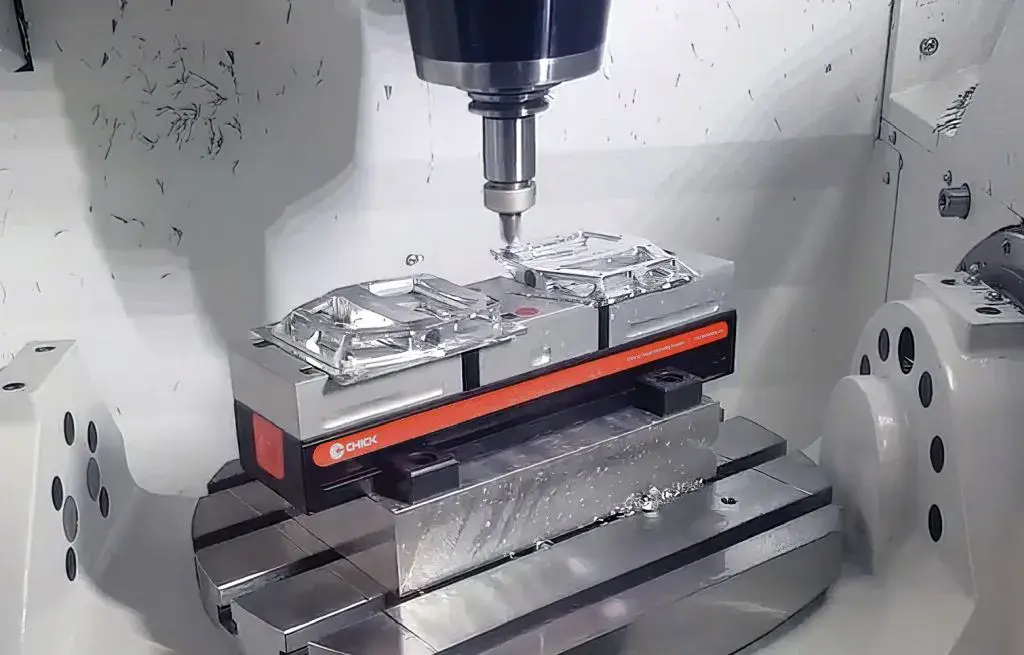
Fixturing for 5-axis CNC machining is the practice of holding a part so the machine can reach five of its six sides in a single setup while the table and spindle tilt and rotate around it. The job is harder than 3-axis workholding for one reason: the part and table are moving through space, so the fixture has to hold the work rigidly from one small footprint, stay out of the path of the spindle and cutter at every angle, and clear the machine table as it pivots. Get the fixture wrong and a capable 5-axis machine spends its time avoiding collisions instead of cutting.
The payoff for getting it right is large. Machining five sides in one setup removes the repositioning that introduces error and eats labor, and it keeps an expensive spindle cutting instead of waiting. This guide breaks down the specific challenges of 5-axis fixturing, the solution toolkit that answers each one, the design principles, and how to choose an approach for your parts. It builds on our broader guide to CNC workholding, so start there if you want the full workholding picture first.
Why 5-Axis Fixturing Is a Different Problem
On a 3-axis machine the tool comes from essentially one direction, so the fixture mostly has to resist side and downward loads and stay below the part. You can hold work in a standard vise and clamp it on top, because the top is the only place the tool is not.
On a 5-axis machine the part rotates and tilts so the spindle can approach from many angles. Now the top, the sides, and the area around the part all need to stay clear, and the fixture has to grip from the smallest possible footprint while still holding the part rigidly against aggressive cutting. Applying 3-axis thinking here is the most common mistake. A tall vise that worked fine on a vertical machining center can block the spindle, collide with the trunnion, or run out of clearance the moment the table tilts.
The mindset shift is to design around access first, then holding. The fixture serves the toolpath, not the other way around.
The Goal: Five Sides in One Setup
The reason shops buy 5-axis machines is to cut a complex part in fewer setups. Every time a part comes out of a fixture and goes back in, two things happen: a small relocation error creeps into the feature-to-feature accuracy, and the spindle sits idle while an operator works. Doing five sides in one setup attacks both.
- Accuracy. Features machined in one setup share the same datum, so they line up far better than features split across multiple setups.
- Spindle utilization. Fewer setups mean more hours of actual cutting per shift, which is where the return on a 5-axis machine comes from.
- Labor. One load and unload instead of several, with less skilled fixturing time per part.
This is why so much 5-axis fixturing is built to expose five of the six faces of a blank at once. The sixth face is whatever the fixture grips.
The Core Challenges of 5-Axis Fixturing
Five problems show up on nearly every 5-axis setup. The right fixture is the one that solves all five at once.
Clearance and interference. As the table pivots, the fixture and part must clear the table, the spindle housing, and the tool. Small parts gather toward the center of the table where interference is worst. This is the single most cited challenge in 5-axis work.
Tool access from many angles. The fixture has to be compact enough that the spindle can reach the part from the angles the program needs. A bulky workholder limits the machine’s range of motion and forces compromises in the toolpath.
Rigidity and height. The part is often lifted off the table to get it into the work envelope, but height reduces rigidity and invites chatter and tool deflection. The fixture has to be tall enough for access and rigid enough to resist cutting forces at the same time.
Clamping force versus part deformation. The grip has to be strong enough to stop movement and chatter under multi-directional cutting, but not so strong that it distorts a thin or delicate feature. Balancing those is harder when the fixture grips from a small area.
Repeatability for multi-operation jobs. When a part needs more than one setup, or runs across multiple machines, the fixture has to let the part be removed and relocated to the same position so the features still line up.
The 5-Axis Fixturing Solution Toolkit
Each of the following answers one or more of those challenges. Most real setups combine two or three.
Dovetail Fixtures
A dovetail fixture grips a small pre-machined dovetail form on the bottom of the blank, often just an eighth of an inch of stock, and pulls it down onto a solid seat. Because the grip lives entirely in that thin bottom section, five of the six sides stay fully exposed to the cutter. The tradeoff is a first operation to machine the dovetail, which is usually worth it for the access it unlocks. Dovetail fixtures have become a backbone of production 5-axis work for exactly this reason.
Solves: maximum tool access to five sides from a minimal footprint.
Riser Blocks and Pedestal Columns
Risers and pedestal columns lift the part up off the table and into the center of the work envelope, away from the table surface so the spindle can tilt without hitting anything. They are often paired with a dovetail fixture or a compact vise on top.
Solves: clearance from the table during tilt, and getting the part into reach.
Low-Profile and Self-Centering Vises
Compact 5-axis vises grip a part with a low, narrow body that stays out of the spindle’s way. Self-centering versions locate the part on its centerline, which helps repeatability. Many can be fitted with dovetail or step jaws to combine vise convenience with dovetail access.
Solves: familiar vise workflow without the bulk and interference of a standard vise.
Zero-Point and Quick-Change Systems
A zero-point system uses a standardized base with reference receivers that accept pull studs on the bottom of a fixture or pallet. The fixture drops in and locks to a known position in seconds, repeatable to within microns. Parts and fixtures swap without re-indicating, which is what makes fast multi-operation and automated work possible.
Solves: repeatability across setups and machines, and fast changeover.
Tombstones and Multi-Part Fixtures
A tombstone is a multi-sided block, usually on a 4th or 5th axis, that holds many parts at once. Multi-part fixtures array several blanks so the machine cuts them in one cycle. Both reduce changeover frequency, which pushes spindle utilization up.
Solves: more parts per setup and fewer changeovers for higher throughput.
Modular Fixturing
Reconfigurable bases, locators, and clamps that build into a custom 5-axis layout and come apart for the next job. Modular gives most of the benefit of a dedicated fixture without the dedicated cost, and it suits a changing mix of parts. It does ask for more setup skill than a simple vise.
Solves: flexible custom holding for varied parts and uncertain volumes.
Dedicated Custom Fixtures
Purpose-built tooling designed around one part and one set of operations, optimized for access, rigidity, and fast loading. For high-volume or geometrically difficult parts, a dedicated 5-axis fixture delivers the best cycle time and repeatability. This is the category we design and build through our custom jig and fixture design services.
Solves: the best access, rigidity, and cycle time for a specific high-value part.
Comparison of 5-Axis Fixturing Approaches
| Approach | Main strength | Tool access | Repeatability | Best volume |
| Dovetail fixture | Exposes 5 sides from a tiny grip | Excellent | Good | Medium to high |
| Riser / pedestal | Clearance and reach | Good | Good | Any |
| Low-profile vise | Familiar, compact | Good | Good | Low to medium |
| Zero-point / quick-change | Fast, repeatable relocation | Depends on top tooling | Excellent | Medium to high |
| Tombstone / multi-part | Many parts per setup | Good | Good | High |
| Modular | Flexible custom layouts | Good | Good | Low to medium |
| Dedicated fixture | Best access and cycle time | Excellent | Excellent | High |
Design Principles for 5-Axis Fixtures
The locating fundamentals carry over from all workholding, so locate to the 3-2-1 principle and foolproof the load. On top of that, 5-axis adds its own rules.
Grip the smallest necessary area. The less the fixture covers, the more sides the tool reaches. A dovetail on a thin bottom section is the clearest expression of this idea.
Map the clearance envelope before you build. Simulate the full range of table tilt and spindle approach in CAM and confirm nothing collides. Clearance is designed in, not discovered on the machine.
Make it compact and rigid at the same time. Lift the part only as high as access requires, and build the support stout enough to resist cutting forces at that height. Height and rigidity pull against each other, and the fixture has to win both.
Balance clamping force against the part. Apply enough grip to stop chatter, placed so it does not distort thin walls or delicate features.
Design for relocation when the job needs it. If the part will see more than one setup, build in a zero-point or hard-located reference so it returns to the same position every time.
For the full design workflow these rules sit inside, see our guide to designing jigs and fixtures, and for the operation-level fixture taxonomy, our milling fixtures guide.
Choosing a 5-Axis Fixturing Approach
The right approach depends on the part, the volume, and your team.
| If your priority is… | Consider | Why |
| Maximum access to 5 sides | Dovetail fixture on a riser | Tiny grip, full exposure |
| Fast changeover across many jobs | Zero-point / quick-change | Repeatable swap in seconds |
| Highest throughput on one part | Tombstone or multi-part fixture | More parts per cycle |
| Flexibility on a changing mix | Modular fixturing | Reconfigures per job |
| Best cycle time on a high-value part | Dedicated custom fixture | Built around the part |
| Simplicity and low cost | Low-profile vise | Easy to implement |
Operator skill matters too. A simple vise is easy to deploy, while modular and dedicated systems reward a team that can set them up well. The best fixture is the one your shop can run reliably, not the most sophisticated one on paper.
A Worked Example: One Setup on a Small Part
A shop needs to machine a small aerospace bracket on all sides to tight feature-to-feature tolerance. In a 3-axis flow, the part would take three or four setups, each adding relocation error and idle time.
In a 5-axis flow, the operator first machines a shallow dovetail on the bottom of the blank. The blank then mounts in a dovetail fixture on a riser block, lifting it into the work envelope and exposing five faces. The machine cuts all five sides in one program, every feature referenced to the same datum, while the spindle stays cutting instead of waiting for setups. A final light operation removes the dovetail stub. The part comes out with better accuracy, in less time, with fewer chances for human error. That is the entire case for 5-axis fixturing in one job, and it is why so much aerospace and medical work runs this way.
Build vs Buy and the Productivity Payoff
Dovetail fixtures, low-profile vises, risers, and zero-point systems are bought as standard equipment and cover a wide range of work. The investment decision is about dedicated, part-specific fixtures, and on 5-axis machines the math is often more favorable than on 3-axis, because the savings stack.
Setups eliminated. Each setup removed cuts both labor and relocation error across every part in the run.
Spindle utilization. Fewer changeovers keep an expensive machine cutting, and on a 5-axis center that machine time is valuable.
Accuracy and scrap. Single-setup machining tightens feature-to-feature accuracy and cuts the scrap that comes from stacked setup errors.
The rule we use: high-value, complex, or high-volume 5-axis parts usually justify a dedicated or dovetail-based fixture quickly, because the spindle hours and accuracy gains pay it back. Simpler or low-volume parts run well on standard 5-axis vises and risers. When you are between the two, a zero-point system plus modular elements is the flexible middle path.
If you are running complex parts on a 5-axis machine and fighting setups, clearance, or accuracy, our team designs 5-axis fixturing built around your part and your machine. You can see the multi-axis capability on our CNC milling page, and you can send us your part files for a quote.
Frequently Asked Questions
Why is fixturing harder for 5-axis machining? Because the part and table rotate and tilt, the fixture must hold the work rigidly from a small footprint while staying clear of the spindle, tool, and table at every angle. A standard vise that works on a 3-axis machine often blocks access or collides on a 5-axis machine.
What is a dovetail fixture? A dovetail fixture grips a small pre-machined dovetail form on the bottom of the blank, usually a thin section of stock, and pulls it down onto a seat. Because the grip is confined to that bottom area, five of the six sides stay exposed to the cutter, which is ideal for single-setup 5-axis work.
How do you machine five sides in one setup? You hold the part from a minimal footprint, often a dovetail on a riser block, so the spindle can reach the top and all four sides. The five exposed faces are machined in one program referenced to a single datum, and a final light cut removes the gripping stub.
What is a zero-point workholding system? A zero-point system is a standardized base with reference receivers that accept pull studs on a fixture or pallet, locking it into a known position within microns in seconds. It allows fast, repeatable changeover and relocation across setups and machines.
What are the biggest challenges in 5-axis workholding? Clearance and interference as the table tilts, tool access from multiple angles, balancing fixture height against rigidity, applying enough clamping force without deforming the part, and repeatable relocation for multi-operation jobs.
Should I buy standard 5-axis workholding or have a custom fixture built? Standard dovetail fixtures, low-profile vises, and risers cover much of 5-axis work. A dedicated custom fixture pays off for high-value, complex, or high-volume parts where the saved setups, spindle time, and accuracy justify the upfront cost.
Getting 5-Axis Fixturing Right on Your Parts
Good 5-axis fixturing is the difference between a machine that cuts five sides in one accurate setup and one that spends its time dodging collisions. Design around access first, grip from the smallest rigid footprint, map the clearance envelope before you build, and balance clamping force against the part. Match the approach to your part, your volume, and your team.
If complex parts are costing you setups, clearance headaches, or feature-to-feature accuracy on a 5-axis machine, that is the signal a purpose-built fixture will earn its keep. Send us your part files for a quote and our engineering team will design the 5-axis fixturing approach that fits your part and your machine.




 English
  French
  Spanish
  Japanese
  German
  Portuguese