Ask a machinist what slows a job down and you’ll rarely hear “the machine.” You’ll hear about setups. Clamping, indicating, re-clamping, checking, doing it all again on part two. Jigs and fixtures exist to kill that loop. They hold the work in the same place every time, so the machine can focus on cutting. This guide covers how they differ, the main types, what good design looks like and how to tell when a custom build is worth paying for.
The Difference Between Jig and Fixture in Plain Terms
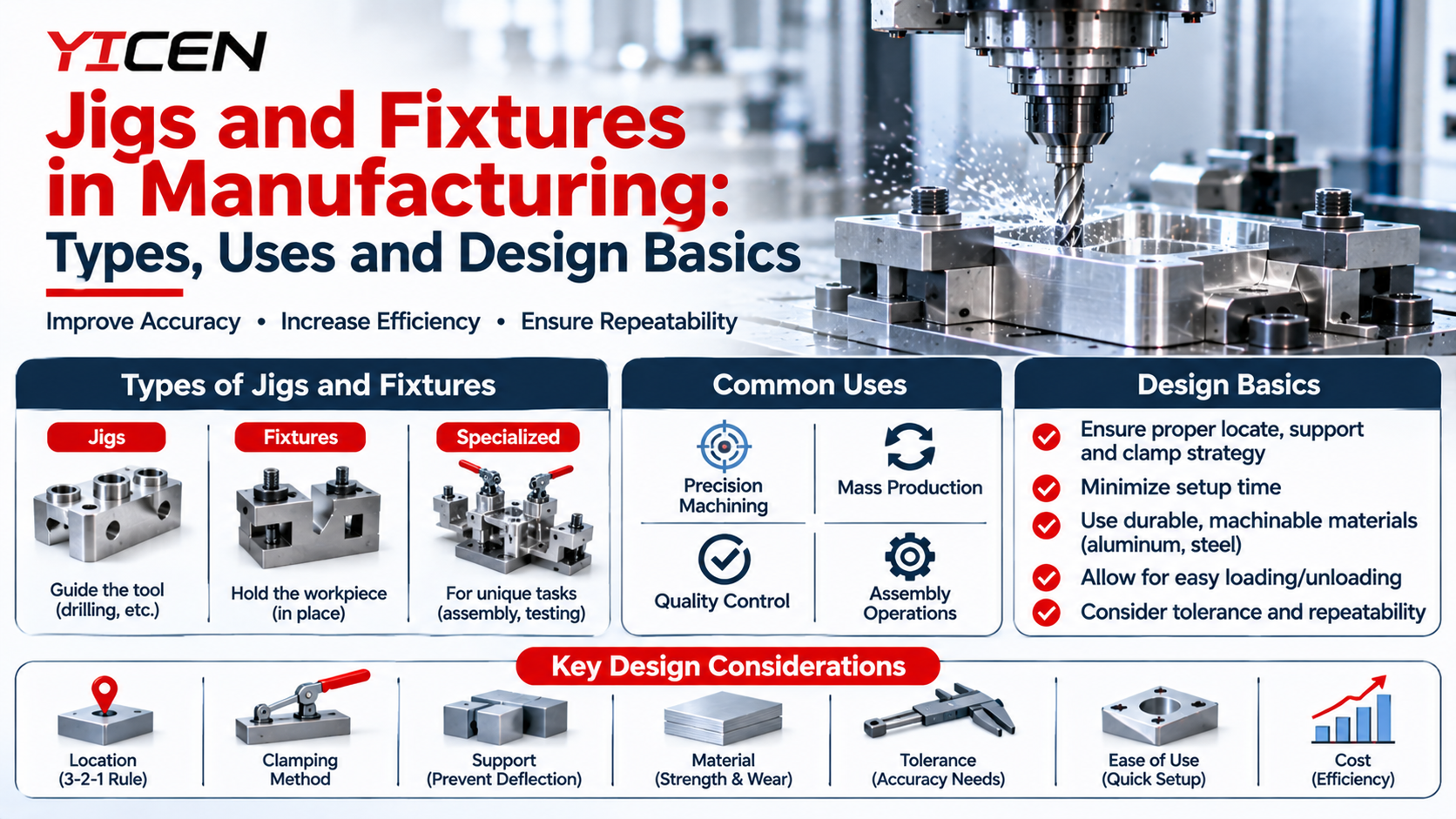
People mix these two up constantly, and honestly, shops do too. The simple version: a jig guides the tool, and a fixture holds the part.
A drill jig is the classic example. It clamps the workpiece and carries hardened bushings that steer the drill to the exact spot. The tool is guided. A milling fixture works differently. It locates and clamps the part, but the cutter’s path comes from the machine’s program, not from the fixture itself.
That’s the whole difference between jig and fixture in one paragraph. In practice, plenty of tools do a bit of both, and nobody on the floor cares what you call them as long as the parts come out right. What matters is the job each one does: locate, support, clamp, and sometimes guide.
Common Types of Fixtures You’ll See on a Shop Floor
There’s no single official list, but most fixtures fall into a few families. Knowing the main types of fixtures helps you pick the right starting point.
- Plate fixtures. A flat base with locators and clamps. Cheap, fast to build and great for simple parts.
- Angle plate fixtures. They hold the work at ninety degrees, handy when a feature has to be cut square to a datum face.
- Vise-jaw fixtures. Custom soft jaws that wrap around an awkward shape. Very common in production milling.
- Indexing fixtures. They rotate the part to set positions, so one clamping covers several faces.
- Modular fixtures. Built from reusable grid plates and standard parts. Good for short runs and changing designs.
- Tombstones and multi-part fixtures. They carry many parts at once, which keeps the spindle cutting instead of waiting.
- Vacuum and magnetic fixtures. These suit thin or flat parts that clamps would bend.
Welding, assembly and inspection fixtures follow the same logic. They locate the parts so the process stays repeatable.
CNC Fixture Design: Where the Real Accuracy Comes From
A machine can hold a tolerance of a few microns and still make bad parts if the workholding moves. Good CNC fixture design starts with how the part sits, not with how pretty the fixture looks.
Designers usually work from a few basics:
- Locate first, clamp second. Locators set the position. Clamps only keep the part there. If clamps are doing the locating, something’s off.
- Respect the 3-2-1 idea. Three points define a base plane, two define a side, one stops the part from sliding. It’s old advice and it still works.
- Clamp where the part is strong. Push against a thin wall and you’ll distort it, then measure a part that “springs back” out of tolerance.
- Keep the cutter’s path clear. A fixture that collides with the tool isn’t a fixture, it’s a scrapped plate.
- Plan for chips and coolant. Pockets that trap chips cause scratches and surprise errors.
- Make loading easy and mistake-proof. If a part can go in backwards, eventually it will.
Material and weight matter too. Aluminum plates are quick to machine and easy to handle. Steel adds rigidity for heavy cuts. Hardened locators last longer where parts load and unload thousands of times.
Where Jigs and Fixtures Pay Off Fastest
The gains show up in four places. First, accuracy: every part sits in the same position, so dimensions stay consistent from the first piece to the five-hundredth. Second, speed: loading takes seconds instead of minutes, and operators don’t spend time indicating in each part. Third, safety: a part that’s clamped properly doesn’t move when the cutter hits it. Fourth, skill: a good fixture lets a newer operator produce the same quality as a veteran.
Better fixturing also supports aggressive cutting. When you trust the hold, you can push feeds and depth, and cycle times drop. That’s why high-volume Fresagem CNC runs lean so heavily on well-built workholding.
When a Custom Build Beats an Off-the-Shelf Setup
Standard vises and clamps handle a lot. Eventually you hit a part they can’t hold well. Odd shapes, thin walls, tight position tolerances and long production runs all push toward a custom solution.
Here’s a rough way to decide. If you’re making one or two parts, simple clamping and careful setup usually win. If you’re running a few hundred pieces, a modular or semi-custom setup often pays back fast. If you’re running thousands, or the part is difficult and scrap is expensive, a dedicated fixture almost always earns its keep. Work out the cost of setup time, rejects and operator hours across the full run, then compare it to the fixture price.
A dedicated builder helps here, since a fixture designed around the part and the machine tends to cost less than one fixed after the first failed batch. If you’d like a second opinion, our team handles Conceção de gabaritos e dispositivos de fixação personalizados for parts from simple brackets to complex multi-face components.
Industries That Lean on Fixturing
Almost every sector that makes repeatable parts depends on workholding. Aerospace uses it for tight tolerances on high-value parts. Medical manufacturing uses it for consistency and traceability. In the indústria da automação, fixtures also show up inside the machines themselves, holding, aligning and positioning parts in assembly and inspection stations. Automotive and electronics shops use them to keep large batches uniform.
Planning Your Next Project
Before you order a fixture, gather a few things: the part drawing, the material, the expected quantity, the machine you’ll run it on and the tightest tolerance on the print. With those five items, a designer can usually suggest a workable approach quickly.
If you want to know who’ll be building it, here’s more Sobre a nossa empresa and how we work. And if you’d like more practical tips on workholding and machining, browse our blog.
Ready to cut setup time and scrap on your next run? Send us your part drawing and quantity, and contact our team for honest advice on jigs and fixtures that fit your process. We’ll review it for manufacturability and reply with a clear recommendation and quote.
Perguntas mais frequentes
Qual é a diferença entre um gabarito e um dispositivo de fixação?
A jig holds the part and guides the cutting tool, like a drill bushing plate. A fixture holds and locates the part, while the machine’s program controls the tool path. Many real tools combine both roles.
How do fixtures improve CNC machining accuracy?
They place every part in exactly the same position and keep it from shifting under cutting forces. That removes the small setup errors that add up from part to part. The result is steadier dimensions across the whole run.
When is a custom fixture worth the cost?
When the run is large, the part is awkward or scrap is expensive. Add up setup time, rejects and operator hours, then compare the total to the fixture price. For long runs, the fixture usually pays for itself.
What materials are used to make fixtures?
Aluminum is popular for plates because it’s light and quick to machine. Steel adds rigidity for heavy cuts, and hardened tool steel suits locators that see constant wear. Plastics and composites work for light-duty or protective contact surfaces.
Can jigs and fixtures be reused for different parts?
Modular systems can, since you rebuild them from standard plates and components. Dedicated fixtures usually serve one part or a small family of similar parts. Reuse saves money on short runs but can limit precision on demanding parts.