 Zum Inhalt springen
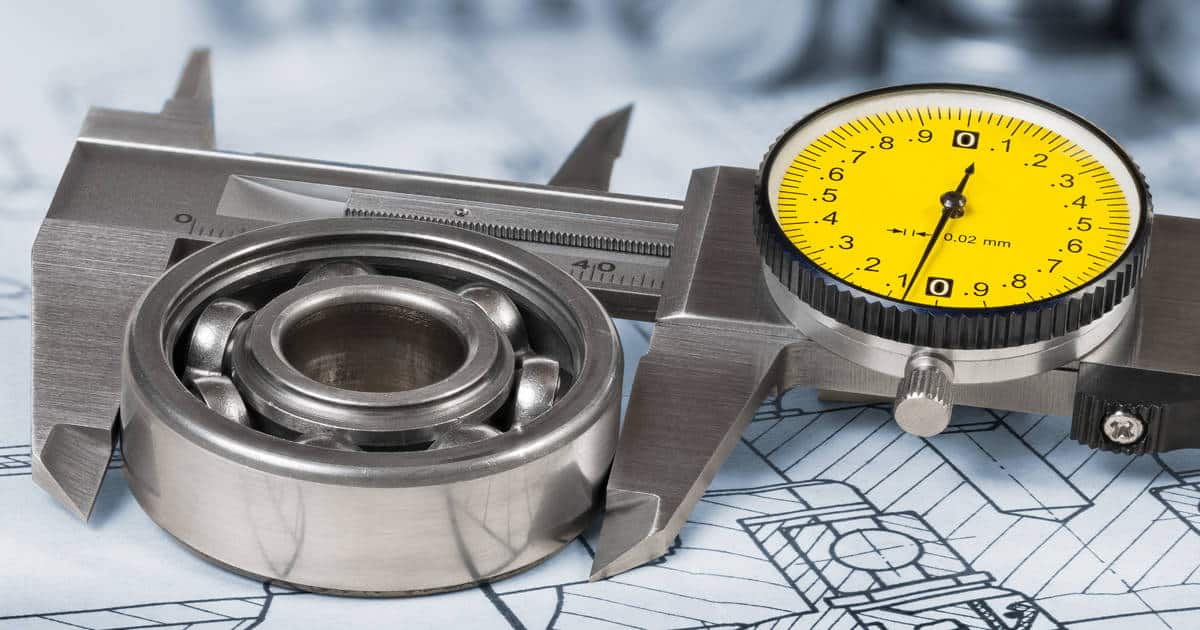
Bearing fit tolerance is the controlled interference or clearance between a bearing’s inner or outer ring and its mating shaft or housing bore. Get it wrong too loose and the bearing spins in its seat, fretting the housing and generating debris that destroys the rolling elements. Too tight and the bearing preloads internally, runs hot, and fails early. This guide covers ISO fit classes, when to use interference versus clearance fits, how to call out tolerances on your machining drawing, and the most common fit specification mistakes that show up in design review.
Bearing selection gets the attention. Bearing fit tolerance gets ignored until something fails.
The bearing manufacturer’s load ratings assume the bearing is correctly installed which means the inner ring is supported uniformly by the shaft and the outer ring is supported uniformly by the housing. Both assumptions require correct fit tolerance. An interference fit that’s 0.01 mm too loose on a shaft rotating under load allows the ring to micro-slip. That micro-slip generates fretting corrosion, produces iron oxide debris, and initiates fatigue at the raceway all while the bearing’s load rating remains unaffected on paper.
The fit tolerance that prevents this is not complicated to specify. What’s complicated is that it interacts with shaft material, housing material, operating temperature, load direction, rotational speed, and installation method in ways that generic guidelines don’t fully capture. This guide gives you the systematic approach.
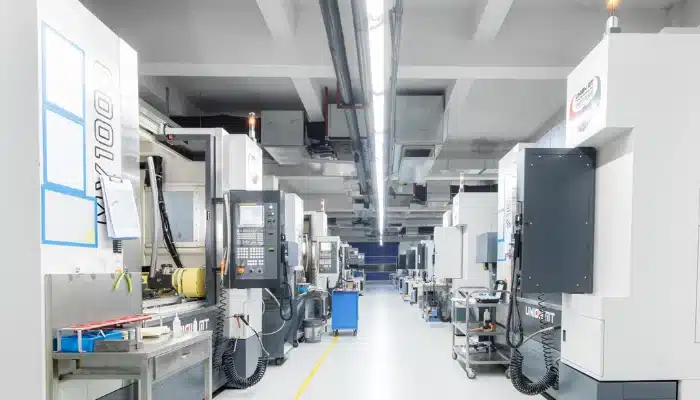
Unter Yicen Präzision, bearing bores and shaft journals are regularly held to IT5 and IT6 tolerances — the range where most bearing fit specifications live. What follows is the technical framework for specifying them correctly.
Understanding Bearing Fit: What the Numbers Mean
ISO Tolerance System Basics
Bearing fits are specified using the ISO 286 tolerance system, which defines the position and size of a tolerance zone using a letter (position relative to nominal) and a number (tolerance grade, or IT grade).
For shafts, lowercase letters are used: k, m, n for interference fits; h for a sliding fit; g, f, e for clearance fits. For housing bores, uppercase letters: K, M, N for interference fits; H for neutral; G, F, E for clearance fits.
The IT grade number defines the total tolerance range. IT5 allows less variation than IT6, which allows less than IT7. For bearing seats:
- IT5 is used for high-precision applications (machine tool spindles, precision instruments)
- IT6 is the standard for most industrial applications
- IT7 is used for light-duty or non-critical bearing locations
Combining these: a shaft specification of k6 means an interference fit (k) with IT6 tolerance grade. A housing specification of H7 means a neutral-to-clearance fit (H) with IT7 tolerance grade. The actual interference or clearance produced depends on the nominal bore size and the specific tolerance values from the ISO 286 tables.
When to Use Interference Fits vs. Clearance Fits
Which Bearing Ring Rotates Relative to the Load?
This is the governing question. The rule is straightforward: the ring that rotates relative to the load direction must have an interference fit. The ring that is stationary relative to the load may use a clearance fit or light interference.
In a typical electric motor shaft application, the shaft rotates and the housing is stationary. The load on the bearing (from belt tension, gear force, or gravity) is fixed in space — it always points in the same direction regardless of shaft rotation. So the inner ring rotates relative to the load, and the outer ring is stationary relative to the load.
Result: inner ring needs interference fit (k6 or m6 on the shaft). Outer ring can use a looser fit (H6 or H7 in the housing).
If the load rotates with the shaft — as in a wheel hub where the hub rotates and the shaft is stationary — the logic inverts: outer ring gets the interference fit in the rotating hub bore, inner ring uses a lighter fit on the stationary shaft.
Getting this wrong is one of the most common bearing fit specification errors. An inner ring with a clearance fit on a rotating load application will spin in place within months.
Standard Fit Recommendations by Application
Normal radial loads, shaft rotating:
- Shaft: k6 (light interference) for d < 100 mm; m6 for d 100–140 mm
- Housing: H7 (clearance to neutral)
- Typical interference produced: +5 to +20 µm on shaft
Heavy or shock radial loads, shaft rotating:
- Shaft: n6 or p6 (medium to heavy interference)
- Housing: H6 (tighter housing tolerance than standard)
- Typical interference: +15 to +40 µm on shaft
Axial loads only (thrust bearings):
- Both rings can use loose fits — the load is transmitted through the ring faces, not the bore contact
- Shaft: j6 or h6
- Housing: H7 or G7
Rotating outer ring (wheel hub applications):
- Housing bore: N7 or M7 (interference in the rotating member)
- Shaft: h6 or g6 (sliding fit on stationary member)
Precision machine tool spindles:
- Shaft: j5 or k5 (IT5 grade, tighter tolerance band)
- Housing: H5 or J5
- Requires IT5 or better on machined features — achievable with precision grinding or fine boring, not standard turning
How Thermal Expansion Changes Your Fit Calculation
Room-temperature interference fit calculations are a starting point, not an endpoint. Operating temperature changes the interference.
Steel shafts and steel bearings have similar thermal expansion coefficients (approximately 12 µm/m°C). A steel bearing on a steel shaft in a steel housing doesn’t change fit dramatically with temperature.
Aluminum housings are the problem. Aluminum expands at roughly 23 µm/m°C — nearly double steel’s rate. An interference fit specified at 20°C for an aluminum housing can become a clearance fit at 80°C operating temperature.
The calculation: for a 62 mm housing bore in aluminum with a steel outer ring, a 60°C temperature rise produces approximately: 62 mm × (23 − 12) µm/m°C × 60°C = 40.9 µm of additional clearance. A fit that was 15 µm interference at room temperature becomes 26 µm clearance at operating temperature. The outer ring is now spinning.
For aluminum housings, tighten the initial interference by the thermal expansion differential at maximum operating temperature. Or specify a steel sleeve insert in the housing bore, which eliminates the aluminum expansion problem at the bearing seat.
Calling Out Bearing Tolerances on a Machining Drawing
The tolerance call-out on your drawing determines what your machining supplier produces. Vague call-outs produce correct-looking parts that fail fit checks at assembly.
Shaft journal: Specify the nominal shaft diameter, the tolerance designation (e.g., φ25 k6), and the explicit upper and lower deviation values in parentheses for clarity. For φ25 k6, the deviations are +15/+2 µm, meaning the finished shaft must measure between 25.002 and 25.015 mm. The feature should carry a cylindricity tolerance (not just roundness) of half the IT grade value or better.
Housing bore: Specify the nominal bore, tolerance designation (e.g., φ52 H7), and explicit deviations. For φ52 H7, the deviations are 0/+30 µm, meaning the bore must measure between 52.000 and 52.030 mm. Specify cylindricity and perpendicularity of the bore axis to the shaft centerline.
Surface finish: Bearing seats require Ra 0.8 µm or better. Coarser surfaces reduce the effective interference — surface peaks crush during installation, and the effective bearing contact is less than the nominal interference. For precision applications, Ra 0.4 µm is standard on ground shaft journals.
Unter Yicen Präzision, bearing journals and housing bores are regularly produced to IT5 and IT6 with surface finish to Ra 0.8 µm. CMM verification is standard before shipping.
Installation Method and Its Effect on the Fit You Need
How a bearing is installed affects what initial interference you need to specify.
Cold pressing (mechanical press at room temperature) is the most common installation method. Maximum press force is approximately: F = µ × p × π × d × B, where µ is the friction coefficient, p is the interface pressure from interference, d is the bore diameter, and B is the bearing width. For a k6 fit on a 40 mm shaft, press force is typically 10–30 kN. Exceeding this damages the rolling elements — never press a bearing by applying force through the rolling elements.
Thermal installation (heating the bearing to expand the bore for slip installation) is used for heavier interference fits and larger bearings. Heating to 80–100°C above ambient expands a 100 mm bore by approximately 120–150 µm, providing clearance for slip installation even on p6 fits. Never exceed 120°C — this can affect the bearing’s dimensional stability and hardness.
Hydraulic mounting uses oil injection through a hydraulic fitting in the shaft to temporarily separate the surfaces during installation. Used for large tapered bore bearings — the 150 mm and above range where press and thermal methods become impractical.
Specifying the installation method in your design documentation changes what interference is practical to specify. A p6 fit that requires hydraulic mounting on a shaft that your assembly team plans to press cold is a design error.
Schlussfolgerung
Bearing fit tolerance is not a detail. It’s a primary failure mode that gets misattributed to bearing quality, lubrication, or load calculations when the root cause is a bore or shaft that was machined to the wrong tolerance class.
Specify fits based on load direction and rotation. Correct for thermal expansion if your housing is aluminum or your operating temperature is significantly above ambient. Call out tolerances explicitly on the machining drawing — not just the ISO designation but the actual deviation values. And specify surface finish: Ra 0.8 µm is not optional on bearing seats.
Request a quote from Yicen Precision for bearing housing bores and shaft journals machined to IT5 and IT6 with CMM verification.
Häufig gestellte Fragen
What is the standard tolerance for a bearing housing bore?
For most industrial applications with a rotating shaft and stationary housing, the housing bore is specified as H7 — a tolerance zone that spans from nominal (H = zero lower deviation) to nominal plus the IT7 tolerance value. For a 52 mm housing bore, H7 specifies a bore diameter between 52.000 and 52.030 mm. Tighter applications use H6; precision machine tool spindles may use H5 or better, which requires grinding rather than boring.
What happens if a bearing fit is too loose?
A bearing ring that is too loose relative to its mating surface will micro-slip under load — the ring oscillates slightly in its seat during each load cycle. This generates fretting corrosion, produces iron oxide debris, and initiates fatigue cracking at the interface. The debris migrates into the rolling element path and accelerates raceway wear. The failure appears as bearing surface damage but traces to the fit specification. Standard diagnosis: fretting marks (reddish-brown oxide) on the shaft journal or housing bore surface.
How do I account for thermal expansion in aluminum housings?
Calculate the differential thermal expansion between aluminum and steel over your operating temperature range. Aluminum expands at 23 µm/m°C; steel at 12 µm/m°C. For each degree of temperature rise, the aluminum housing expands 11 µm/m more than the steel bearing outer ring. Multiply the bore diameter by 11 µm/m°C by the expected temperature rise to get the additional clearance generated at operating temperature. Add this value to your room-temperature interference specification to ensure adequate fit remains at operating temperature.
What surface finish is required on a bearing shaft journal?
Ra 0.8 µm is the standard requirement for bearing shaft journals in general industrial applications. Coarser surfaces reduce effective interference because surface peaks crush during installation, and the real contact is smaller than the nominal interference calculation assumed. For precision spindle applications, Ra 0.4 µm or better is standard, typically achieved by cylindrical grinding after turning. Turned surfaces without grinding typically achieve Ra 0.8–1.6 µm depending on feed rate and tool condition.
Can I use the same fit specification for both the inner and outer bearing rings?
No. The fit for each ring depends on whether it rotates relative to the load direction. The rotating ring (relative to load) requires interference; the stationary ring can use a lighter fit or clearance. In most electric motor and gearbox applications, the inner ring rotates with the shaft and needs interference, while the outer ring sits stationary in the housing and uses H7 or similar. Using interference for both rings is not wrong but increases installation difficulty and is unnecessary for the stationary ring.


 German
  English
  French
  Spanish
  Japanese
  Portuguese