Zum Inhalt springen
Why Jigs and Fixtures Matter in Modern Manufacturing
In modern manufacturing, precision and repeatability are crucial for achieving high-quality products in large volumes. Jigs und fixtures are essential tools that contribute significantly to this goal by ensuring accuracy und consistency throughout the production process. They help secure the workpiece and guide the cutting tool, reducing errors and improving productivity. These tools are critical in processes like Bohren, milling, weldingund assembly, where even minor inaccuracies can result in costly defects.
How They Improve Accuracy, Repeatability, and Cycle Time
Jigs and fixtures enable high precision in production by securely holding workpieces in the correct position during machining. They improve repeatability, ensuring that every part is manufactured to the same specifications. By reducing the need for frequent adjustments, they also enhance cycle time, allowing machines to run continuously without interruption. This leads to faster production rates, particularly in mass production environments.
When Each Type is Used (Manual, CNC, Mass Production, Assembly, Welding)
Jigs and fixtures are used in various manufacturing environments:
- Manual operations: Simpler jigs and fixtures help operators perform tasks with precision without relying on complex machinery.
- CNC operations: Fixtures are designed to secure workpieces while CNC-Maschinen execute automated tasks with high precision.
- Mass production: Both jigs and fixtures are crucial in high-volume environments to ensure the fast, accurate, and consistent production of identical parts.
- Montage: Fixtures hold components in place during assembly processes, ensuring proper alignment.
- Welding: Specialized welding fixtures prevent distortion and ensure parts are correctly positioned during welding operations.
What Are Jigs?
Definition + Purpose
A jig is a custom-made tool designed to guide the movement of a cutting tool during machining operations. Unlike fixtures, which only hold the workpiece in place, jigs actively control the positioning of both the workpiece and the cutting tool. This guidance ensures that operations like Bohren, reamingund tapping are performed with high accuracy and repeatability.
How Jigs Guide Tools During Machining (Drilling, Reaming, Tapping)
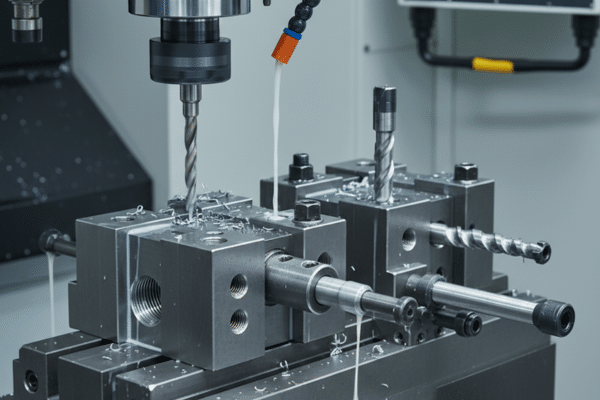
Jigs are commonly used in Bohren, reamingund tapping operations. They typically consist of a guide bushing oder template that directs the cutting tool to the correct position on the workpiece. For example, in drilling operations, a jig may have predefined holes or bushings that align the drill bit to create holes in the same exact spot on every part.
Types of Jigs
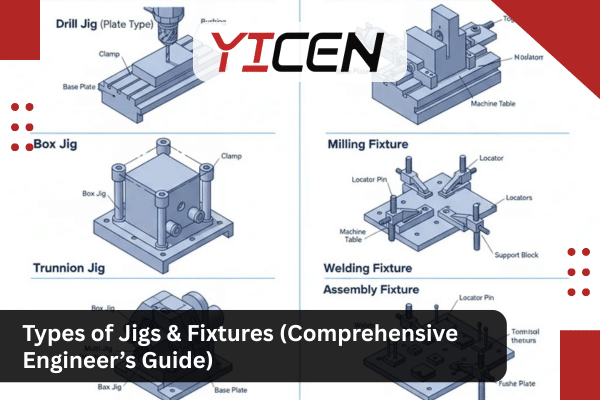
1. Template Jig
A template jig is the simplest type of jig, typically a flat plate with pre-drilled holes. It serves as a template to guide the cutting tool, making it ideal for simple Bohren tasks.
2. Plate Jig
A plate jig features a flat plate with additional support, such as guide bushings, to provide more precision than a template jig. It is commonly used for tasks requiring higher accuracy.
3. Channel Jig
A channel jig has a channel-like design that secures the workpiece in place. The tool is guided through a drill bushing as it moves along the channel. This type of jig is especially useful for long, narrow parts.
4. Leaf Jig
A leaf jig features a hinged cover that allows easy loading and unloading of workpieces. The leaf may include guide bushings to direct the tool, and it’s particularly effective for high-volume tasks requiring rapid part exchange.
5. Box Jig
A box jig surrounds the workpiece on all sides, allowing tools to access the workpiece from multiple angles. This makes it ideal for multi-face machining operations where the workpiece must be accessed from various directions.
6. Sandwich Jig
A sandwich jig is designed for parts that need to be clamped between two plates, allowing for multi-stage operations wie Bohren and tapping in one setup. This type of jig is commonly used in mass production environments.
7. Angle-Plate Jig
An angle-plate jig holds the workpiece at an angle, allowing for the machining of diagonal or angled holes. This type of jig is used in operations like Bohren at an angle oder milling komplexe Geometrien.
8. Indexing Jig
An indexing jig is equipped with a mechanism that allows the workpiece to be rotated to specific angles, ensuring precision in tasks that require multiple steps, like Bohren oder tapping at various positions.
9. Trunnion Jig
A trunnion jig uses a rotating base or trunnion to secure the workpiece at a fixed angle, commonly used for large components that require multi-axis machining.
10. Universal Jig
A universal jig is adjustable and designed to fit a variety of workpieces. It is often used in versatile production environments where different components are produced in low to medium volumes.
11. Multi-Station Jig
A multi-station jig allows for multiple machining operations to be performed on several workpieces simultaneously, increasing productivity in high-volume manufacturing.
What Are Fixtures?
Definition + How Fixtures Differ from Jigs
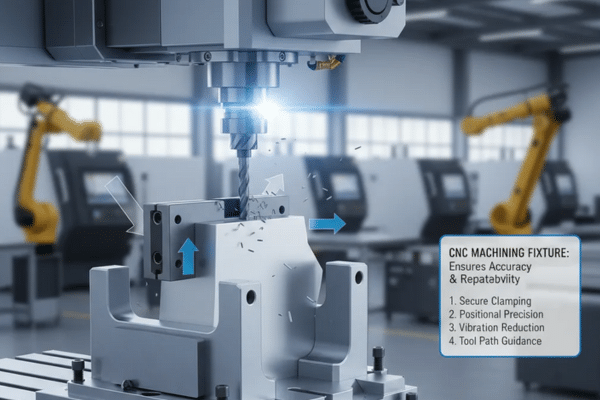
A fixture is a device used to hold and support a workpiece during machining, welding, assembly, or inspection. Unlike jigs, which guide the tool, fixtures only secure the workpiece in a fixed position, ensuring it remains stable during operations.
Role in CNC Machining, Welding, Assembly, Inspection
- CNC-Bearbeitung: Fixtures are essential in CNC-Maschinen to secure the workpiece while the machine performs automated operations.
- Welding: Fixtures ensure that parts are positioned correctly for welding, reducing distortion and improving weld quality.
- Montage: Fixtures hold components in place during assembly processes, improving accuracy and reducing operator error.
- Inspektion: Fixtures are used to hold parts during measurement und inspection, ensuring consistent results across all components.
Types of Fixtures
Machining Fixtures
Milling Fixtures
Milling fixtures are designed to hold a workpiece during milling operations. They secure the part in place to allow the milling machine to remove material efficiently.
Turning Fixtures
Turning fixtures are used on Drehbänke to hold workpieces in place during Dreharbeiten. They are crucial for irregularly shaped parts that require rotation around a central axis.
Grinding Fixtures
Grinding fixtures are used to hold workpieces during Schleifen operations. They provide stability and ensure that the grinding process is accurate, especially for cylindrical parts.
Drilling Fixtures
Drilling fixtures secure the workpiece during Bohren operations, ensuring accuracy in hole placement and reducing errors caused by part movement.
Boring Fixtures
Boring fixtures are used to hold workpieces during boring operations, providing the necessary support and alignment for precision.
Broaching Fixtures
Broaching fixtures are designed to hold workpieces during broaching operations, where keyways or holes are cut into the part with a broaching tool.
Tapping Fixtures
Tapping fixtures are used to secure workpieces during tapping operations, ensuring the part is held securely while internal threads are created.
Welding Fixtures
BIW Welding Fixtures
Body-in-White (BIW) welding fixtures are used in the automotive industry to hold car body parts in place during welding, ensuring dimensional accuracy and preventing distortion.
Fabrication Jigs
Fabrication jigs help position parts during the fabrication of metal structures, ensuring that they are aligned correctly before welding or other processes.
Assembly Fixtures
Assembly fixtures hold components in place during assembly, ensuring that parts fit together precisely, reducing the chances of errors during assembly.
Modular Fixtures
Modular fixtures are made from standardized elements that can be reconfigured for different parts and operations, making them highly versatile for low- to medium-volume production.
Inspection Fixtures
CMM (Coordinate Measuring Machine) inspection fixtures are used to hold parts in place during measurement operations, ensuring consistent results across all parts.
Attribute Gauges & Checking Fixtures
These fixtures help ensure parts meet quality standards by providing specific gauges and checks during the inspection process.
Workholding Fixtures
Vise Jaw Fixtures
Vise jaw fixtures secure workpieces during milling oder Bohren, allowing operators to hold the workpiece firmly while machining.
Collet Fixtures
Collet fixtures are used to secure cylindrical workpieces in place during Drehen oder milling operations, providing precision and stability.
Chucks
Chucks hold round workpieces during operations like Bohren oder milling, ensuring accurate machining and reducing errors.
Magnetic Fixtures
Magnetic fixtures use magnetic force to hold ferrous parts in place during machining, offering quick setup and easy repositioning.
Vacuum Fixtures
Vacuum fixtures hold workpieces in place using suction, commonly used for delicate parts oder thin materials in industries like electronics.
Special Purpose Fixtures
Multi-Station Fixtures
Multi-station fixtures allow multiple parts to be processed simultaneously, improving throughput in high-volume production environments.
Pallet Fixtures
Pallet fixtures are used to hold multiple workpieces on a pallet, allowing for automated loading/unloading in CNC machines.
Lifting / Transport Fixtures
These fixtures are used to lift and transport workpieces safely during production, ensuring they remain secure throughout the manufacturing process.
Tailstock Fixtures
Tailstock fixtures provide support for long, slender workpieces during operations such as Schleifen oder Drehen to prevent deflection.
Types of Locators in Jig & Fixture Design
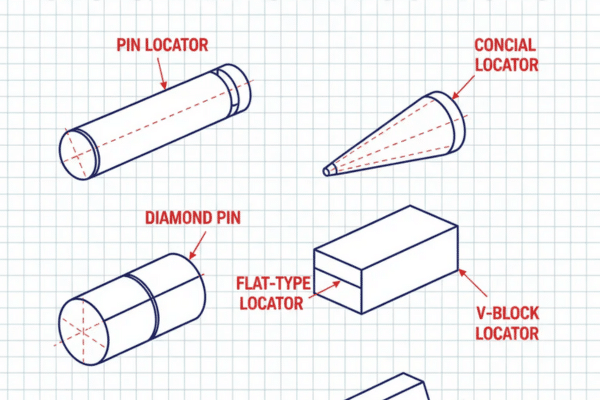
1. Flat Locators
Flat locators are commonly used in fixtures to ensure parts are placed at the correct height and orientation relative to the cutting tool.
2. Cylindrical Locators (Rest Buttons / Pins)
Cylindrical locators are used to support parts by making contact with flat surfaces or holes, ensuring proper positioning.
3. Diamond Pins
Diamond pins are used in fixtures to provide precise positioning für circular or irregular parts, ensuring alignment during operations.
4. Conical Locators
Conical locators are used in fixtures to ensure parts are correctly aligned by using conical-shaped features to guide the workpiece into position.
5. V-Locators
V-locators are used to hold cylindrical parts securely during machining, ensuring that they are positioned correctly for milling oder Drehen.
6. Adjustable Locators
Adjustable locators allow for flexibility in positioning and aligning workpieces with varying shapes and sizes.
7. Nesting Locators
Nesting locators are used to secure parts with complex shapes, ensuring they are placed securely in the fixture during machining.
8. Cam Locators
Cam locators use a cam mechanism to lock the workpiece into place, ensuring proper alignment and secure holding.
9. Blade / Edge Locators
Blade or edge locators are used to secure parts by contacting their edges, making them ideal for thin or flat parts.
3-2-1 Locating Principle
Die 3-2-1 locating principle is used to locate workpieces with three points of contact to control the part’s degree of freedom (DOF). This principle ensures the workpiece is positioned securely while allowing for efficient machining.
Types of Clamping Systems in Jigs & Fixtures
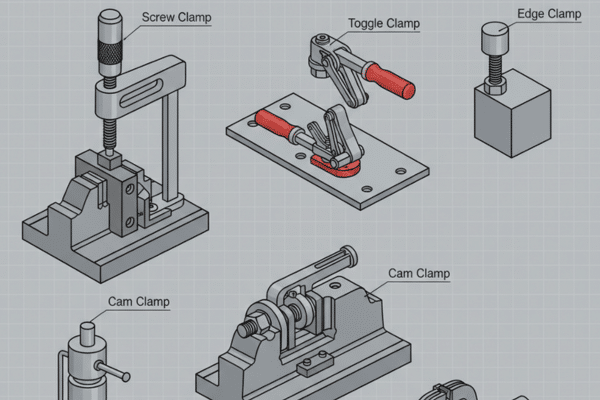
Manual Clamps (Toggle, Strap, Cam)
Manual clamps use mechanisms like toggle oder strap designs to secure workpieces, suitable for low-volume or manual operations.
Pneumatic Clamps
Pneumatic clamps use air pressure to apply clamping force, improving speed and consistency in clamping during high-volume operations.
Hydraulic Clamps
Hydraulic clamps provide significant force for heavy-duty clamping, offering precise and consistent clamping during machining operations.
Magnetic Clamps
Magnetic clamps provide a quick and adjustable means to secure ferrous materials using magnetic force, enhancing productivity during setup.
Vacuum Clamps
Vacuum clamps use suction to secure delicate or thin workpieces, commonly used in electronics und Präzisionsbearbeitung.
Power Clamping Units (Cylinders, Swing Clamps)
Power clamping units use cylinders oder swing clamps for high force clamping in automatisiert oder high-speed machining.
Components Used in Jigs & Fixtures
Locators
Locators ensure that parts are placed in the correct position and orientation, eliminating alignment errors.
Clamps
Clamps hold workpieces firmly in place during machining, preventing movement and ensuring precision.
Supports
Supports provide additional stability to workpieces, preventing deflection during machining operations.
Jig Bushings
Jig bushings guide tools accurately during operations like Bohren or reaming, reducing tool wear and improving precision.
Body / Base Plate
The base plate provides a rigid foundation for the fixture or jig, ensuring the workpiece is secured in the correct position.
Fasteners
Fasteners are used to attach the jig or fixture securely to the machine tool or workbench, ensuring stability during operations.
Applications of Different Jig & Fixture Types
Automotive Manufacturing (BIW, Machining, Welding)
Jigs and fixtures play a critical role in Automobilherstellung, particularly in Body-in-White (BIW) assembly, machiningund welding processes.
Aerospace Components
Jigs and fixtures ensure precision during the manufacturing of aerospace components, such as wings und fuselages, which require extremely tight tolerances.
CNC Toolrooms
Jigs and fixtures are used to secure workpieces in CNC toolrooms, where automated machinery performs precise machining tasks.
Mass Production & Assembly Lines
In mass production, jigs and fixtures streamline the manufacturing of identical parts, improving speed and consistency in high-volume production.
Tool & Die Industry
The tool and die industry relies on jigs and fixtures to ensure accurate shaping and forming of metal components, which are essential for creating molds and dies.
PDF Download — Types of Jigs & Fixtures
This downloadable PDF provides a concise reference for common jig and fixture types used in machining and manufacturing. It is intended as a quick guide for engineers, machinists, and production planners who need a clear overview without digging through long manuals. The document focuses on practical classification, typical use cases, and shop floor relevance rather than theory.
Summary Table
The summary table gives a compact comparison of major jig and fixture categories. It outlines their primary purpose, typical applications, and key advantages. This table is useful for fast decision making during process planning or quoting, especially when selecting between jigs, fixtures, or combined setups for a specific operation.
Locator Types Chart
The locator types chart visually explains common locating methods such as pin locators, rest pads, V blocks, and adjustable locators. It highlights how each locator controls degrees of freedom and why certain locator types are chosen for accuracy, repeatability, or ease of loading. This section helps clarify correct workpiece positioning principles used in real production.
Tooling Examples
This section shows practical tooling examples used in everyday manufacturing. It includes typical jig Bohren setups, milling fixtures, welding fixtures, and inspection fixtures. The focus is on how these tools are applied on the shop floor, what problems they solve, and where errors usually occur if tooling is poorly designed or selected.
Link to Downloadable PDF
A direct download link is provided for easy access to the complete PDF. The file is suitable for offline reference, internal training, or quick consultation during process planning, fixture design, or supplier discussions.
Schlussfolgerung
Choosing the right jig or fixture is vital for achieving Präzision, safetyund cost reduction in manufacturing processes. By selecting the appropriate tooling, engineers can standardize operations, improve repeatabilityund enhance productivity across various industries. Investing in the right jigs and fixtures will contribute significantly to long-term manufacturing success.
FAQs
1.What Are the Main Types of Jigs?
The main types of jigs include template jigs, plate jigs, channel jigs, leaf jigs, box jigs, sandwich jigs, angle-plate jigs, indexing jigs, trunnion jigs, universal jigs, and multi-station jigs. Each type is designed to suit specific tasks, from simple Bohren to complex multi-stage machining.
2.What Are the Main Types of Fixtures?
Fixtures are typically categorized as machining fixtures, welding fixtures, assembly fixtures, modular fixtures, inspection fixtures, workholding fixtures, and special-purpose fixtures. Each serves a distinct role in securing workpieces during various operations like milling, Drehen, Bohren, and welding.
3.How Many Types of Locators Are Used in Jigs and Fixtures?
There are several types of locators used in jig and fixture design, including flat locators, cylindrical locators, diamond pins, conical locators, V-locators, adjustable locators, nesting locators, cam locators, and blade/edge locators. These locators are designed to precisely position the workpiece and control its movement during machining.
4.Which Jig Is Used for Drilling?
Die template jig und plate jig are commonly used for drilling operations. They guide the cutting tool to ensure holes are drilled in the correct position on the workpiece.
5.What Is the 3-2-1 Locating Principle?
Die 3-2-1 locating principle is a method used in jig and fixture design to secure a workpiece with three points of contact, ensuring it is properly aligned and stable. It helps control the degrees of freedom (DOF) of the workpiece, ensuring precise positioning during machining.
6.Can I Download the PDF for Jig and Fixture Types?
Yes, a downloadable PDF of the different types of jigs and fixtures is available, which includes a summary table, locator types chart, and tooling examples for reference.