Einführung
Cutting thick metal without warping it is tough. Heat-sensitive materials need special care. Dienstleistungen des Wasserstrahlschneidens solve both problems using high-pressure water streams.
This guide explains how water jet cutting services work and what they cost. You’ll learn which materials cut best and how to pick the right provider. Whether you need one prototype or thousands of parts, this information helps you decide if waterjet is right for your project.
At Yicen Precision, we’ve helped manufacturers across aerospace, medical, and automotive industries since 2008. Our ISO 9001:2015 certified facility operates five 5-axis waterjet systems. We’ve completed over 5,000 precision cutting projects with a 98% on-time delivery rate.
What Is Waterjet Cutting and How Does It Work?
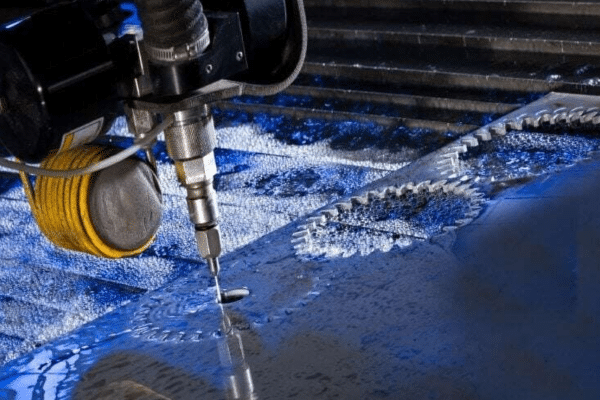
Waterjet cutting uses water pressurized to 60,000 PSI. That’s 40 times stronger than a typical pressure washer. The water exits through a tiny nozzle at 2,500 feet per second. This creates enough force to cut through almost anything.
The Basic Process
Soft materials like foam or rubber only need pure water. Harder materials need help. Steel, aluminum, and titanium require adding crushed garnet sand to the water. This abrasive mixes in just before the water exits the nozzle.
Modern waterjet services use CNC technology for precision. The system reads your CAD file and calculates the cutting path. Then it guides the cutting head with accuracy down to 0.005 inches. The whole process generates zero heat. No warping happens. No heat-affected zones form. Material stress doesn’t occur.
Materials Compatible with Waterjet Cutting Services
Dienstleistungen des Wasserstrahlschneidens handle materials that defeat other cutting methods. The versatility stands out immediately.
Metalle
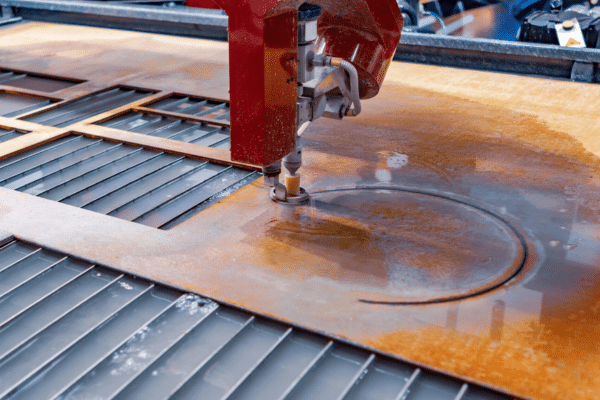
Most metals cut successfully:
- Steel (mild, stainless, tool steel) up to 6″ thick
- Aluminum alloys up to 5″ thick
- Titanium up to 4″ thick
- Copper and brass up to 3″ thick
- Exotic alloys like Inconel up to 3″ thick
Reflective metals don’t cause problems. Heat-affected zones don’t form. Material integrity stays intact.
Plastics and Composites
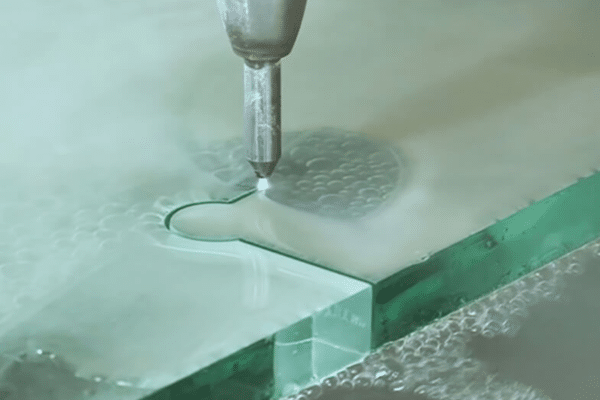
Water jet cutting services excel with plastics that melt under laser heat:
- Acrylic, polycarbonate, ABS, PVC
- Nylon and PEEK engineering plastics
- Carbon fiber composites without delamination
- Fiberglass and Kevlar laminates
Other Materials
Stone like granite and marble cuts cleanly. Glass, ceramics, rubber, and foam all work. Leather, textiles, and wood products process easily. One cutting method handles all these materials.
| Material Category | Typical Max Thickness | Beste Anwendungen |
| Steel/Stainless | 6 inches | Structural components, machinery parts |
| Aluminium | 5 inches | Aerospace, automotive, enclosures |
| Titan | 4 inches | Medical implants, aerospace components |
| Kunststoffe | 3 inches | Prototypes, consumer products |
| Verbundwerkstoffe | 2 inches | High-performance parts, sporting goods |
Key Advantages of Waterjet Cutting Services
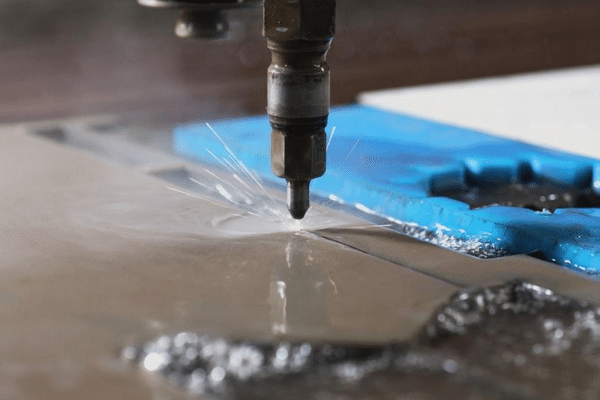
Understanding the benefits helps you decide when custom waterjet cutting makes sense.
Cold Cutting Process
The biggest advantage is cold cutting. Waterjet services generate zero heat. Warping doesn’t happen. Distortion stays away. Material hardness doesn’t change. Grain structure stays original. This matters for heat-sensitive materials and tight-tolerance parts.
According to a 2024 study by the Society of Manufacturing Engineers, waterjet-cut parts showed 47% less dimensional variation compared to Laserschneiden von Rohren equivalents in materials over 1 inch thick.
Material Vielseitigkeit
Cut 2-inch stainless steel today. Cut quarter-inch acrylic tomorrow. No equipment changes needed. Material hardness doesn’t matter. Conductivity doesn’t limit you. Thickness works within reasonable limits.
Minimal Secondary Operations
The cutting edge needs little finishing. Most parts skip deburring. Grinding isn’t necessary. Sanding rarely happens. Extra manufacturing steps disappear. Labor costs drop. Processing time shrinks.
Environmental Benefits
No toxic fumes form. Dust doesn’t fly. Hazardous waste doesn’t exist. Water recycles easily. Garnet abrasive stays inert and non-toxic. The process respects the environment.
Anwendungen in der Industrie
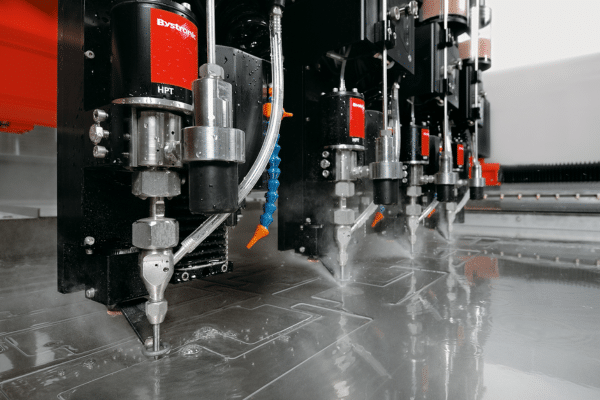
Different industries use Dienstleistungen des Wasserstrahlschneidens for specific advantages.
Aerospace Manufacturing
Aerospace manufacturers rely on these services for titanium bulkheads and aluminum structural components. Composite panels cut without delamination. The technology meets AS9100 quality standards. Boeing uses waterjet cutting for critical carbon fiber components where heat damage would compromise safety.
Automotive Production
Auto manufacturers depend on water jet cutting services for prototype parts. Custom exhaust components need precise cuts. Decorative trim pieces require clean edges. Rubber gaskets seal perfectly. Tesla chose waterjet cutting for aluminum battery enclosures in their Model 3 production line.
Herstellung medizinischer Geräte
Medical device companies choose these services for surgical instruments. Implant components need biocompatible cuts. Diagnostic equipment parts require precision. The process meets ISO 13485 standards. Contamination stays at zero.
Architektur und Bauwesen
Architects specify waterjet-cut stone and glass for building facades. Decorative interior panels add beauty. Stone flooring with intricate inlays impresses clients. Architectural metal features stand out. The Salesforce Tower in San Francisco features extensive waterjet-cut marble in its lobby.
Comparing Waterjet to Other Cutting Methods
Choosing the right cutting method depends on your specific needs. Material type matters. Thickness counts. Precision requirements vary.
| Merkmal | Wasserstrahl | Laser | Plasma |
| Max thickness | Up to 6″ | Up to 1″ | Up to 2″ |
| Material range | Almost anything | Limited by reflectivity | Conductive metals only |
| Heat-affected zone | Keine | Yes | Yes |
| Toleranz | ±0.005″ | ±0.003″ | ±0.020″ |
| Edge finish | Striated | Very smooth | Requires cleanup |
Waterjet services work best for thick materials. Exotic alloys cut beautifully. Heat-sensitive applications stay safe. Laser cutting suits thin metals needing speed. Plasma cutting handles heavy steel plates when precision matters less.
Cost Factors and Pricing
Several factors influence pricing for custom waterjet cutting projects. Understanding these helps you budget accurately.
Material and Thickness
Quarter-inch aluminum costs less than 2-inch stainless steel. Thicker materials take longer. Harder materials consume more abrasive. Titanium cuts slower than aluminum. These factors add up.
Teil Komplexität
Simple rectangles cost less than intricate patterns. Complex paths take more time. Sharp corners slow cutting speed. Small features need more precision. Slower cutting increases cost.
Quantity and Nesting
Higher quantities reduce per-part costs. Efficient nesting packs parts tightly on sheets. Setup time spreads across more parts. Bulk material pricing helps. Volume discounts apply.
Timeline Requirements
Rush orders cost 25-50% more. Standard lead times run 5-10 business days. Rush delivery happens in 24-48 hours. Planning ahead saves money.
According to 2025 manufacturing industry data from the Fabricators & Manufacturers Association, prototype parts range from $50-$200. Small batches of 10-50 parts average $15-$75 per part. Production runs of 100-1000 parts drop to $8-$40 per part. High-volume orders over 1000 parts reach $5-$25 per part.
At Yicen Precision, we offer transparent instant quoting through our online portal. Upload your CAD file and receive a firm price within 2 hours during business days.
Selecting a Waterjet Cutting Service Provider
Choosing the right provider impacts quality and delivery. Several factors matter greatly.
Essential Capabilities
Standard tolerance runs ±0.010″. Tighter tolerances of ±0.005″ need verification. Ask if they stock common materials. Customer-supplied material adds lead time. Modern equipment makes a difference. 5-axis capability reduces taper.
Quality Standards
Regulated industries need proper certifications. ISO 9001 covers quality management. AS9100 applies to aerospace. ISO 13485 serves medical devices. ITAR registration matters for defense work. Verify these before ordering.
Warning Signs
Watch for providers without clear tolerance guarantees. Extremely low prices suggest old equipment. Poor communication during quoting signals problems. Missing material certifications raise concerns. No inspection reports mean quality issues.
Positive Indicators
Qualität Dienstleistungen des Wasserstrahlschneidens offer modern equipment. Quick quoting happens within one business day. Online file upload systems work smoothly. Material traceability exists. Complete documentation arrives with parts. Helpful design feedback reduces your costs.
Yicen Precision maintains ISO 9001:2015 certification and ITAR registration. Our engineering team reviews every design for manufacturability before quoting. We provide first article inspection reports and material certifications with every order.
Design Optimization Tips
Smart design choices reduce costs and improve part quality when using water jet cutting services. Small changes make big differences.
Spaltbreite
The kerf is material removed by cutting. It typically measures 0.030″ to 0.045″. Small holes need kerf accommodation. Minimum hole diameter should equal 2x material thickness. Parts may measure slightly smaller than CAD shows. Good shops compensate automatically.
Corner Radius Requirements
Waterjet creates small radii in inside corners. Expect 1x to 2x material thickness. A half-inch plate produces a half-inch corner radius. Sharp 90° corners need corner tabs or overcuts. Secondary machining adds cost. Designing fillets works better.
Minimum Feature Sizes
Recommended minimums protect your design:
- Part size: 3″ x 3″ minimum
- Feature width: 2x material thickness (0.125″ minimum)
- Spacing between features: 2x material thickness
- Hole diameter: 2x material thickness minimum
Thinner materials allow smaller features. Consider using thinner material when possible.
Common Design Mistakes
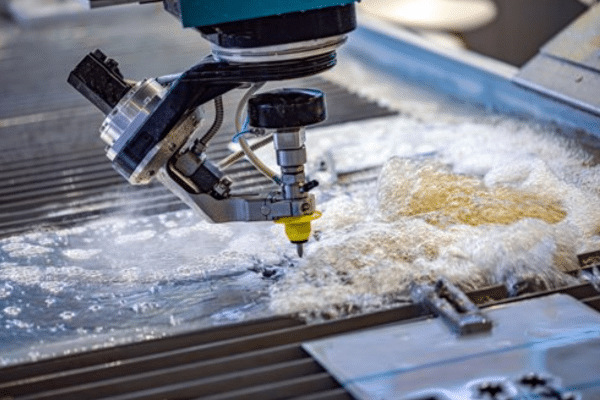
Avoiding these errors saves time and money when ordering waterjet services.
Undersized Features
Features too small for material thickness fail. A 1-inch thick plate can’t have 0.050″ slots. Features should measure at least 2x material thickness. This rule prevents problems.
Ignoring Taper
Materials over 2 inches thick show slight taper. The top edge measures slightly larger than bottom. Premium providers use 5-axis equipment to compensate. Discuss critical dimensions upfront.
Unrealistic Edge Expectations
Waterjet edges show striation marks. Tiny vertical lines appear. This is normal. Function stays unaffected for most uses. Mirror-smooth edges need secondary finishing. That costs extra.
Over-Specified Tolerances
Don’t specify ±0.001″ when ±0.010″ works. Tighter tolerances increase cost significantly. Lead time grows too. Specify only what you actually need.
The Cutting Process Explained
Understanding the workflow helps set realistic expectations for custom waterjet cutting projects. Each step matters.
File Preparation Through Delivery
Upload your design file first. DXF, DWG, or STEP formats work best. The shop reviews manufacturability. Suggestions for improvements arrive. Material selection follows. Stock inventory ships faster. Sourced material adds 2-5 days.
Programming imports your geometry into CAM software. Cutting paths optimize automatically. Multiple parts nest efficiently on sheets. The operator loads material and calibrates head height. Cutting happens while submerged in water. This reduces noise and catches debris.
Cutting speeds vary from 2-20 inches per minute. Material and thickness determine speed. After cutting, parts separate from scrap. Rinsing and drying follow. Any tabs break away. Quality inspection checks dimensions and edges. Packaging prevents shipping damage.
Total turnaround runs 5-10 business days normally. Rush options exist for 24-48 hours. At Yicen Precision, our average lead time is 7 business days with rush service available for critical projects.
Advanced Capabilities
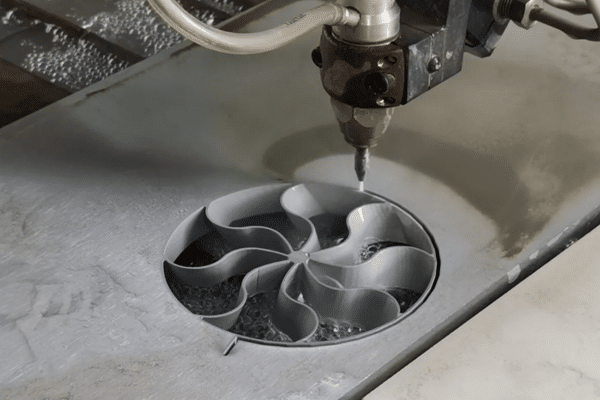
Modern Dienstleistungen des Wasserstrahlschneidens offer enhanced features beyond basic cutting. Technology keeps improving.
5-Axis Taper Compensation
Premium providers use 5-axis cutting heads. The head tilts the cutting stream. This compensates for natural taper in thick materials. Near-vertical edges result even in 4-inch plate. Quality improves dramatically.
Stack Cutting
Multiple thin sheets cut simultaneously in some cases. This works well for gaskets and seals. Sheet metal parts in quantity benefit. Identical prototype iterations process faster. Sheets must clamp tightly to prevent shifting.
Multi-Head Systems
High-volume operations run multiple cutting heads. One table holds several heads. Production speed doubles or triples. Repeated parts finish much faster. This capability suits large orders.
Schlussfolgerung
Dienstleistungen des Wasserstrahlschneidens deliver precision without heat distortion. The technology works across diverse materials from aerospace titanium to architectural stone. Selecting a qualified provider with modern equipment ensures successful outcomes. Understanding material limitations and design requirements helps manufacturers use water jet cutting services effectively for both prototyping and production needs.
Häufig gestellte Fragen
Q: What’s the thickest material waterjet can cut?
Waterjet services typically handle up to 6 inches on steel and aluminum. Specialized systems reach 12 inches but cutting becomes very slow and expensive.
Q: How accurate is waterjet cutting?
Standard Dienstleistungen des Wasserstrahlschneidens maintain ±0.005″ to ±0.010″ tolerances. This matches laser cutting accuracy on thin materials while handling much thicker stock.
Q: Can waterjet create threaded holes?
No, water jet cutting services only make 2D through-cuts and some 2.5D taper cuts. Threads and countersinks require secondary operations.
Q: Is waterjet cutting environmentally friendly?
Yes, the process produces no toxic fumes or hazardous waste. Water recycles and garnet abrasive is natural and non-toxic.
Q: What file formats do waterjet providers accept?
Die meisten custom waterjet cutting providers accept DXF and DWG files primarily. STEP, IGES, and STL files work but require 2D profile extraction.
Zitate
- Society of Manufacturing Engineers (SME). “Comparative Analysis of Thermal vs. Non-Thermal Cutting Processes.” Manufacturing Engineering Journal, March 2024. https://www.sme.org/technologies/articles/2024/cutting-process-comparison/
- Fabricators & Manufacturers Association International. “2025 Metal Fabrication Pricing and Cost Analysis Report.” FMA Communications, January 2025. https://www.fmanet.org/professional-development/articles/2025-pricing-report
- American Waterjet Association. “Waterjet Cutting Technology Standards and Best Practices.” AWA Technical Bulletin, 2024. https://www.americanwaterjet.org/technical-standards
- National Institute of Standards and Technology. “Precision Measurement in Advanced Manufacturing Processes.” NIST Special Publication 1800-32, 2024. https://www.nist.gov/publications/precision-measurement-manufacturing
- International Organization for Standardization. “ISO 9001:2015 Quality Management Systems – Manufacturing Sector Guidelines.” ISO Standards Catalogue, 2024. https://www.iso.org/standard/62085.html
 German
  English
  French
  Spanish
  Japanese
  Portuguese