Guide des coûts de thermolaquage pour les pièces en tôle 2026
If you are a sheet metal buyer pricing the finishing line on a steel enclosure run, an NPI manager comparing powder-coat quotes that swing from $1.75 to $5.00 per square foot for what looks identical on paper, or a hardware engineer trying to decide between powder coating and anodising for an aluminium chassis — this guide is for you. Powder coating is the workhorse finish of sheet metal manufacturing. It is durable, colour-flexible, environmentally cleaner than wet paint, and works on steel, aluminium, stainless, and galvanised substrates. But the pricing has four moving parts — pretreatment, powder type, surface area, and texture — and most buyers see only the last one.
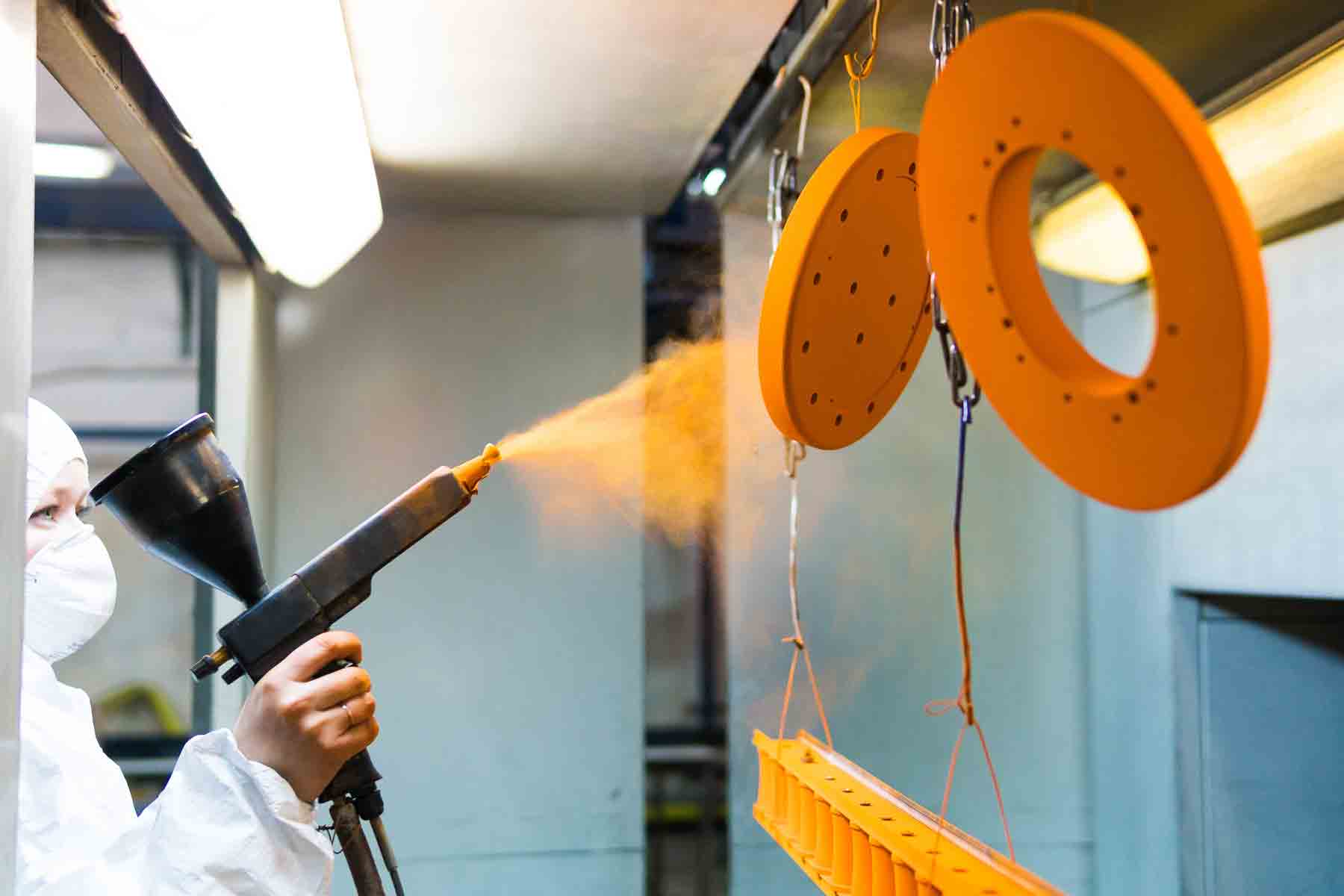
Au Précision Yicen we run powder coating in-house as part of our sheet metal finishing line in Shenzhen. Roughly 65 percent of the sheet metal we fabricate each month goes through powder coating — industrial enclosures, control panels, brackets, frames, machine guards, automotive accessory parts. Over the years we have quoted enough side-by-side jobs against US and European shops to understand exactly where the pricing differences sit and what drives them. This guide gives you the 2026 cost ranges across powder types, the pretreatment math most quotes hide, the texture premiums to watch for, and the DFM moves that typically reduce powder-coat spend 15–25 percent without compromising durability.
The Powder Coating Cost Formula
Every powder-coat quote — from a one-bay automotive shop in Texas to an automated finishing line in Guangdong — is built from four buckets. The headline rate gets the attention, but the pretreatment and minimum-lot charges usually drive the final invoice.
Powder Coating Cost = Lot Minimum + Pretreatment + (Surface Area × Rate per ft²) + Texture/Colour Premium
Lot minimums on US powder-coat shops typically run $75–$200 per job. Pretreatment — usually sandblasting, chemical degreasing, or phosphate conversion — runs $1.50–$7.00 per square foot depending on substrate condition. The per-square-foot powder application rate is the variable component, scaling with surface area, powder type, and required coating thickness. Texture and colour premiums sit on top — wrinkle, hammertone, metallic, and custom-matched colours can each add 10–40 percent over a standard smooth-gloss finish.
From my experience reviewing quotes, the single most common buyer mistake is comparing the headline per-square-foot rate without checking what is included. A $1.85/ft² quote that excludes pretreatment is more expensive than a $3.20/ft² quote that includes everything. Always ask whether the price covers blasting, pretreatment chemistry, masking, and oven time, or whether each is a separate line.
Powder Types — Cost and Application
Powder coatings are broadly grouped by resin chemistry, each with a different cost, durability, and use case. Specifying the wrong powder type costs money either upfront (premium powder where standard would do) or downstream (standard powder fading in 18 months when super-durable would last 15 years).
| Powder Type | Use Case | Powder Price (USD/lb) | Outdoor Rating | Cost vs Standard |
| Epoxy | Indoor only, pipes, electrical | $3.20–$4.00 | Poor — chalks in 6 months UV | Base de référence |
| Polyester (TGIC) | General outdoor, machinery | $3.50–$4.20 | Good — 5–8 years | +5% |
| Epoxy-Polyester Hybrid | Indoor furniture, appliances | $3.40–$4.10 | Moderate — indoor only | Base de référence |
| Super-Durable Polyester | Architectural, marine | $4.25–$6.50 | Excellent — 10–20 years | +20–35% |
| Urethane | Chemical exposure, harsh duty | $5.50–$8.00 | Excellent — 10–15 years | +45–60% |
| Fluoropolymer (PVDF) | Extreme weather, architectural | $12.00–$22.00 | Best in class — 25+ years | +200–350% |
Three pricing notes worth absorbing. First, standard polyester (TGIC) is the workhorse — it covers about 80 percent of sheet metal jobs at modest cost premium over indoor epoxy. Second, super-durable polyester is the right choice for any part that will live outdoors more than five years; the 20–35 percent powder cost premium is recovered the first time you avoid a recoat. Third, PVDF is enormously expensive and reserved for architectural panels, marine fittings, and parts where 25-year UV stability is genuinely required. Most quotes that come in over $7/ft² are PVDF — confirm before assuming you have been overcharged.
Cost by Part Size and Quantity — Real Numbers
Revêtement en poudre, like anodising, has a quantity curve dominated by the lot minimum on small runs. Here is what we see across customer quotes for standard polyester TGIC in a stock RAL colour, applied to a typical sheet metal enclosure (around 4 ft² wetted area).
| Quantité | Lot Charge | Per-Part Powder Cost | Coût total | Per-Part Unit Cost |
| 1 | $120 | $8.40 | $128.40 | $128.40 |
| 10 | $120 | $8.40 each | $204.00 | $20.40 |
| 50 | $120 | $8.20 each | $530.00 | $10.60 |
| 100 | $120 | $8.00 each | $920.00 | $9.20 |
| 500 | $120 | $7.80 each | $4,020.00 | $8.04 |
| 1,000 | $120 (waived) | $7.60 each | $7,600.00 | $7.60 |
Three observations. First, at quantity one, the per-part cost is dominated by the lot charge — anodising and powder coating share this characteristic. Second, the per-part rate barely moves between quantity 100 and quantity 1,000 (only $1.60 per part savings) because powder application time, oven cycle, and racking labour all scale linearly with quantity. Third, larger shops waive the lot minimum above 500 units, which is why high-volume sheet metal programmes get noticeably better unit pricing than prototype work.
Pretreatment Costs — Often Half the Total Bill
Pretreatment is what separates a good powder coat job from one that flakes off in two years. New mill-finish sheet metal needs only a degrease and phosphate conversion before powder. Refinishing old painted parts, rusty parts, or galvanised parts requires aggressive blasting. This is where buyers get surprised on quotes for refurbishment work, where pretreatment can be more expensive than the powder itself.
| Pretreatment Type | Cost (USD/ft²) | When Required |
| Degrease + phosphate (standard) | $0.30–$0.80 | New mill-finish sheet metal, clean substrates |
| Light sandblasting | $1.50–$2.50 | Mild rust, light contamination |
| Heavy sandblasting | $3.00–$7.00 | Heavy rust, old painted surfaces |
| Chemical strip | $2.00–$5.00 | Old powder coat removal |
| Combined strip + blast | $5.00–$10.00 | Heavily degraded refurbishment |
| Zinc-phosphate conversion | $0.80–$1.80 | Premium corrosion-critical applications |
For new sheet metal coming off our laser-and-bend line, the pretreatment is a simple degrease and phosphate — included in our headline rate. For customers shipping us refurbishment work or parts coated by a third party, we quote pretreatment separately because the time and chemistry vary too much to absorb into a flat rate.
Texture and Colour Premiums
Standard smooth gloss in a stock RAL colour is the cheapest powder finish. Every deviation from that baseline adds cost. Here is the typical premium structure we see in 2026.
| Variation | Premium vs Standard | Raison |
| Stock RAL colour, smooth gloss | Base de référence | Highest-volume powder type |
| Stock RAL, smooth matte | 0–5% | Same powder, different cure profile |
| Hammertone texture | +10–15% | Two-stage application, longer cure |
| Wrinkle finish | +10–15% | Specialised powder, longer cure |
| Metallic flake | +20–30% | Aluminium-flake powder, line-of-sight spray issues |
| Pearlescent / candy | +25–40% | Multiple passes, base + tint coats |
| Custom colour match (small batch) | +$80–$250 setup | Powder mixing, sample approval |
| Two-tone or split finish | +50–80% | Masking, double cure cycle |
If your part design allows it, default to a stock RAL gloss or matte finish. The visual quality is excellent, the durability matches more expensive options, and you avoid both the colour-match setup and the texture surcharge. Specify a non-standard finish only where the customer-facing appearance genuinely requires it.
US vs China — Real Powder Coating Cost Comparison
Powder coating, like anodising, has a smaller China-vs-US cost gap than CNC or tooling. Chemistry, oven energy, and consumable powder costs are global. The gap comes from labour for racking and inspection, and from line utilisation.
| Process / Add-On | ÉTATS-UNIS | Allemagne / UE | Chine (niveau 1) | Précision Yicen |
| Standard polyester TGIC, per ft² | $1.75–$4.50 | €1.80–€4.50 | $0.95–$2.20 | $0.85–$2.00 |
| Super-durable polyester, per ft² | $2.50–$5.50 | €2.60–€5.60 | $1.40–$2.80 | $1.30–$2.60 |
| PVDF fluoropolymer, per ft² | $7.00–$14.00 | €7.50–€14.50 | $4.50–$8.50 | $4.20–$8.00 |
| Lot charge — standard | $75–$200 | €80–€220 | $30–$80 | $25–$75 |
| Sandblast prep, per ft² | $1.50–$7.00 | €1.50–€7.00 | $0.60–$2.20 | $0.55–$2.00 |
| Hammertone texture | +10–15% | +10–15% | +8–12% | +8–12% |
| Custom colour match setup | $150–$400 | €160–€420 | $60–$180 | $55–$160 |
The savings on per-square-foot rates are roughly 45–55 percent on standard polyester and even more pronounced on lot charges and pretreatment. The combined savings on a typical 100-unit sheet metal programme are usually 50–60 percent total versus a US shop. The catch — as with all China sourcing — is freight, duty, and lead-time risk that need to be added to the landed-cost calculation.
Combined Sheet Metal + Powder Coat Example
Here is a realistic worked example. The part: a 1.5 mm cold-rolled steel control-panel enclosure, 350 mm × 250 mm × 150 mm, with two doors and a vented bottom. Standard RAL 7035 light grey, smooth gloss, polyester TGIC. Approximate wetted area: 5.8 ft².
| Scène | Quantity 25 | Quantité : 100 | Quantity 500 |
| Wetted surface area | 5.8 ft² each | 5.8 ft² each | 5.8 ft² each |
| Sheet metal fabrication (Yicen) | $48.50 each | $32.20 each | $26.80 each |
| Degrease + phosphate pretreatment | $2.90 each | $2.90 each | $2.90 each |
| Polyester TGIC application | $5.80 each | $5.50 each | $5.20 each |
| Lot charge — powder coat | $1.80 each (∕25) | $0.45 each (∕100) | $0.09 each (∕500) |
| Total finished part | $59.00 each | $41.05 each | $34.99 each |
| Powder coat share of total cost | 18% | 21% | 23% |
Two takeaways. First, powder coating adds roughly 18–23 percent to the cost of a finished sheet metal part at production volume — significant but predictable. Second, the share is slightly higher at higher quantities not because finishing cost rises, but because the fabrication cost falls faster (more setup amortisation) while powder cost stays nearly flat. If you see powder coating quoted above 30 percent of total finished-part cost on a production sheet metal programme, ask the supplier to break it down.
Powder Coat vs Anodise — Quick Cost and Use Decision
These are the two main finishing options for aluminium parts, and the choice has cost and performance implications. Here is the comparison we walk customers through when they are undecided.
| Facteur | Revêtement par poudre | Anodising (Type II) |
| Substrate | Steel, aluminium, stainless, galv | Aluminium, titanium, magnesium only |
| Typical thickness | 60–120 µm | 8–25 µm |
| Cost (per ft², 100-pc qty) | $1.50–$3.50 | $0.85–$2.00 |
| Colour range | Unlimited — any RAL, any texture | Limited — clear, black, bronze, common dyes |
| Outdoor life | 5–25 years (powder dependent) | 10–25 years |
| Hides surface marks | Yes — thick coating | No — coating is transparent |
| Edge wear resistance | Lower — can chip on impact | Higher — coating is part of substrate |
| Dissipation de la chaleur | Lower — polymer insulator | Higher — oxide conducts well |
| Conductivité | Insulating | Electrically insulating (Type II) |
Rule of thumb we use: for steel parts, powder coating wins by default because anodising is not an option. For aluminium parts, anodising is better if cosmetic precision matters, if the part needs heat dissipation, or if edge wear resistance is critical. Powder coating wins on aluminium when colour flexibility or thicker protective coating matters more, or when surface imperfections need to be hidden.
DFM Tips That Cut Powder Coating Cost
- Default to stock RAL colours in smooth gloss or matte. Custom colour match adds $60–$400 setup; texture finishes add 10–40 percent.
- Specify standard polyester TGIC unless the part will live outdoors more than five years or face chemical exposure. Super-durable powders cost 20–35 percent more for unneeded performance.
- Design for racking. Parts that need only one fixture point cost less to powder than parts that need cradles, jigs, or multi-point hangers.
- Allow drainage holes on hollow parts. Pretreatment chemistry trapped inside a closed hollow leaks out during cure and damages the finish — costly rework.
- Specify mil-thickness only where function requires it. Asking for 150 µm coatings when 80 µm would do uses twice the powder and costs roughly 30 percent more.
- Group parts by colour. Switching colours between batches on a powder line requires line clean-out — most shops add a $50–$150 surcharge per colour change on small runs.
FAQs — Powder Coating Cost
How much does powder coating cost per part?
For a typical sheet metal enclosure with around 5 ft² of wetted area in standard polyester TGIC: roughly $25–$60 per part at quantity 25 in the US, $9–$15 per part at quantity 500. At Yicen Precision, those same quantities run $11–$25 and $4–$8 respectively. Per-square-foot rates are $1.75–$4.50 in the US versus $0.85–$2.00 at Yicen.
How does powder coating compare to wet paint cost?
Per-square-foot rates are similar for low quantities — wet paint is sometimes cheaper for one-off parts because no oven cure is needed. At production volumes, powder is typically 20–30 percent cheaper because of higher transfer efficiency (90 percent for powder versus 60 percent for wet), less waste, and a much faster cure cycle. Powder also lasts 2–4× longer in service, making the lifetime cost dramatically lower.
Why does sandblasting cost so much?
Sandblasting is labour-intensive — every surface must be manually directed at, every contour and crevice cleaned, and the spent media must be collected and disposed of. On heavily rusted or thickly painted refurbishment work, blasting can easily exceed the powder coating cost itself. New mill-finish sheet metal only needs degrease and phosphate, which is far cheaper.
Can I powder coat over an old powder coat?
Yes, but only after chemical stripping or sandblasting removes the original coating to bare metal. Powder over powder typically fails within 2–5 years from adhesion issues. Total recoat cost (strip + blast + new powder) is usually 2–3× the cost of an original-build powder coat — the only economic option for refurbishment of expensive parts.
How does Yicen Precision handle powder coating in-house?
We operate an automated powder coating line in our Shenzhen tôle facility, with degrease, phosphate conversion, electrostatic application, and gas-fired curing oven. We stock over 50 standard RAL colours in polyester TGIC and super-durable polyester, with custom colour matching available within 5–7 days. Powder coating lead time is 3–5 days after sheet metal fabrication completes. Full inspection report included with every order.
Get a Sheet Metal + Powder Coat Quote from Yicen Precision
If you have sheet metal parts that need fabrication plus powder coating, we handle the full process in-house. Send a STEP or DXF file with your colour, finish, and quantity, and we will quote the complete fabricate-and-finish cost within 12 working hours.
- Standard polyester TGIC in 50+ stock RAL colours from $0.85 per ft², lot charge from $25
- Super-durable polyester from $1.30 per ft² for outdoor and architectural use
- PVDF fluoropolymer for extreme weather applications from $4.20 per ft²
- In-house sandblasting, phosphate conversion, and masking for complete finishing workflow
- Hammertone, wrinkle, metallic, and custom colour-match capability
- ISO 9001:2015 and IATF 16949 certified, lead time 3–5 days after fab complete
Upload your sheet metal files at yicenprecision.com — tell us your colour and finish spec and we will quote the complete part.

 French
  English
  Spanish
  Japanese
  German
  Portuguese