

Überprüft vom Yicen Precision Engineering Team | Letzte Aktualisierung: Juni 2026
A CNC machining tolerance chart tells a machine shop how much a dimension is allowed to vary when the drawing does not state an exact tolerance next to that feature. The most widely used chart is ISO 2768, an international standard that lets an engineer write one note in the title block, such as ISO 2768-mK, and have it set the default permissible variation for every untoleranced dimension on the part. This page gives the full ISO 2768 tables with verified values, explains how to read the callouts, shows how it relates to GD&T, and adds what most charts leave out: the tolerances different machining processes can actually hold, and what tight tolerances do to your cost.
If you are specifying a part, the practical takeaway is simple. Use a general tolerance standard for the dimensions that do not need to be tight, and reserve explicit tolerances for the few features that drive fit and function. That keeps the part manufacturable and the price reasonable. We apply this every day across our CNC-Bearbeitungsdienstleistungen.
What ISO 2768 Is and When It Applies
ISO 2768 is the dominant general tolerance standard in Europe and Asia and is recognized by CNC suppliers worldwide. It is also published as DIN 7168 in Germany. It exists to remove ambiguity: without a general tolerance reference, every shop interprets an untoleranced dimension differently, and some simply guess.
The standard has two parts that work together.
- ISO 2768-1 covers linear and angular dimensions: lengths, widths, heights, diameters, step sizes, external radii, chamfer heights, and angles. It has four classes, fine (f), medium (m), coarse (c), and very coarse (v).
- ISO 2768-2 covers geometrical tolerances: straightness, flatness, perpendicularity, symmetry, and circular run-out. It has three classes, H, K, and L.
A few things ISO 2768 does not cover: thread tolerances, surface roughness, and any dimension that already carries its own explicit tolerance. Those always take precedence. For surface finish, see our separate surface roughness chart.
ISO 2768-1: Linear Dimension Tolerances
All values are permissible deviations in millimeters. A dash means the class does not define a value for that range.
| Nominal length (mm) | Fine (f) | Medium (m) | Coarse (c) | Very coarse (v) |
| 0.5 up to 3 | ±0.05 | ±0.1 | ±0.2 | – |
| over 3 up to 6 | ±0.05 | ±0.1 | ±0.3 | ±0.5 |
| over 6 up to 30 | ±0.1 | ±0.2 | ±0.5 | ±1.0 |
| over 30 up to 120 | ±0.15 | ±0.3 | ±0.8 | ±1.5 |
| over 120 up to 400 | ±0.2 | ±0.5 | ±1.2 | ±2.5 |
| over 400 up to 1000 | ±0.3 | ±0.8 | ±2.0 | ±4.0 |
| over 1000 up to 2000 | ±0.5 | ±1.2 | ±3.0 | ±6.0 |
| over 2000 up to 4000 | – | ±2.0 | ±4.0 | ±8.0 |
For nominal sizes below 0.5 mm, the deviation must be called out next to the dimension.
How to read it: a 50 mm length under the medium class is allowed to fall anywhere from 49.7 to 50.3 mm, because 50 sits in the over 30 up to 120 row and medium gives ±0.3 mm.
ISO 2768-1: External Radii and Chamfer Heights
| Nominal length (mm) | Fine (f) | Medium (m) | Coarse (c) | Very coarse (v) |
| 0.5 up to 3 | ±0.2 | ±0.2 | ±0.4 | ±0.4 |
| over 3 up to 6 | ±0.5 | ±0.5 | ±1.0 | ±1.0 |
| over 6 | ±1.0 | ±1.0 | ±2.0 | ±2.0 |
ISO 2768-1: Angular Dimensions
Deviations are given in degrees and minutes, based on the length of the shorter side of the angle.
| Shorter side length (mm) | Fine (f) | Medium (m) | Coarse (c) | Very coarse (v) |
| up to 10 | ±1° | ±1° | ±1°30′ | ±3° |
| over 10 up to 50 | ±0°30′ | ±0°30′ | ±1° | ±2° |
| over 50 up to 120 | ±0°20′ | ±0°20′ | ±0°30′ | ±1° |
| over 120 up to 400 | ±0°10′ | ±0°10′ | ±0°15′ | ±0°30′ |
| over 400 | ±0°5′ | ±0°5′ | ±0°10′ | ±0°20′ |
ISO 2768-2: Geometrical Tolerances
ISO 2768-2 sets general tolerances for the form and position of features in three classes, H, K, and L. It covers straightness, flatness, perpendicularity, symmetry, and circular run-out. It does not cover parallelism, cylindricity, concentricity, profile, or true position, which always need an explicit GD&T callout.
Straightness and Flatness (mm)
| Nominal length (mm) | H | K | L |
| up to 10 | 0.02 | 0.05 | 0.1 |
| over 10 to 30 | 0.05 | 0.1 | 0.2 |
| over 30 to 100 | 0.1 | 0.2 | 0.4 |
| over 100 to 300 | 0.2 | 0.4 | 0.8 |
| over 300 to 1000 | 0.3 | 0.6 | 1.2 |
| over 1000 to 3000 | 0.4 | 0.8 | 1.6 |
Perpendicularity (mm)
| Nominal length (mm) | H | K | L |
| up to 100 | 0.2 | 0.4 | 0.6 |
| over 100 to 300 | 0.3 | 0.6 | 1.0 |
| over 300 to 1000 | 0.4 | 0.8 | 1.5 |
| over 1000 to 3000 | 0.5 | 1.0 | 2.0 |
Symmetry (mm)
| Nominal length (mm) | H | K | L |
| up to 100 | 0.5 | 0.6 | 0.6 |
| over 100 to 300 | 0.5 | 0.6 | 1.0 |
| over 300 to 1000 | 0.5 | 0.8 | 1.5 |
| over 1000 to 3000 | 0.5 | 1.0 | 2.0 |
Circular Run-Out (mm)
| H | K | L |
| 0.1 | 0.2 | 0.5 |
How to Read an ISO 2768 Callout
When a drawing should follow general tolerances, the title block carries the note ISO 2768 followed by the class. The most common callout you will see is ISO 2768-mK, which combines one class from each part of the standard.
- m is the medium class from ISO 2768-1 for linear and angular dimensions.
- K is the middle geometrical class from ISO 2768-2 for form and position.
Read together, it means: for any dimension on this drawing without its own tolerance, apply the medium linear and angular tolerance and the K geometrical tolerance. Common combinations and where they fit:
| Callout | Dimensional class | Geometrical class | Typische Verwendung |
| ISO 2768-fH | Fine | H (fine) | High-precision optical, medical, and instrument parts |
| ISO 2768-mK | Mittel | K (medium) | Most general CNC machining and sheet metal work |
| ISO 2768-cL | Coarse | L (coarse) | Non-critical brackets, weldments, rough structures |
Choose the class your part actually needs. Asking for fine on every dimension when medium would function is one of the most common ways a drawing quietly drives up cost.
ISO 2768 vs GD&T (ASME Y14.5)
ISO 2768 sets blanket defaults. GD&T, defined in the United States by ASME Y14.5, controls specific critical features with far more precision and ties them to datums so that fit and function are guaranteed regardless of size variation. Most well-made drawings use both: a general tolerance note for the everyday dimensions, and GD&T callouts on the handful of features that matter most.
GD&T organizes geometric control into five groups.
| Category | Controls | Beispiele |
| Form | Shape of a single feature | Straightness, flatness, circularity, cylindricity |
| Orientation | Angle to a datum | Perpendicularity, angularity, parallelism |
| Standort | Position relative to datums | Position (true position), concentricity, symmetry |
| Profil | Shape of a surface or line | Profile of a surface, profile of a line |
| Runout | Variation during rotation | Circular runout, total runout |
A note on revisions: ASME Y14.5-2018 removed the separate concentricity and symmetry symbols, since position and profile controls do the same job more reliably. You will still see the older symbols on legacy drawings.
| Faktor | ISO 2768 | GD&T (ASME Y14.5) |
| Zweck | General default tolerances | Precise control of critical features |
| Scope | All untoleranced dimensions | Specific called-out features |
| Uses datums | Nein | Ja |
| Region | Europe and Asia | United States, increasingly global |
| Am besten für | Everyday, non-critical dimensions | Fit, function, and assembly-critical features |
What Tolerances CNC Machining Can Actually Hold
A tolerance chart tells you what a class permits, but not what a process can realistically achieve. The values below are typical, achievable tolerances for common processes. They vary with material, part size, geometry, and setup, so treat them as a planning guide rather than a guarantee.
| Prozess | Typical achievable tolerance |
| Standard CNC milling | ±0.005 in (±0.13 mm) |
| Standard CNC turning | ±0.005 in (±0.13 mm) |
| CNC-Präzisionsbearbeitung | ±0,001 Zoll (±0,025 mm) |
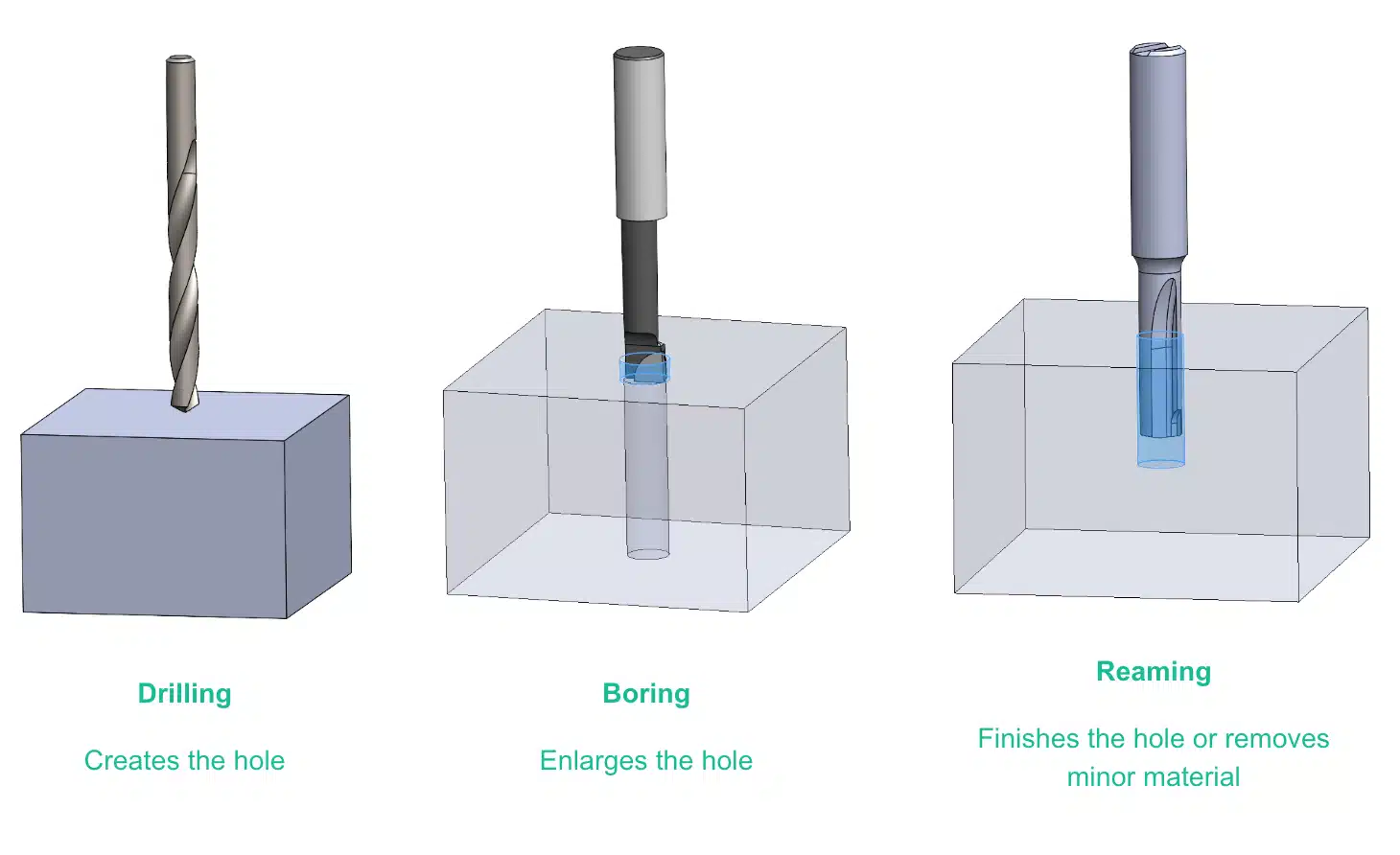
| Reaming (hole diameter) | ±0.0005 in (±0.013 mm) |
| Precision and surface grinding | ±0.0001 to ±0.0005 in (±0.0025 to ±0.013 mm) |
| Drahterodieren | ±0.0001 in (±0.0025 mm) |
For context, the ISO 2768 fine class lines up well with what a capable CNC machine holds without special effort, while the medium class is comfortably within reach for almost any shop. Tolerances tighter than the fine class usually move the feature into grinding, reaming, or Drahterodieren und Präzisionsschleifen territory. Our standard CNC-Fräsen und CNC-Drehen hold tight tolerances with full CMM inspection, and we move to grinding or EDM when a feature calls for it.
Tolerance and Cost: Why Tighter Is Not Always Better
Every step tighter on a tolerance adds cost, and the curve is steep at the precise end. Tighter tolerances mean slower feeds, more finishing passes, better tooling, tighter workholding, more frequent inspection, and a higher scrap rate when a part falls outside the band. A feature held to ±0.025 mm can cost noticeably more than the same feature at ±0.1 mm, for no benefit if the function does not require it.
The discipline that saves money: tolerance only what needs it. Put a general tolerance note on the drawing for the bulk of the dimensions, then apply tight tolerances or GD&T only to the mating surfaces, bores, and datums that control fit and function. A drawing that does this is cheaper to make, faster to deliver, and easier to inspect, with no loss of quality where it counts.
How to Choose a Tolerance Class
A quick way to decide:
- Fine (f) / H: precision parts, close-fitting assemblies, instruments, medical and optical components.
- Medium (m) / K: the default for most machined and sheet metal parts. Start here unless you have a reason not to.
- Coarse (c) / L: non-critical parts, brackets, weldments, and rough structures where function does not depend on tight dimensions.
Start at medium, then tighten only the specific features that justify it. If you are unsure what your part needs, send us the drawing and we will advise on a tolerance scheme that holds function without overpaying for precision you will not use.
Häufig gestellte Fragen
What is a CNC machining tolerance chart? It is a reference, most commonly ISO 2768, that defines how much a dimension may vary when the drawing does not state an explicit tolerance. One title-block note then sets the default for every untoleranced feature on the part.
What does ISO 2768-mK mean? It applies the medium linear and angular tolerance class from ISO 2768-1 and the K geometrical class from ISO 2768-2 to all dimensions that do not carry their own tolerance. It is the most common callout on CNC and sheet metal drawings.
What is the difference between ISO 2768 and GD&T? ISO 2768 sets blanket default tolerances for ordinary dimensions, while GD&T (ASME Y14.5) precisely controls specific critical features and ties them to datums. Good drawings use a general note for everyday dimensions and GD&T for the features that control fit and function.
What tolerance can CNC machining hold? Standard CNC milling and turning typically hold around ±0.005 in (±0.13 mm), precision machining reaches about ±0.001 in (±0.025 mm), and grinding or wire EDM can hold ±0.0001 in (±0.0025 mm). Achievable values depend on material, size, geometry, and setup.
Does ISO 2768 cover surface finish or threads? No. ISO 2768 covers only linear, angular, and general geometrical tolerances. Surface roughness, thread tolerances, and any explicitly toleranced dimension are handled separately and take precedence.
Why do tighter tolerances cost more? Tighter tolerances require slower machining, extra finishing, better tooling and workholding, more inspection, and produce more scrap. Specifying tight tolerances only where function demands them keeps a part affordable.
Specifying Tolerances on Your Parts
A tolerance chart is only useful if it is applied with judgment. Use ISO 2768 to set sensible defaults, reach for GD&T on the few features that control fit and function, and match your tolerance class to what the part actually needs rather than the tightest number available. That approach delivers parts that work and that do not cost more than they should.
If you want a second opinion on the tolerance scheme for a part, send us your drawings for a quote. Our engineering team will flag any tolerances that will drive cost without adding function and confirm what we can hold, backed by CMM inspection and full documentation.
 German
  English
  French
  Spanish
  Japanese
  Portuguese