
Stainless Steel vs Aluminum CNC Machining: Engineer’s Decision Guide
Author: Eric Lin, Senior Process Engineer, Yicen Precision
Eric Lin has 11 years of CNC process engineering experience, qualifying material-specific machining processes for automotive Tier 1 and precision instrument clients across Shenzhen and Dongguan.
For mechanical engineers specifying material for a CNC-machined part, defaulting to 316 stainless because ‘it’s more durable’ when the application would perform identically in 6061 aluminium is a cost decision that adds $80–$300 per part on medium-complexity geometry — and 3–5× the machining time. The inverse mistake — specifying aluminium in a seawater, chloride, or aggressive chemical environment where 316’s passivation chemistry is what prevents corrosion failure — is an engineering failure waiting to happen in the field.
Stainless steel and aluminium are not interchangeable. They serve fundamentally different engineering requirements: stainless for corrosion resistance, strength at elevated temperature, and hygienic surface applications; aluminium for lightweight structures, high machining speed, and applications where weight, thermal conductivity, or anodising aesthetics matter. The cost difference between them — both material and machining — is substantial enough that getting the material selection right before the drawing is released is one of the highest-ROI engineering decisions on any CNC programme.
This guide covers the material comparison across every engineering dimension that matters for CNC machining: machinability, cost, corrosion, weight, thermal properties, surface finish options, and a decision matrix for the most common engineering scenarios where these two materials compete.
Stainless Steel vs Aluminium: Full Material Comparison
| Eigentum | 304 / 316 Stainless Steel | 6061-T6 / 7075-T6 Aluminium |
|---|---|---|
| Density | 7.9–8.0 g/cm³ | 2.7 g/cm³ — 3× lighter than stainless |
| Tensile strength | 515 MPa (304/316) / 1,310 MPa (17-4PH) | 276 MPa (6061-T6) / 503 MPa (7075-T6) |
| Yield strength | 205–310 MPa (austenitic) | 241 MPa (6061-T6) / 434 MPa (7075-T6) |
| Thermal conductivity | 16 W/m·K (304/316) | 167 W/m·K (6061) — 10× better than stainless |
| Machinability rating | ~45% of free machining steel (austenitic) | ~300–600% of free machining steel — 5–8× faster |
| Corrosion resistance (chloride) | Good (304) / Excellent (316 with Mo) | Moderate — anodising required for marine environments |
| Corrosion resistance (general) | Self-healing passive layer (chromium oxide) | Aluminium oxide forms but is less robust than Cr₂O₃ |
| Max service temperature | 870°C (austenitic, oxidising env.) | ~175°C (6061-T6) — loses temper above 175°C |
| Weldability | Excellent (304/316L) | Good (6061); 7075 — poor, not recommended |
| Anodising | Not applicable | Excellent — Type II and Type III anodising available |
| Machining cost index | 3.0–5.0× (vs 6061 baseline) | 1,0× (Grundlinie) |
Machining Cost Comparison: The Real Numbers
The machining cost difference between stainless steel and aluminium on equivalent geometry is driven by three factors: cutting speed (aluminium runs 5–8× faster than stainless), tool life (carbide end mills last 5–10× longer in 6061 than in 304), and coolant requirements (stainless demands flood coolant; aluminium often runs dry or with minimal mist). Combined, these produce a 3–5× per-part machining cost multiplier for stainless vs aluminium on comparable geometry.
| Cost Element | 6061 Aluminium | 304 Edelstahl | Edelstahl 316 |
|---|---|---|---|
| Machine time (relative) | 1,0× (Grundlinie) | 3.5–5.0× longer | 4.0–5.5× longer |
| Tool life (carbide end mill) | 200–400 parts per edge | 30–60 parts per edge | 25–50 parts per edge |
| Coolant requirement | Dry or MQL mist often sufficient | Flood coolant mandatory | Flood coolant mandatory |
| Yicen Precision rate (USD/hr) | $25–$38/hr | $32–$48/hr (additional tooling cost) | $35–$52/hr |
| Estimated per-part cost (medium bracket, 10 pcs) | $30–$70 | $110–$220 | $130–$260 |
| Estimated per-part cost (50 pcs) | $18–$40 | $65–$130 | $75–$150 |
Unser CNC-Bearbeitungsdienst uses dedicated toolholding and parameter sets for each material — the same machine, fixture, and setup does not run stainless and aluminium interchangeably. This is the process discipline that prevents the work-hardening failures and tool breakage that occur when stainless is machined with aluminium parameters.
The 6 Engineering Scenarios Where This Decision Matters
Scenario 1: Marine or Chloride Environment
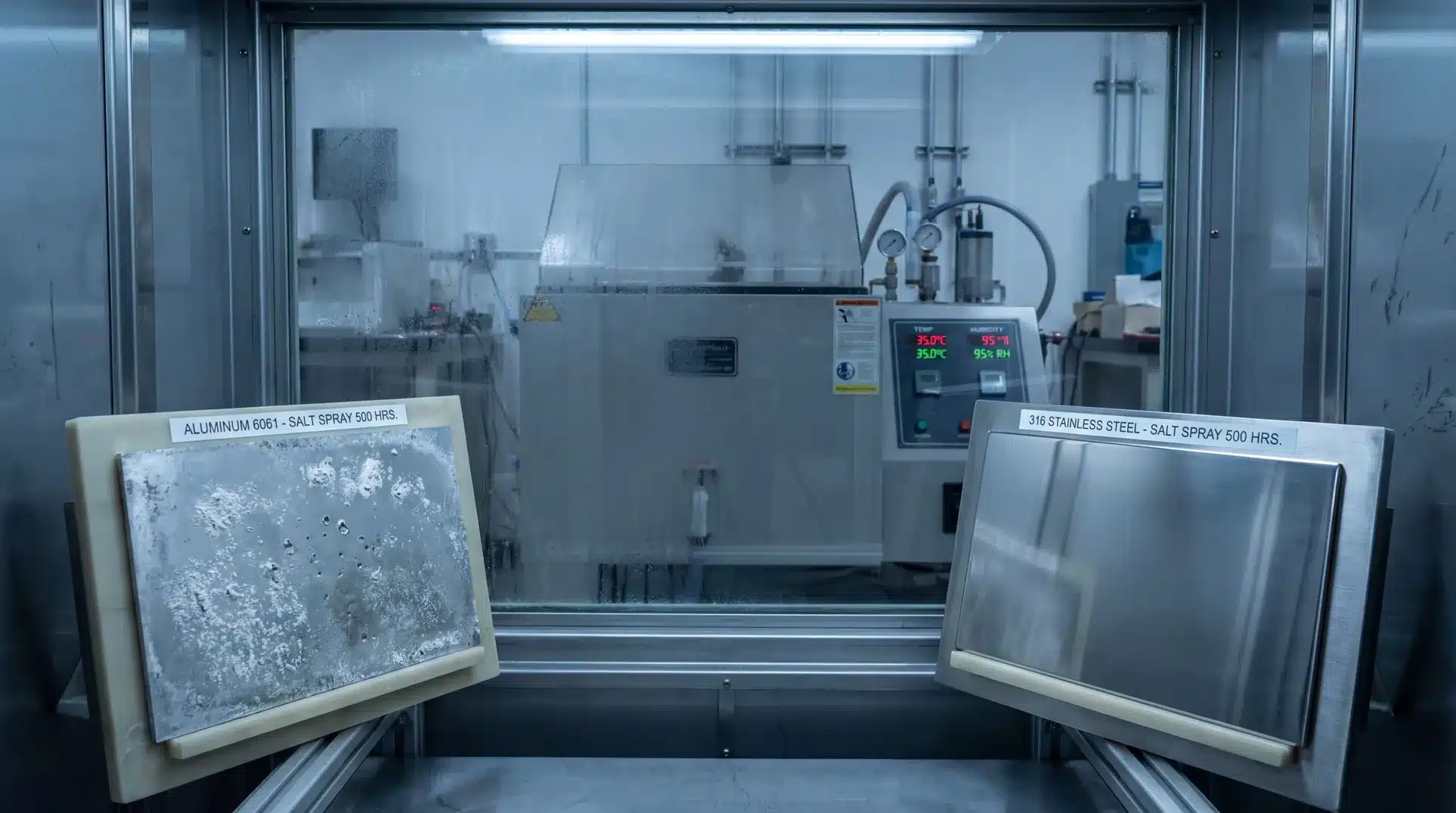
Use 316 stainless. 6061 aluminium forms an aluminium oxide passive layer that is insufficient in seawater, high-humidity marine environments, or chloride-containing industrial environments. 316’s molybdenum content (2–3%) specifically prevents pitting corrosion in these conditions. Anodised aluminium is not an acceptable substitute for long-term marine exposure.
Scenario 2: Structural Bracket — Strength Required
Depends on the strength requirement. If the design requires yield strength above 434 MPa, 7075-T6 aluminium (434 MPa yield) may meet it at 3× lower machining cost than 316 stainless (310 MPa yield — which is actually lower than 7075). If yield strength above 500 MPa is genuinely required, consider 17-4PH stainless (1,170 MPa in H900) or switch to a different alloy class. 304/316 stainless is not inherently ‘stronger’ than 7075 aluminium on a yield strength basis.
Scenario 3: Medical Instrument or Hygienic Application
Use 316L stainless. Medical instruments require a passive oxide surface that survives autoclave sterilisation (steam at 121–134°C and 15–30 PSI) — aluminium anodising does not survive repeated autoclave cycling. 316L’s passivated surface is the standard for reusable surgical instruments, food processing equipment, and pharmaceutical wetted surfaces.
Scenario 4: Lightweight Structure — Weight Is Primary
Use aluminium. Aluminium is 3× lighter than stainless at the same volume. For aerospace brackets, UAV structures, consumer electronics enclosures, and any application where weight directly affects product performance or shipping cost, aluminium’s strength-to-weight ratio is decisive. 7075-T6 (503 MPa tensile, 2.81 g/cm³) has a higher specific strength than most stainless grades.
Scenario 5: Heat Dissipation Required
Use aluminium. Aluminium’s thermal conductivity (167 W/m·K for 6061) is 10× that of 304 stainless (16 W/m·K). For heat sink applications, thermal management housings, electronics enclosures with heat-generating components, and any application where heat must move through the material, aluminium is the correct choice. Stainless steel is a thermal insulator by comparison.
Scenario 6: Anodised Cosmetic Finish
Use aluminium. Anodising is an aluminium-specific surface treatment that cannot be applied to stainless steel. Type II anodising produces colour-consistent, hard-wearing aesthetic surfaces for consumer electronics, architectural components, and premium product enclosures. If the design requires consistent colour, anodising texture, or Type III hard anodise for wear resistance — aluminium is the only option.
Decision Matrix: Stainless Steel vs Aluminium for CNC Machining
| Engineering Requirement | Stainless Steel (304/316) | Aluminium (6061/7075) |
|---|---|---|
| Chloride / marine corrosion | 316 wins — use stainless | Insufficient without coating |
| Weight minimisation | 3× heavier — not suitable | Aluminium wins — use 6061 or 7075 |
| Sterilisation (autoclave) | 316L wins — use stainless | Anodising doesn’t survive autoclave |
| Anodised colour finish | Not anodisable | Aluminium wins — use 6061 |
| Yield strength > 500 MPa | 17-4PH stainless (1,170 MPa) — use stainless | 7075-T6 (434 MPa) — borderline |
| Heat dissipation | Poor conductor (16 W/m·K) | Aluminium wins — 167 W/m·K |
| Weldability | 304/316L — excellent | 6061 — good; 7075 — avoid welding |
| Machining cost (equal geometry) | 3–5× higher than aluminium | Aluminium wins — lowest machining cost |
| Max service temp > 175°C | Stainless to 870°C | 6061 loses temper above 175°C — use stainless |
| High-volume production (>10K parts) | High per-part cost | Aluminium — more economical at scale |
Häufig gestellte Fragen
Is stainless steel stronger than aluminium for CNC machined parts?
It depends on the grade comparison. Standard austenitic stainless (304/316) has yield strength of 205–310 MPa — lower than 7075-T6 aluminium (434 MPa yield). 304 stainless is not categorically stronger than high-strength aluminium alloys. Precipitation-hardening 17-4PH stainless (H900 condition) reaches 1,170 MPa yield — far exceeding any aluminium grade. The correct question is: what specific yield or tensile strength does the design require, and which material meets it at the lowest machining cost? Do not default to stainless for ‘more strength’ without checking the specific grade comparison against your FEA result.
How much more expensive is stainless steel to machine than aluminium?
Stainless steel (304/316) typically costs 3–5× more to machine than 6061 aluminium on equivalent geometry, driven by 5–8× slower cutting speeds, 5–10× more tool wear, and mandatory flood coolant requirements. On a medium-complexity bracket at 10-piece quantity, aluminium runs $30–$70/part; 316 stainless runs $130–$260/part at Yicen Precision. At 50 pieces, aluminium drops to $18–$40/part; 316 stainless drops to $75–$150/part. The gap narrows at higher volumes as setup cost amortises, but the machining time differential remains constant.
When should I use aluminium instead of stainless steel?
Use aluminium when: weight is a primary design requirement (aluminium is 3× lighter); heat dissipation is required (aluminium conducts heat 10× better than stainless); anodised colour or Type III hard anodise finish is specified; budget is the primary constraint and corrosion resistance is manageable with anodising; or the strength requirement is below 434 MPa (yield) where 7075-T6 meets the specification at 3–5× lower machining cost than stainless. Do not use aluminium in direct seawater, chloride, or autoclave sterilisation environments.
Can I replace 316 stainless with aluminium to save cost?
Only if the corrosion environment allows it. In freshwater, indoor, or dry environments — yes, anodised 6061-T6 often performs adequately. In chloride-containing environments (seawater, saltwater spray, certain chemical process streams), aluminium’s passive oxide layer is insufficient and pitting corrosion will occur within 1–3 years regardless of anodising quality. In autoclave sterilisation environments, aluminium anodising degrades under repeated steam cycling. The substitution decision must be driven by a corrosion environment analysis, not just cost comparison.
Conclusion: The Right Material Is the One That Meets the Spec at the Lowest Cost
- Stainless steel (316) wins: chloride/marine environments, autoclave sterilisation, service temperatures above 175°C, and weld-in-service assemblies
- Aluminium (6061/7075) wins: weight-critical structures, heat dissipation, anodised finishes, high-volume production, and applications where stainless’s corrosion properties are not required
- Getting this right before releasing the drawing saves $80–$300 per part on typical medium-complexity CNC components
Submit your drawings for a free material review and DFM quote at yicenprecision.com. Our engineers review every submission before quoting.
 German
  English
  French
  Spanish
  Japanese
  Portuguese