
Most machining problems come down to this: your part has geometry that a 3-axis machine can’t reach cleanly. You end up with multiple setups, accumulated tolerancing errors, and a lead time that keeps slipping. 5-axis CNC machining solves all three in one.
This guide explains how 5-axis works, when it’s the right call, which industries depend on it, and what to look for when choosing a supplier.
What Is 5-Axis CNC Machining?
5-axis CNC machining is a subtractive manufacturing process where the cutting tool moves across five axes simultaneously: X, Y, Z (linear), plus A and B (rotational). This lets the tool approach a workpiece from virtually any angle in a single setup, enabling complex geometries that would require multiple repositions on a 3-axis machine.
Standard 3-axis machines move left/right (X), front/back (Y), and up/down (Z). Adding the A axis tilts the tool around the X axis. Adding the B axis rotates it around the Y axis. The result is a cutter that can maintain optimal contact with curved, undercut, or deep-pocket features without ever stopping to re-fixture the part.
Two main configurations exist. In “3+2” mode, the machine locks the rotational axes at a fixed angle and machines from that position. In true simultaneous 5-axis mode, all five axes move together in real time, allowing complex contoured surfaces to be cut in a single continuous pass.
5-Axis vs. 3-Axis CNC: What the Numbers Actually Mean
| Merkmal | 3-Achsen-CNC | 5-Achsen-CNC |
|---|---|---|
| Axes of movement | X, Y, Z | X, Y, Z + A, B |
| Setups per complex part | 3 to 6+ | 1 to 2 |
| Geometric capability | Prismatic shapes, simple contours | Compound curves, undercuts, deep cavities |
| Erreichbare Toleranz | ±0.025 mm typical | Down to ±0.005 mm |
| Qualität der Oberflächenbehandlung | Good on flat faces | Excellent on curved and blended surfaces |
| Am besten für | Brackets, plates, housings | Turbine blades, implants, mold inserts |
Each time you re-fixture a part on a 3-axis machine, you introduce a new datum. Stack four setups and that tolerance error compounds. A single 5-axis setup eliminates that accumulation entirely. For tight-tolerance work, that’s not a convenience. It’s a quality requirement.
Wie funktioniert die 5-Achsen-CNC-Bearbeitung?
The key mechanical difference is the table or head: one or both tilt and rotate. Trunnion-style machines tilt the table and rotate the part. Swivel-head machines pivot the spindle itself. Some combine both. Which configuration suits your part depends on its size, weight, and the surfaces that need to be reached.
The process flow from CAD file to finished part:
- CAD/CAM programming. A programmer builds toolpaths using CAM software, running collision simulations before a single chip is cut.
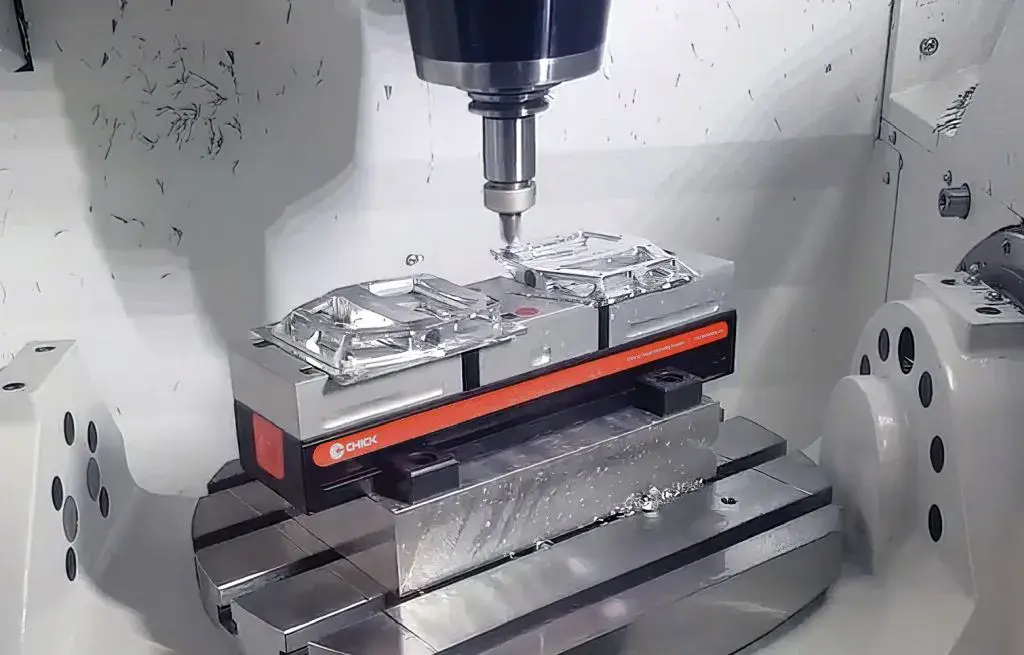
- Workholding. The part is fixtured once. Vises, custom fixtures, or vacuum tables hold the workpiece while all five surfaces are machined.
- Roughing. Bulk material is removed quickly with large-diameter tools.
- Semi-finishing. The machine begins defining final geometry with finer passes.
- Finishing. Small-radius tools at optimized cutting angles produce the final surface and dimension.
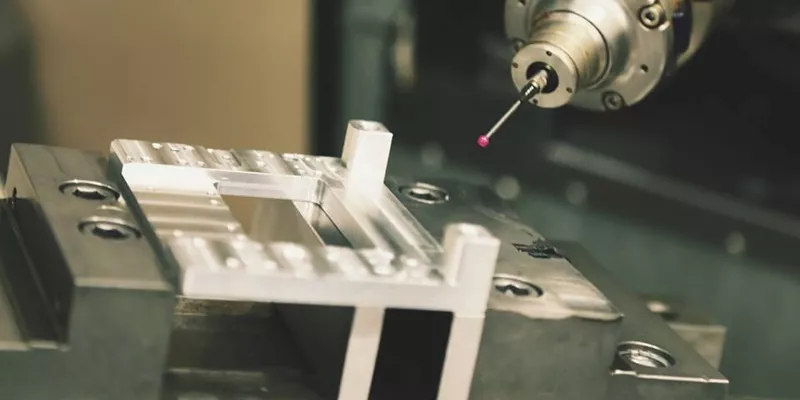
- Inspection. CMM (coordinate measuring machine) probing verifies geometry against the CAD model.
At Yicen Precision, our 5-axis centers are part of a 300+ machine CNC facility with integrated CMM inspection on every order. Tolerances to ±0.005 mm. Prototypes delivered in 24 hours.
When Should You Use 5-Axis Machining?
The short answer: when your part has geometry that requires tool access from more than three directions, or when tolerance accumulation across multiple setups is a risk you can’t accept.
Use 5-axis when your design includes any of these:
Compound curved surfaces. Turbine blades, impellers, and aerodynamic housings have continuously changing surface normals. A 3-axis machine forces you to approximate with many short linear passes, leaving a stepped finish that requires extensive hand polishing. 5-axis maintains constant tool contact along the entire curve.
Deep pockets or undercuts. Features recessed below surrounding walls, or geometry that undercuts back toward the part center, are inaccessible from a fixed vertical spindle. 5-axis tilts the tool to reach them cleanly.
Tight tolerance on multiple related surfaces. If you have a bore and a mating flat that must maintain a precise angular relationship, machining both from the same datum in one setup is the only reliable way to hold that relationship at ±0.005 mm.
High surface finish requirements. Trochoidal and barrel-cutter toolpaths on a 5-axis machine can achieve Ra 0.4 µm or better on curved surfaces. That often eliminates a polishing step entirely.
If your part is a flat plate with orthogonal features, 3-axis CNC-Fräsen is faster and cheaper. Use the right process for the geometry.
Benefits of 5-Axis CNC Machining
Fewer Setups, Better Accuracy
Every time you lift a part and re-fixture it, you accept a new positioning error. On a 5-axis machine, complex features machined in one go share a single datum. Dimensional relationships between features are as accurate as the machine’s inherent positioning error, typically ±0.005 mm at Yicen’s facility.
Shorter Lead Times
Eliminating three to five intermediate setups removes the labor time, the queue time, and the risk of a damaged part during transfer. For a 10-piece prototype run, that can cut production time in half.
Better Tool Life
5-axis machines tilt the cutting tool to maintain optimal chip load and cutting angle against curved surfaces. Compare this to a 3-axis machine forced to use the tip of a ball-end mill on a sloped face: the tip has near-zero surface speed, generating heat instead of cutting cleanly. Proper cutting angle extends tool life and reduces surface burning on heat-sensitive alloys like titanium.
Surface Finish Without the Handwork
Barrel-cutter and tapered-ball toolpaths cover more surface area per pass, leaving a better as-machined finish. For aerospace parts und medizinische Implantate, this often satisfies the drawing requirement without adding a grinding or polishing operation.
Industries That Rely on 5-Axis CNC Machining
Luft- und Raumfahrt
Wing spars, turbine blades, engine housings, and structural brackets demand tolerances that 3-axis machining cannot consistently achieve across compound geometry. Material choices add difficulty: titanium and nickel superalloys are hard to machine efficiently from fixed angles. 5-axis paths maintain optimal cutting conditions throughout.
Yicen holds IATF 16949 certification and supports aerospace customers with full FAI reports, material certs, and dimensional traceability on every batch.
Medizinische Geräte
Orthopedic implants, surgical instruments, and endoscopic components have organic geometries designed to match human anatomy. Surface finish on implant contact surfaces must be consistent to Ra values specified on the drawing. Manual polishing introduces variability. 5-axis machining with a verified toolpath delivers repeatability across every part in the lot.
Yicen is ISO 13485 certified for medical device manufacturing. We supply medical device customers in titanium, CoCr, stainless steel 316L, and PEEK.
Automobilindustrie
Engine heads, intake manifolds, brake calipers, and transmission housings require precise port geometry, smooth transition radii, and accurate bore positions. Performance automotive parts also demand consistent results across high production volumes. 5-axis machining delivers both the geometric accuracy and the cycle-time efficiency to make that economical.
See how Yicen supports automotive manufacturers.
Robotics and Automation
Robotic joints, gripper bodies, and servo mounts combine tight bearing fits with complex external profiles. Machining them in multiple setups accumulates positional error between the bore axis and the mounting face. One-setup 5-axis machining eliminates that problem. Fast cycle times also suit the short-run, frequent-revision model common in robotics development.
Tool and Die
Injection mold inserts and die components have complex cavity geometry, textured surfaces, and cooling channels that change direction in three dimensions. 5-axis machining reaches these features directly, replacing time-consuming EDM work in many cases and delivering a better pre-polish surface. Yicen’s wire EDM machining can complement 5-axis work where electrode erosion geometry is still required.
5-Axis Machining Materials: What Works and What Doesn’t
5-axis machining is compatible with the full range of machinable metals and engineering plastics. The rotational axes give the programmer more options for approach angle, which is especially valuable with difficult materials.
Titan (Ti-6Al-4V): Low thermal conductivity means heat builds up fast. 5-axis tilting keeps the tool at a cutting angle that maintains chip thickness and prevents rubbing. Yicen produces titanium parts to tolerances of ±0.005 mm across 50+ available materials.
Aluminium-Legierungen: High feed rates and large depths of cut are possible. 5-axis capability reduces fixtures needed for complex housings and enclosures.
Stainless steel (303, 304, 316L): Work-hardens quickly if the tool dwells. 5-axis continuous paths reduce dwell and maintain consistent chip load.
Inconel and nickel superalloys: Very low machinability. Proper 5-axis toolpath strategy with correct cutting angles is essential to avoid tool failure.
Engineering plastics (PEEK, Delrin, nylon): Low cutting forces make fixturing easier. 5-axis reduces the number of fixtures needed for complex plastic housings and brackets.
What to Look for in a 5-Axis CNC Supplier
Not every shop with a 5-axis machine produces 5-axis quality. These are the questions worth asking before you place an order.
What’s your positioning accuracy? Ask for the machine spec sheet. A reputable supplier can state ±0.005 mm or better. Vague answers like “tight tolerances” mean nothing without a number.
Can you provide CMM inspection with reports? Visual inspection isn’t enough for critical geometry. First Article Inspection (FAI) reports with CMM data confirm dimensional compliance against your drawing.
What certifications do you hold? ISO 9001:2015 is the baseline for quality management. If your part is medical, you need ISO 13485. Automotive requires IATF 16949. Yicen holds all three, plus ISO 14001.
Do you offer DFM feedback? A supplier who reviews your CAD for machining issues before cutting saves you revision cycles and money. Yicen provides DFM (Design for Manufacturability) feedback on every uploaded file.
What are your actual lead times? Prototype lead times at Yicen: 1 to 5 days. Low-volume production: 5 to 15 days. Request a quote directly to confirm for your specific geometry.
Upload your CAD file and get an instant quote to see lead time and pricing for your 5-axis part.
Limitations of 5-Axis CNC Machining
5-axis is the right process for complex geometry. It’s not always the cheapest option for simple parts. Here’s where the tradeoffs matter.
Machine and programming cost. 5-axis machines cost more than 3-axis machines. CAM programming is more complex and takes longer. For a flat plate with drilled holes, standard CNC machining will give you a faster, cheaper part.
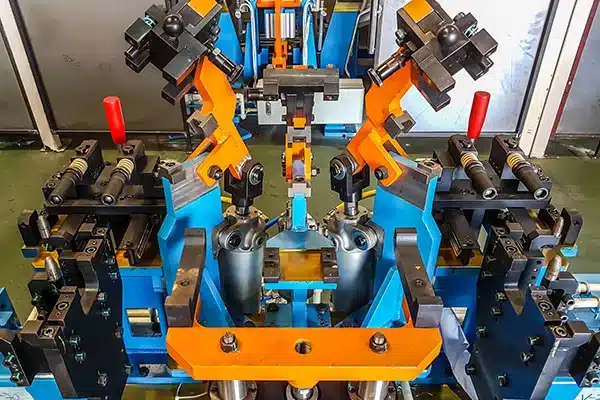
Workholding complexity. Parts with no flat faces are harder to hold rigidly. Custom fixture design adds cost and lead time on the first run. Yicen’s custom jig and fixture design service handles this in-house.
Programmer skill. Poor 5-axis toolpaths create gouges, missed surfaces, and unpredictable tool engagement. Good programmers with simulation capability are the difference between a successful part and scrap.
For truly complex geometry, these costs are justified. For simple parts, they’re not.
Get Your 5-Axis Parts Quoted in Minutes
Yicen Precision runs 300+ CNC machines from our factory in Shenzhen’s Bao’an District. We’re ISO 9001:2015, ISO 13485, IATF 16949, and ISO 14001 certified. Tolerances to ±0.005 mm. 50+ materials. 30+ surface finish options. Prototypes in 24 hours, factory-direct with no broker markup.
Upload your CAD file and get an instant quote: yicenprecision.com/get-a-quote
Questions before you quote? Reach our engineering team at sales@yicenprecision.com or +86 0755 2705 2682. Response within 12 hours.
Häufig gestellte Fragen
What’s the difference between 5-axis and 5-sided machining?
5-sided machining (sometimes called 3+2) indexes the rotational axes to a fixed position and machines from there, essentially doing 3-axis cutting from five different angles. True 5-axis simultaneous machining moves all five axes at once, which is required for smooth contoured surfaces and complex compound curves.
Can 5-axis CNC machine both metals and plastics?
Yes. At Yicen, we work with 50+ materials including aluminum, titanium, stainless steel, brass, copper, Inconel, PEEK, Delrin, and nylon. Material selection depends on your mechanical requirements, operating environment, and surface finish specification.
What tolerances can 5-axis CNC achieve?
Yicen’s 5-axis centers hold tolerances down to ±0.005 mm (±0.0002 in) on qualified features. Achievable tolerance also depends on material, feature geometry, and part size. Upload your CAD file and our team will confirm what’s achievable for your specific design.
Do I need to redesign my part for 5-axis machining?
No. Your existing CAD model is machined as designed. In some cases, DFM feedback from Yicen’s engineers can suggest minor adjustments that reduce machining time and cost without changing function. We provide this before cutting begins.
How fast can I get a 5-axis prototype?
Yicen offers 24-hour schneller Prototypenbau on qualifying orders. Standard prototype lead time is 1 to 5 days depending on part complexity and material.
What file formats do you accept? STEP, IGES, SolidWorks, Parasolid, and most standard CAD formats. Upload directly at yicenprecision.com/get-a-quote.

 German
  English
  French
  Spanish
  Japanese
  Portuguese