What is welding jig design, what types of welding jigs are used in manufacturing, and how can a properly designed jig improve welding accuracy, repeatability, distortion control, and production efficiency?
Welding jig design is the engineering process of creating a workholding system that positions, locates, supports, and clamps components in the correct relationship during welding. A well-designed welding jig helps maintain part geometry while welding heat causes expansion and contraction. It also makes loading more consistent, reduces manual alignment, improves repeatability, and can shorten production time. For precision welding, the jig must be designed around the weld sequence, material, tolerances, accessibility, heat input, and expected production volume rather than simply holding the components together.
What Is a Welding Jig?
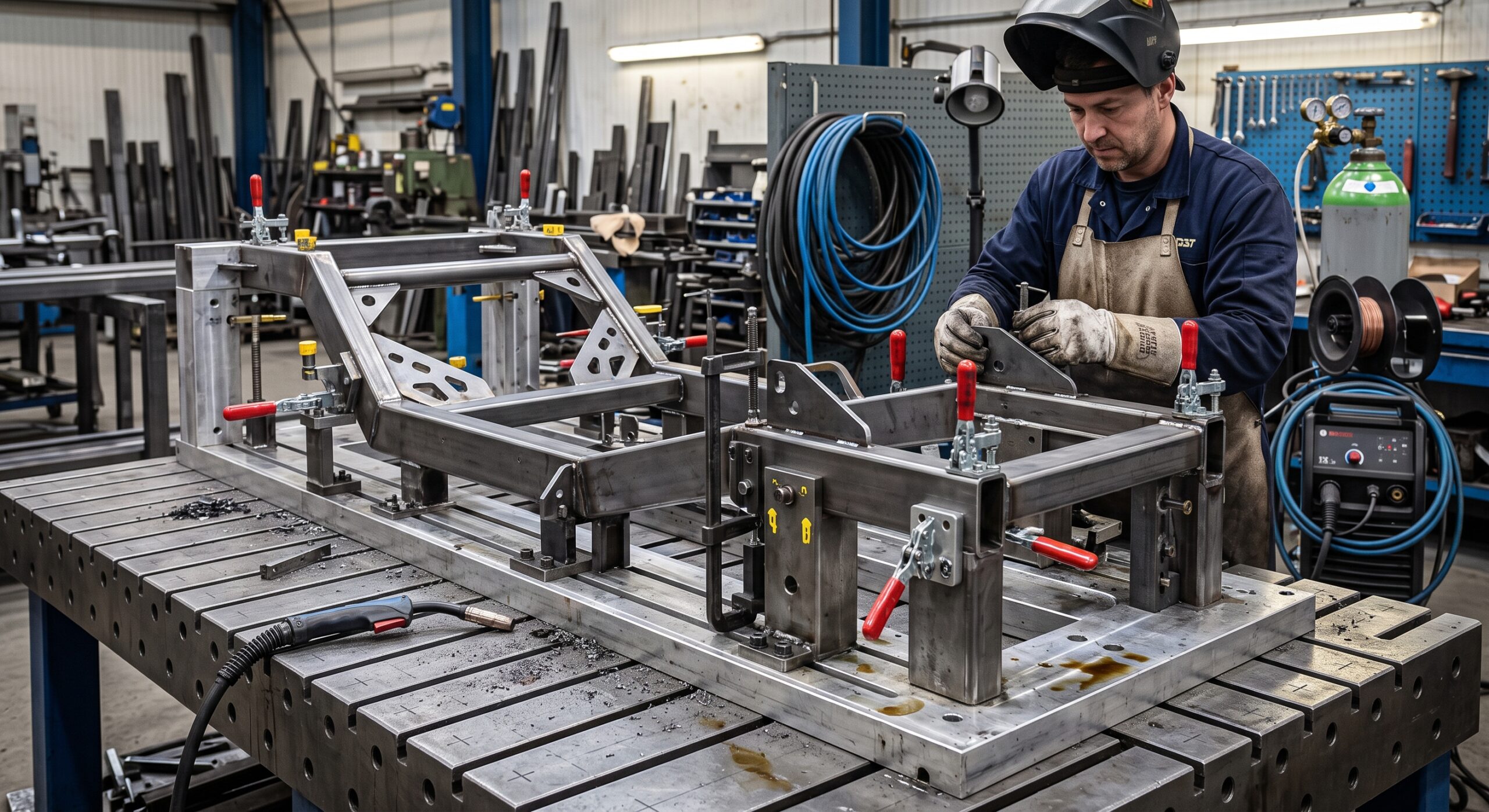
A welding jig is a specialized fixture used to position and secure components before and during welding. It establishes the relationship between parts so the welder does not have to repeatedly measure, align, and manually reposition every component.
Although the terms 溶接治具 そして 溶接治具 are often used interchangeably, they can have slightly different functions. A jig generally helps locate the workpiece and may guide a tool or welding operation, while a fixture primarily holds and locates the components. In practical manufacturing environments, however, the distinction can vary by application.
Welding creates a unique workholding challenge because heat changes the dimensions of metal. During welding, localized areas expand. As they cool, they contract. If the assembly is not adequately controlled, this can produce warping, angular distortion, dimensional variation, and inconsistent joint alignment.
Yicen Precision’s engineering guidance explains that welding jigs and fixtures are specifically designed to maintain the intended relationship between components while controlling the movement created by welding heat. Its existing guide on welding jigs and fixtures also covers distortion control and practical fixture considerations.
Why Is Welding Jig Design Important?
Without a suitable jig, a welding process can become heavily dependent on operator skill. Even experienced welders may find it difficult to reproduce exactly the same alignment across hundreds or thousands of assemblies.
A properly engineered jig creates a repeatable manufacturing reference. Once the components are placed against defined locators and secured with appropriate clamps, the welder can focus on producing the weld rather than continuously checking dimensions.
The value becomes particularly clear in production environments. If an assembly requires several brackets, tubes, plates, or structural members to maintain precise relationships, manually positioning each component adds time and creates opportunities for variation.
A welding jig can address these problems by providing consistent positioning, controlled clamping, improved access, and a repeatable loading process. It can also help reduce rework caused by incorrectly positioned components.
For manufacturers producing precision components, welding jigs can therefore contribute to both quality and production economics.
Main Types of Welding Jigs
The right jig depends on the geometry of the assembly, welding process, required accuracy, and production quantity. A simple angle jig may be sufficient for a basic assembly, while a complex automotive or industrial weldment may require a dedicated multi-point fixture.
| Welding Jig Type | 代表的なアプリケーション | Main Benefit |
| Plate welding jig | Flat plates and brackets | Simple positioning |
| Angle jig | 90-degree assemblies | Maintains fixed angles |
| チャンネルジグ | Frames and structural sections | Consistent alignment |
| Box welding jig | Enclosures and rectangular frames | Controls multiple dimensions |
| Tube welding jig | Tubular structures | Maintains tube position |
| Modular welding jig | Multiple product designs | Flexible configuration |
| Dedicated welding fixture | Repeated production parts | High repeatability |
| Rotary welding jig | Circular or multi-sided assemblies | Easier access to weld joints |
| Automated welding fixture | 大量生産 | Consistent loading and welding |
Plate and Angle Welding Jigs
Plate welding jigs are among the simplest types. They use a flat base, stops, locating pins, and clamps to maintain the relationship between components.
Angle jigs are useful when two components must be held at a specific angle, such as 90 degrees. The jig establishes the reference angle so the operator does not have to manually measure it before every weld.
These designs are often economical for low-volume manufacturing because they can be relatively simple while still providing substantial improvements in repeatability.
Tube and Frame Welding Jigs
Tube assemblies present additional challenges because round or rectangular tubes can shift during positioning. A tube welding jig uses locating blocks, stops, clamps, and supports to maintain the required geometry.
For frames, the fixture may need to control several dimensions simultaneously, including overall length, width, diagonal measurements, and joint locations.
This becomes particularly important when the finished frame must interface with other components. A small error in one welded joint can accumulate across the assembly and create significant dimensional problems.
モジュール式溶接治具
Modular jigs use interchangeable components such as bases, locating pins, stops, supports, and clamps. Their configuration can be changed for different parts.
This makes modular fixturing useful for manufacturers producing several related products or working with changing designs. Instead of building an entirely new fixture for every component, the same base system can often be adapted.
Modular systems can also be useful during product development when the final production configuration has not yet been completely established.
Dedicated Welding Fixtures
A dedicated fixture is designed specifically for one component or assembly. It normally provides the highest level of repeatability because the locators, supports, and clamps are optimized for the exact geometry.
The initial tooling investment is higher than a simple jig, but the cost can be justified when production volume is substantial. Faster loading, reduced measurement, lower rework, and consistent positioning can produce savings throughout the production run.
易岑精密は カスタム治具設計サービス for manufacturing applications where stable positioning, repeatability, and production efficiency are important.
Essential Welding Jig Design Principles
Good welding jig design begins with understanding how the part will be manufactured. The fixture should not be designed only around the final shape. It must also account for how components are loaded, tack welded, fully welded, cooled, removed, and inspected.
Establish Accurate Locating Points
The first major consideration is location. The jig must establish reliable reference points that position every component consistently.
Locators should normally reference surfaces or features that are dimensionally controlled and relevant to the assembly’s functional requirements. Poor locator selection can transfer errors into the finished weldment.
A common approach is to use a primary locating surface combined with secondary and tertiary locating points. This constrains unnecessary movement without over-constraining the part.
The objective is simple: when a new set of components is loaded, they should return to essentially the same position as the previous set.
Control Clamping Without Over-Constraining
Clamps must provide enough force to prevent movement during welding, but excessive clamping can create another problem.
If a component naturally wants to move as it heats and cools, completely restraining it can increase internal stress. In some applications, the fixture should control the geometry while allowing a carefully considered amount of thermal movement.
The clamp arrangement should also direct forces toward the locating surfaces. This helps prevent components from lifting away from their intended references.
Design for Weld Accessibility
A jig that holds the part accurately but blocks the welding torch is not a successful design.
The welder needs sufficient access to the joint, electrode or wire, shielding gas, and torch. Clamps, locating blocks, and support structures should be positioned so they do not unnecessarily interfere with the welding path.
Access becomes even more important when multiple welds are required from different orientations. A rotary fixture can sometimes provide a practical solution by allowing the assembly to be repositioned without removing it from the jig.
Account for Welding Distortion
Welding distortion is one of the most important factors separating welding fixture design from ordinary workholding.
Heat input causes localized expansion and contraction. The fixture should therefore be designed alongside the welding sequence.
Depending on the assembly, designers may use strategically positioned supports, clamps, balanced weld sequences, temporary restraints, or controlled pre-positioning. The objective is to anticipate predictable movement rather than simply reacting to distortion after it occurs.
This is why welding jig design should involve both fixture engineering and process planning.
Materials for Welding Jigs
The jig material should withstand repeated clamping, welding heat, handling, and production use.
Steel is commonly selected for heavy-duty welding fixtures because it provides rigidity and durability. Aluminum can reduce fixture weight and may be useful where frequent manual handling is required, although its thermal properties and proximity to the welding process must be considered.
Wear-resistant materials or hardened inserts may be appropriate for locating points that are repeatedly contacted by components.
The choice should also consider thermal expansion. A fixture that becomes significantly hotter during production can change dimensions and influence positioning if the design does not account for temperature.
For precision applications, the material selection should therefore be based on the complete production environment rather than simply initial tooling cost.
Welding Jig Design for Different Production Volumes
Production volume has a major influence on fixture design.
For prototypes, a simple adjustable jig may be the most economical choice. Spending heavily on dedicated tooling before the design has been validated can increase development costs.
For low-volume production, modular systems and adjustable fixtures can provide a balance between repeatability and flexibility.
For high-volume production, dedicated fixtures become more attractive because the upfront tooling cost can be distributed across a larger number of parts.
| 生産要件 | Recommended Jig Approach | Primary Consideration |
| プロトタイプ | Adjustable or simple jig | Low tooling cost |
| 少量 | Modular jig | 柔軟性 |
| Medium volume | Semi-dedicated fixture | Setup efficiency |
| 大容量 | 専用治具 | Repeatability and cycle time |
| Automated production | Automation-ready fixture | Robot access and consistent loading |
| Complex assembly | Multi-point custom fixture | Geometry and weld sequence |
This relationship between volume and tooling investment is also relevant to CNC workholding. Yicen Precision’s guide to CNC workholding and custom fixtures explains how standard, modular, and dedicated workholding should be selected according to the part, tolerance, and production volume.
Welding Jig Design for Precision Applications
Precision welding requires more than simply keeping parts in place. The jig must support the dimensional requirements of the finished assembly.
If a welded frame needs to interface with machined components, mounting holes, brackets, or other assemblies, the fixture should reference the critical functional dimensions.
This is where welding and CNC machining can complement each other. Components can be welded in a controlled fixture and then undergo machining operations to achieve final critical dimensions.
易岑精密が提供するもの CNC加工サービス using 3-axis, 4-axis, and 5-axis equipment and supports precision components for prototype and production applications. Its published capabilities include dimensional inspection and GD&T verification.
For assemblies that require both fabrication and machining, integrating these processes can help maintain a more controlled manufacturing workflow.
Designing Jigs for Inspection and Quality Control
A good welding jig can also support inspection.
Inspection points can be incorporated into the fixture so operators can quickly verify critical dimensions before or after welding. Reference surfaces, locating pins, gauge points, and checking features can make dimensional verification easier.
For high-precision production, inspection should not be treated as a final step only. The fixture itself should help establish a repeatable relationship between the component and measurement system.
This approach supports process control because problems can be identified earlier rather than after an entire production batch has been completed.
Yicen Precision states that its manufacturing processes include CMM, digital micrometer, and optical measurement systems for dimensional verification, along with GD&T and tolerance checks.
Common Welding Jig Design Mistakes
One common mistake is designing the jig only around the final component geometry. A fixture must also consider loading, unloading, welding access, heat, cleaning, inspection, and maintenance.
Another mistake is using too many locating points. Over-constraining the assembly can make loading difficult and can increase stresses during welding.
Poor clamp placement is another issue. A clamp positioned far from the support point may allow the component to flex or lift during welding.
Ignoring weld sequence can also reduce fixture effectiveness. If the fixture is designed without understanding where heat will be introduced first, distortion may still occur even when the components are securely held.
Finally, fixtures should not be unnecessarily complicated. Every additional mechanism increases tooling cost, maintenance requirements, and potential failure points. The best jig is usually the simplest design that reliably achieves the required positioning and production objectives.
How to Improve Welding Jig Efficiency
Fixture efficiency can often be improved by reducing the number of manual alignment steps.
Quick-action clamps, accessible handles, clearly defined loading points, and poka-yoke features can make the correct loading orientation obvious. If a component can physically be loaded in only the correct position, the risk of operator error decreases.
Repeatable locating pins and hardened contact points can also improve long-term performance.
For high-volume operations, pneumatic or hydraulic clamping may be considered where consistent force and fast loading are important. Automation-ready fixtures should additionally provide sufficient access for robotic loading and unloading.
The fixture should also be designed for maintenance. Locators that wear over time should be replaceable, and areas that collect weld spatter should be accessible for cleaning.
Welding Jigs and CNC-Machined Fixture Components
Many precision welding jigs contain machined components such as locator blocks, mounting plates, precision pins, support brackets, bushings, and adjustable stops.
CNC machining is well suited to producing these components because the fixture may require accurate hole locations, flat reference surfaces, controlled angles, and repeatable dimensions.
For complex fixture components, CNCフライス加工 can produce the required geometry with multi-axis machining capabilities. Yicen Precision’s CNC manufacturing services cover prototype and production parts in materials including aluminum, stainless steel, brass, titanium, and engineering plastics.
This combination of fixture engineering and precision machining can create a more controlled workholding solution for demanding welding applications.
最終的な感想
Welding jig design is a critical part of precision fabrication because welding introduces heat, movement, and dimensional variation that cannot be solved through manual alignment alone. A properly designed jig establishes reliable datums, controls component positioning, provides weld access, manages clamping forces, and supports a repeatable welding sequence.
The right solution depends on the component and production requirement. Simple adjustable jigs can work well for prototypes and low-volume work, while modular and dedicated fixtures provide greater repeatability as production requirements increase.
The most effective welding fixtures are designed around the entire manufacturing process. Material behavior, weld sequence, thermal distortion, part tolerances, inspection requirements, operator workflow, and future production volume should all be considered before the fixture is manufactured.
For manufacturers that need precision-machined fixture components or integrated manufacturing support, Yicen Precision’s manufacturing services include CNC machining, jigs and fixtures, CNC milling, sheet metal fabrication, 3D printing, and related production capabilities.
よくある質問
What is the purpose of a welding jig?
A welding jig positions and holds components in a repeatable relationship during welding. It reduces manual alignment, improves consistency, and helps control dimensional variation.
溶接ジグと溶接治具の違いは何ですか?
The terminology varies by manufacturer. Generally, a jig helps locate and may guide an operation, while a fixture primarily locates and holds the workpiece. In welding, both terms are commonly used for specialized workholding systems.
How does a welding jig reduce distortion?
A jig can control component movement by providing accurately positioned supports and clamps. However, fixture design must also account for welding sequence, heat input, material behavior, and thermal contraction.
What material is best for a welding jig?
Steel is commonly used for rigid, durable welding fixtures, while aluminum may be appropriate for lighter-duty or weight-sensitive applications. The correct material depends on heat exposure, rigidity, wear, weight, and production requirements.
When should a company use a custom welding fixture?
A custom fixture is especially useful when the assembly has tight dimensional requirements, complex geometry, repeated production, or significant manual alignment time. High production volume can also make dedicated tooling more cost-effective.
Can CNC machining be used to manufacture welding jig components?
Yes. CNC machining can produce precise base plates, locator blocks, mounting components, supports, bushings, and other fixture elements. These components can then be integrated into a complete welding jig.
Can welding jigs be used for automated welding?
Yes. Automation-ready fixtures can be designed around robotic loading, welding access, repeatable positioning, and consistent clamping. The fixture must provide sufficient clearance for the robot and welding equipment while maintaining stable part location.
Yicen精密エンジニアリングチームによる執筆。. 当社は、自動車、医療、半導体分野のお客様向けに精密部品を加工し、公差管理と品質工学に10年以上にわたり取り組んできました。 Yicen Precisionは深センで300台以上の工作機械を稼働させており、ISO 9001:2015、ISO 13485、ISO 14001、およびIATF 16949の認証を取得しています。また、CMMおよびXRFを用いた検査を実施しています。当社の 高精度CNC加工サービス または 当社のエンジニアまでお問い合わせください.