CNC machining is one of the most widely used manufacturing processes in the world, and for good reason. It produces accurate, repeatable parts in real engineering materials without the tooling investment that casting or molding requires. But the term gets used loosely, and buyers who don’t understand the process often over-specify, under-specify, or choose the wrong process entirely.
This guide explains what CNC machining actually is, how it works from start to finish, which machine types handle which part geometries, and how to get the best results when working with a machining supplier.
What Is CNC Machining?
CNC machining is a subtractive manufacturing process where computer-controlled cutting tools remove material from a solid block (called “stock”) to produce a finished part. “CNC” stands for Computer Numerical Control: the machine reads a program of numerical coordinates and executes the cutting sequence automatically, without manual intervention at each step.
The key word is subtractive. The part begins as more material than it needs to be. Milling, turning, drilling, and grinding all remove material until the geometry matches the design. This is the opposite of 3D printing, which builds geometry by adding material layer by layer.
Because the motion of every axis is controlled by a program, the machine repeats the same cut identically on every part. Part 1 and part 1,000 come off the machine within the same tolerance window. That repeatability is why CNC machining is used for everything from single prototypes to production runs of tens of thousands.
How Does CNC Machining Work? The Process Step by Step
Understanding the full process helps you prepare better files, write better drawings, and plan realistic timelines.
Step 1: CAD model and drawing preparation
The process starts with a 3D CAD model of the part you need. The model defines the geometry. A 2D drawing paired with the model defines the engineering intent: which dimensions are critical, what tolerances must be held, what surface finish is required, and what material and post-processing to use.
A complete file submission includes a STEP or IGES 3D model plus a PDF drawing. Parts submitted without a drawing require the machinist to make assumptions about tolerances and finishes, which leads to first-article failures.
Step 2: CAM programming
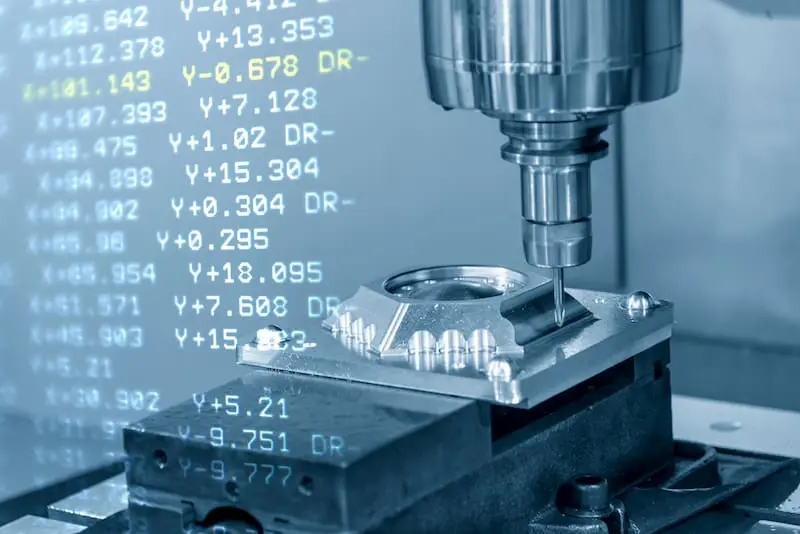
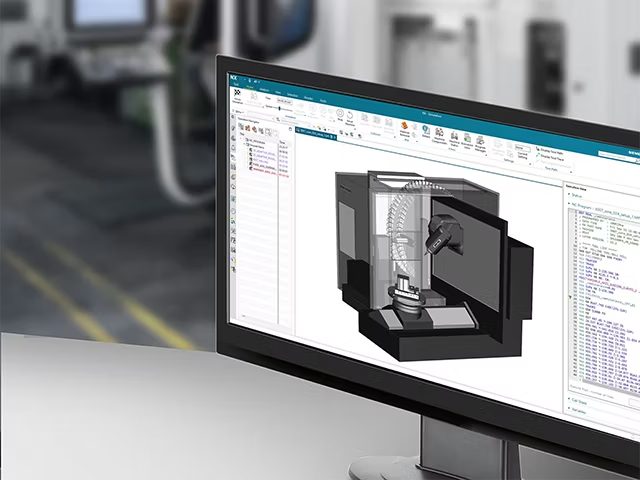
A programmer takes the 3D model and generates toolpaths in CAM (Computer-Aided Manufacturing) software. These toolpaths define exactly how the cutting tool moves through the material: approach direction, depth of cut, feed rate, spindle speed, and cut sequence. The output is a G-code program that the CNC machine controller reads and executes.
Toolpath quality matters enormously. Good programming minimizes cycle time, manages chip evacuation, maintains consistent cutting conditions, and avoids collisions. Poor programming produces chatter, poor surface finish, and excessive tool wear.
Step 3: Workholding setup
Before any cutting starts, the workpiece must be secured. Vises, chucks, custom soft jaws, and vacuum fixtures all hold the part rigidly during cutting. Good workholding eliminates vibration, prevents the part from shifting under cutting forces, and locates the part accurately relative to the machine’s coordinate system.
Poor workholding is a common cause of dimensional drift and surface finish problems, particularly on thin or complex parts.
Step 4: Roughing and finishing
Machining typically happens in two stages. Roughing removes bulk material quickly using large tools at aggressive feeds. The goal is to get the part close to final geometry while leaving 0.3 to 0.5 mm of material for the finishing passes.
Finishing uses smaller tools at lower feeds to bring the part to final dimension and surface finish. This two-stage approach maximizes efficiency while protecting surface quality and dimensional accuracy.
Step 5: In-process inspection
During and after cutting, critical features are measured. Operators use micrometers, bore gauges, and on-machine probing systems to check dimensions against the drawing. Offset adjustments compensate for tool wear and thermal drift. For 航空宇宙 そして 医療機器 parts, in-process records are part of the traceability documentation.
Step 6: Post-processing and surface treatment
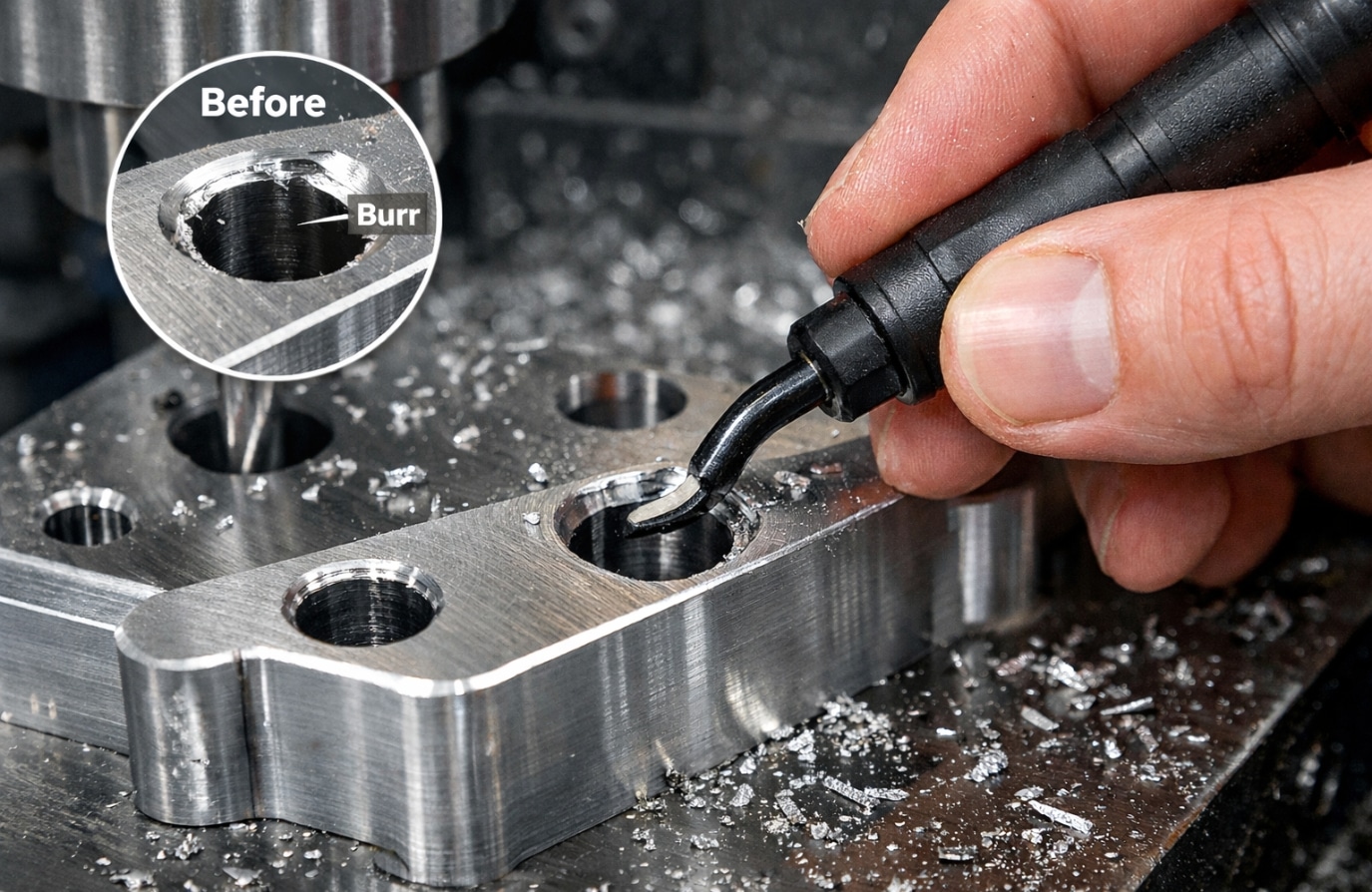
Parts are deburred and cleaned after machining. Most parts then go to surface treatment: anodizing for aluminum, passivation for stainless steel, powder coating for steel and aluminum, or plating for various metals. Yicen Precision offers 30+ surface finish options applied in-house without third-party delays.
Step 7: Final inspection and documentation
Every order at Yicen is inspected against the drawing before shipment. CMM (coordinate measuring machine) inspection confirms dimensions on precision features. Material certs, FAI (First Article Inspection) reports, and RoHS declarations ship with orders when required. Yicen holds ISO 9001:2015, ISO 13485, and IATF 16949 certifications, supporting the full documentation requirements of regulated industries. See our quality assurance process.
CNC Machine Types: Which One Cuts Your Part?
CNC machining isn’t a single machine. Several machine types handle different geometries, and choosing the right one affects cost, lead time, and achievable tolerances.
| Machine Type | 仕組み | 最適 | Typical Limit |
|---|---|---|---|
| 3-axis CNC milling | Cuts along X, Y, Z linear axes | Prismatic parts, flat faces, pockets, holes | Multiple setups for features on different faces |
| 4-axis CNC milling | Adds rotation around one axis (A) | Parts with features on cylindrical surfaces | Still limited for complex compound curves |
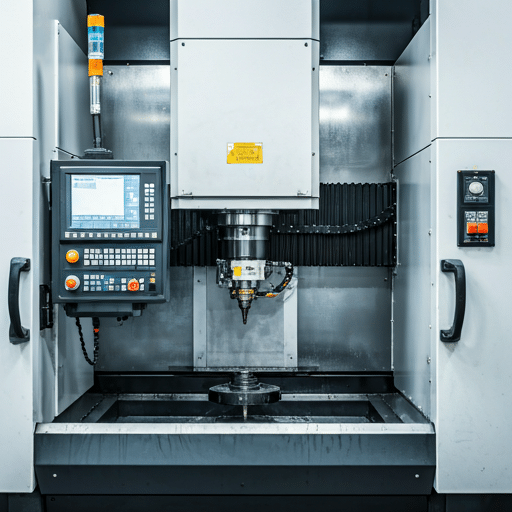
| 5軸CNCフライス加工 | All five axes move simultaneously | Complex geometry, tight tolerances across multiple faces | Higher programming complexity, higher machine cost |
| CNC旋盤加工 | Rotates the workpiece against a stationary tool | Shafts, bushings, fittings, round parts | Limited to rotationally symmetric geometry |
| Turn-mill (mill-turn) | Combines milling and turning in one setup | Complex parts with both rotational and prismatic features | Higher per-hour rate |
| ワイヤー放電加工機 | Uses electrical discharge to erode material along a wire path | Tight internal features, hard materials, thin slots | Slow cycle time, limited to 2D profiles per cut |
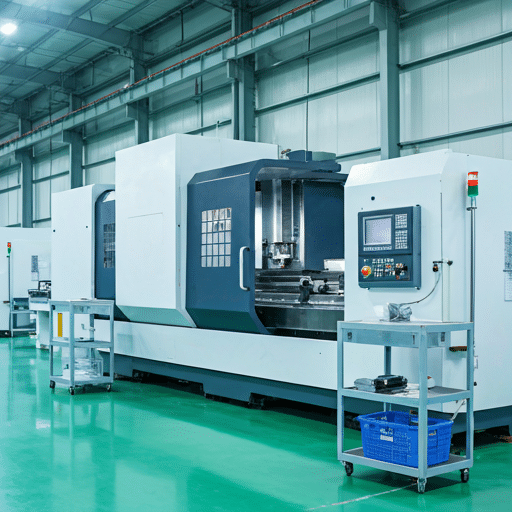
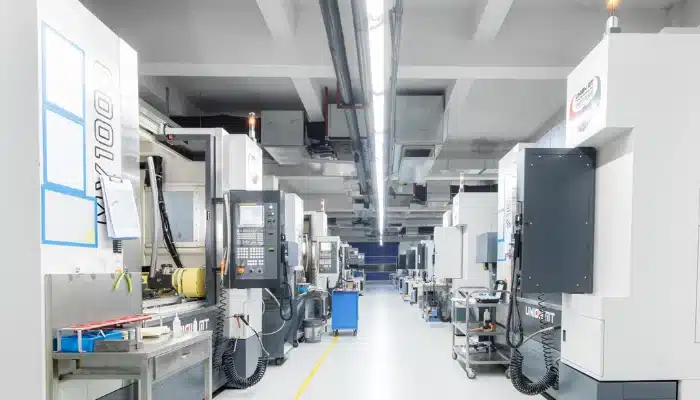
Yicen Precision operates 300+ CNC machines across these types. See our facilities.
For complex parts where multiple faces need machining, 5-axis machining reduces setups, eliminates datum accumulation error, and produces better dimensional relationships between features. Tolerances down to ±0.005 mm are achievable at Yicen’s facility. For parts requiring very tight internal slot geometry in hard alloys, wire EDM machining handles what milling can’t reach.
What Materials Can Be CNC Machined?
CNC machining works across a wide range of metals and engineering plastics. Material selection affects machinability, achievable surface finish, tool wear, and cost. Yicen Precision machines 50+ materials. The most common:
金属:
- Aluminum alloys (6061-T6, 7075-T6, 2024) — fastest to machine, excellent surface finish, wide surface treatment options
- Stainless steel (303, 304, 316L, 17-4 PH) — good corrosion resistance, requires careful feed management to avoid work-hardening
- Carbon and alloy steels (1018, 4140, H13) — broad strength range, heat-treatable, most cost-effective for high-load structural parts
- Titanium (Ti-6Al-4V) — outstanding strength-to-weight ratio and biocompatibility, challenging to machine due to low thermal conductivity
- Copper and brass — excellent machinability, used in electrical connectors, fittings, and heat-transfer components
- Inconel and nickel superalloys — very difficult to machine, required for high-temperature aerospace and energy applications
エンジニアリングプラスチック:
- Delrin (POM) — excellent machinability, low friction, good dimensional stability
- PEEK — high-performance thermoplastic for medical and high-temperature applications
- Nylon (PA6, PA66) — tough and lightweight, common in structural plastic components
- PTFE — chemical resistance, used in seals and liners
- Polycarbonate (PC), ABS, PMMA — consumer electronics housings and display components
See the full Yicen materials library for grades, properties, and applications.
CNC Machining vs. 3D Printing vs. Injection Molding
Buyers frequently need to choose between these three processes. Each has a clear domain.
| ファクター | CNC加工 | 3Dプリンティング | 射出成形 |
|---|---|---|---|
| Tooling cost | なし | なし | High (mold cost) |
| Per-part cost at low volume | ミディアム | Low-medium | Very high (amortized tooling) |
| Per-part cost at high volume | ミディアム | Medium-high | Very low |
| Material range | Very broad (metals and plastics) | Limited (mostly plastics, some metals) | Mostly plastics |
| Tolerance capability | ±0.005 mm | ±0.1–0.3 mm typical | ±0.05–0.1 mm typical |
| Internal channels/lattice | Not possible | Possible | 限定 |
| Lead time (prototype) | 1–5 days | 数時間から数日 | Weeks (mold build) |
| Regulatory documentation | Full (FAI, CMM, traceability) | 限定 | Available but costly |
Use CNC machining when: you need real metal properties, tolerances tighter than 3D printing can reliably hold, a surface finish that additive can’t achieve, or regulatory documentation for a medical or aerospace part.
Use 3D printing when: geometry has internal channels that milling can’t reach, you’re iterating rapidly on design and tolerances aren’t critical, or the part is a fit-and-form prototype for visual evaluation. Yicen offers FDM, SLA, SLS, MJF, and metal 3D printing for when additive is the right choice.
Use injection molding when: volumes are high enough to amortize the mold cost and per-part price matters more than flexibility. Yicen’s rapid prototyping service bridges the gap during mold build.
What Tolerances and Surface Finishes Can CNC Machining Achieve?
Tolerances and finish requirements should be specified on your 2D drawing. Tighter tolerances require slower feeds, more inspection time, and sometimes additional operations like grinding. Over-specifying tight tolerances on non-functional features adds cost without adding value.
Yicen Precision standard capability:
- General tolerances: ±0.1 mm (ISO 2768-m)
- Precision features: ±0.005 mm with proper fixturing and programming
- Surface finish (as-machined): Ra 1.6 µm standard
- Surface finish (fine finishing pass): Ra 0.4 µm
- Surface finish (with grinding): Ra 0.2 µm via 精密研削
Inspection equipment at Yicen: CMM (coordinate measuring machine), XRF analyzers, optical comparators, micrometers, bore gauges, and surface profilometers.
When CNC Machining Is Not the Right Choice
CNC machining excels across a wide range of geometries and volumes, but there are cases where it isn’t the most economical or technically suitable option.
Very high production volumes. Once volumes reach tens of thousands of identical parts, injection molding or die casting typically delivers a lower per-part cost despite the tooling investment.
Internal channels and closed-geometry lattice structures. CNC tools need tool access. Features that are entirely enclosed within a part (cooling channels, topology-optimized internal lattice) can’t be machined. These require additive manufacturing or casting.
Extremely thin, fragile walls. Walls below 0.5 mm in metal are difficult to machine without distortion or chatter. In some cases, 板金加工 is a better process for thin-wall enclosures and brackets.
Very small microfeatures. Features below 0.3 mm require micro-machining with specialized tooling and setups that aren’t standard CNC. Discuss this up front with the supplier.
Industries That Rely on CNC Machining
CNC machining is the backbone of precision manufacturing across regulated and performance-critical industries.
航空宇宙 components require tight tolerances, light alloys, and full traceability. Structural brackets, housings, and fasteners are commonly CNC machined in aluminum, titanium, and high-strength steel.
医療機器 demand biocompatible materials, smooth surfaces, and documented traceability. Implants, surgical instruments, and diagnostic components are machined in titanium, 316L stainless, and PEEK.
自動車 applications include engine components, brake system parts, transmission housings, and EV drivetrain components, where dimensional accuracy and batch consistency are required at production volumes.
Robotics and automation systems need precise joint housings, motor mounts, and gripper components that maintain dimensional relationships between mating surfaces.
家電製品 uses CNC machining for aluminum enclosures, camera housings, and precision brackets where surface finish and dimensional consistency affect perceived product quality.
Get Your Parts Quoted in Minutes
Yicen Precision runs 300+ CNC machines from our factory in Shenzhen’s Bao’an District. Factory-direct, no broker. ISO 9001:2015, ISO 13485, IATF 16949, and ISO 14001 certified. Tolerances to ±0.005 mm. 50+ materials. 30+ surface finishes. Prototypes in 24 hours.
Upload your CAD file for an instant quote.
Engineering questions before you quote? Contact us at sales@yicenprecision.com or +86 0755 2705 2682. Response within 12 hours.
よくある質問
What does CNC stand for?
Computer Numerical Control. It refers to the method of controlling machine tool motion through a program of numerical coordinates rather than manual operator input at each step.
What’s the difference between CNC milling and CNC turning?
Milling holds the workpiece stationary and moves a rotating cutting tool through the material, producing prismatic shapes, pockets, and complex surfaces. Turning rotates the workpiece against a stationary tool, producing cylindrical shapes like shafts, bushings, and fittings. Many complex parts use both operations, sometimes in a single turn-mill setup.
What is a G-code program?
G-code is the programming language CNC machines use. It’s generated automatically by CAM software from your 3D model. Each line tells the machine what to do: move to a coordinate, change the feed rate, switch tools, turn coolant on or off. You don’t need to write G-code yourself; your supplier’s programming team handles this.
How long does CNC machining take?
Prototype lead time at Yicen is 1 to 5 days for most parts, with a 24-hour option for qualifying orders. Low-volume production (5 to 500 parts) typically runs 5 to 15 days. Production runs depend on quantity and complexity. Get a quote with your file for a firm lead time.
What’s the minimum quantity I can order?
There is no minimum order quantity at Yicen. Single-part prototype orders are accepted across all materials and processes.
How does CNC machining handle tight tolerances?
Tight tolerances require slower feed rates, additional finishing passes, optimized workholding to prevent deflection, and CMM inspection to verify compliance. At Yicen, tolerances to ±0.005 mm are achievable on qualifying features with the right fixturing and programming strategy.
 Japanese
  English
  French
  Spanish
  German
  Portuguese