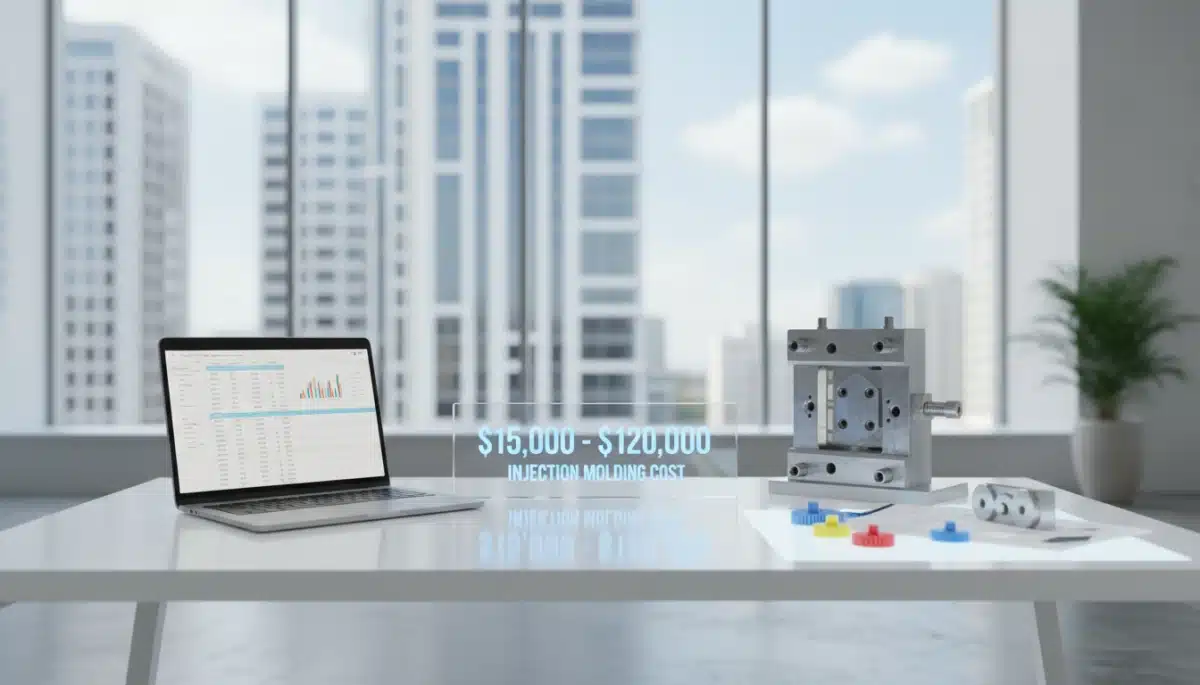
If you are an NPI manager pricing your first production tool, a hardware startup founder staring at a $40,000 mould quote and wondering whether you are being ripped off, or a procurement engineer trying to decide between four cavities or eight — this guide is for you. Injection moulding pricing has the widest spread of any process we quote at Yicen Precision. The same product specification — let’s say a 50-gram ABS enclosure with two snap-fits and one cosmetic surface — can come back as a $3,500 quote from one shop and a $28,000 quote from another. Both quotes can be honest. They are just describing different tools built to different lifetimes, finishes, and tolerances.
At Yicen Precision we build prototype, bridge, and production tooling alongside our CNC and sheet metal services. Most of our customers come to injection moulding after they have already spent five to fifteen thousand dollars on CNC-machined prototypes and confirmed the design. By that point the question is not “should I mould this” but “what tool class, what cavity count, what steel grade, and how many parts before this pays back the tooling investment.” This guide answers all four with real 2026 numbers, the two-bucket cost formula we use internally, and the DFM moves that typically reduce tooling cost by 15–30 percent without compromising the part.
The Two-Bucket Cost Formula
Injection moulding cost has a structure most other processes do not. There are two completely separate buckets — tooling and per-part — and they behave differently as quantity changes. Understanding the split is the single most important step in evaluating any quote you receive.
Total Cost per Part = (Tooling Cost ÷ Quantity) + Material Cost + Processing Cost
Tooling is a one-time fixed investment. You pay it once, before any part comes off the press. It dominates per-part cost at low volumes and becomes irrelevant at high volumes. Per-part cost is recurring — paid every time a shot is moulded — and includes material weighed at the resin price, plus machine time amortised at the press hourly rate. A $20,000 mould amortises to $20 per part at 1,000 units, $2 per part at 10,000 units, and $0.20 per part at 100,000 units. This is why mould class matters so much: a $5,000 prototype mould may save you $15,000 upfront but cost an extra $0.15 per part in cycle time and scrap. At 500,000 lifetime parts, that is $75,000 — fifteen times the savings.
From my experience quoting against US and European mould shops, the headline tooling difference between China and the West is real (40–60 percent on equivalent specifications), but the per-part difference is much smaller (typically 10–20 percent). For low-volume projects under 5,000 units, tooling savings dominate. For volumes above 100,000 units, per-part savings dominate, and freight, tariffs, and lead-time risk start to eat into the China advantage.
What Drives Tooling Cost
Cavity Count
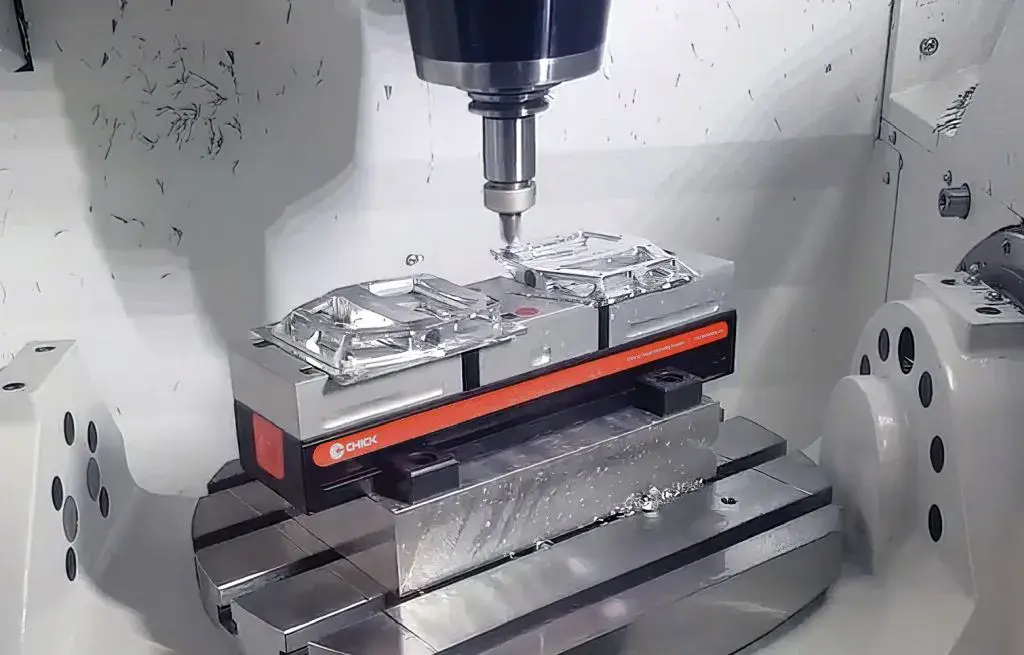
A four-cavity mould does not cost four times a single-cavity mould. It typically costs 1.5–2.5 times because much of the work — mould base design, gate balancing engineering, runner system layout, ejection design — is shared across cavities. The marginal cost of each added cavity is the machining time for the cavity insert plus the cooling and ejection lines. This is why family mould strategies — moulding two related parts in one tool — can cut effective tooling cost per design by 30–60 percent.
Steel Grade and Mould Life
This is the single biggest variable in tooling cost, and the one most often misunderstood by buyers without moulding experience. The steel you specify determines how many shots the tool will run before maintenance or replacement is needed.
| 鋼種 | Hardness (HRC) | Lifetime Shots | コスト乗数 | 典型的な使用例 |
| Aluminium 7075 | — | 5,000–50,000 | 0.6x | Prototype tooling, bridge |
| P20 / 718H (pre-hardened) | 28–32 | 100,000–300,000 | 1.0倍(ベースライン) | Consumer housings, mid-volume |
| NAK80 | 37–43 | 300,000–500,000 | 1.3x | High-polish optical parts |
| H13 / 2344 (hardened) | 48–54 | 500,000–1,000,000 | 1.5x | High-volume engineering plastics |
| S136 / Stavax (stainless) | 48–52 | 500,000–1,000,000+ | 1.8x | Medical, optical, PVC, corrosive resins |
The rule of thumb: pick the cheapest steel grade that comfortably exceeds your expected lifetime quantity. Buying H13 for a 50,000-unit run is overspending; buying P20 for a 2-million-unit run is buying yourself an expensive mid-production tool failure.
Sliders, Lifters, and Undercuts
Every undercut in your part — a snap-fit lip, a side-wall hole, an internal thread — needs a moving piece of steel in the mould to release the part after cooling. A single straight slider typically adds $500–$1,500 to the mould cost. Each lifter adds $400–$1,000. A cam-actuated angled slider can add $2,000 or more. From our quoting experience, two sliders plus one lifter is the dividing line where what looked like a simple consumer enclosure starts costing 30–50 percent more than the buyer expected.
This is where DFM saves the most money. Eliminating a single undercut by adding a 3° draft and a small redesign of a snap feature can remove a $1,200 slider from the quote. We routinely show customers two design variants and the resulting quote delta before they commit to the geometry.
Tolerance and Surface Finish
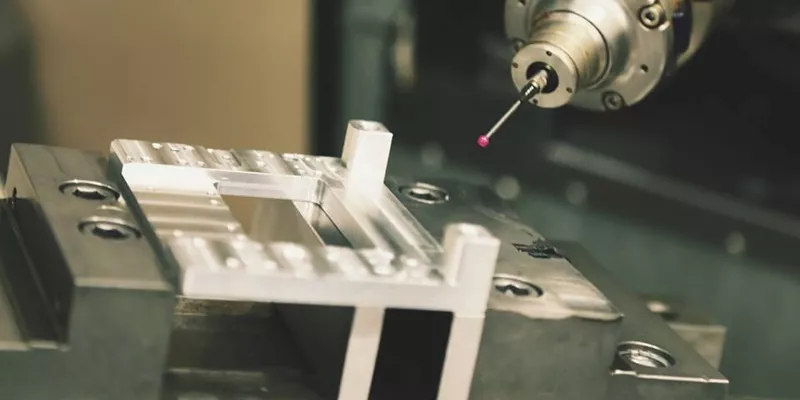
Standard moulded tolerances of ±0.1 mm are achievable with basic machining of the mould inserts. Asking for ±0.02 mm requires precision grinding of the mould features and adds 15–30 percent to tool cost. Surface finish is a similar story. A standard machined-and-light-stoned finish (SPI B-3) is cheap. A mirror polish (SPI A-2 or A-1) requires hours of progressive hand-polishing with diamond paste and can add $1,500–$5,000 to the tooling cost. A textured finish (VDI 3400 series) is often cheaper than a polished finish because it hides minor machining marks.
Tooling Cost Comparison — US, EU, China, Yicen Precision
Real 2026 quote ranges for equivalent specifications. These are blended ranges across simple, moderate, and complex parts in P20 steel with a single cosmetic surface and minimal sliders.
| Mould Class | Lifetime | アメリカ | ドイツ/EU | 中国(ティア1) | イーセン精密 |
| Prototype (alu) | 5–50k | $5,000~$15,000 | €5,500–€14,000 | $1,500–$4,500 | $1,200–$4,000 |
| Bridge (P20, 1-cav) | 100–300k | $10,000–$25,000 | €10,000–€22,000 | $3,500–$9,000 | $3,000–$8,500 |
| Production (P20, 4-cav) | 300k–500k | $30,000–$60,000 | €30,000–€55,000 | $10,000–$22,000 | $9,000–$20,000 |
| High-volume (H13, 8-cav) | 500k–1M | $70,000–$150,000 | €70,000–€140,000 | $28,000–$55,000 | $26,000–$52,000 |
| Medical/optical (S136) | 500k+ | $80,000–$200,000 | €80,000–€180,000 | $32,000–$70,000 | $30,000–$65,000 |
These ranges match what we see in real RFQs almost every month. The 50–60 percent gap between Western and Chinese tooling is consistent across mould classes, and it is driven almost entirely by labour cost in the mould-building phase. A typical production-grade insert takes 80–120 hours of CAM, EDM, milling, polishing, and fitting. At $20–$25 per hour blended cost in China versus $90–$130 per hour in the US, the labour delta alone explains roughly two-thirds of the total cost gap.
Per-Part Cost Components
Once the tool exists, every shot costs the same regardless of where the tool was made. Per-part cost has three buckets: material, machine time, and labour overhead.
Material Cost — Resin Pricing 2026
Material cost per part is calculated as part weight plus runner weight, divided by one minus scrap rate, multiplied by the resin price per kilogram. For a 15-gram part with a 3-gram runner at 2 percent scrap rate in ABS at $3.50/kg, the calculation is (15 + 3) ÷ 0.98 × 3.50 ÷ 1000 = $0.064 per part.
| Resin Family | 例 | Price 2026 (USD/kg) | 典型的な使用例 |
| Commodity | PP, PE, PS | $1.20–$2.50 | Caps, containers, packaging, low-load parts |
| Engineering | ABS, PC, PC/ABS | $2.50–$5.50 | Consumer housings, electronics, automotive trim |
| Engineering — wear | POM (Delrin), Nylon 6/6 | $3.50–$6.00 | Gears, bearings, mechanical components |
| Flame-retardant | PC-FR, ABS-FR, PA-FR | $5.00–$9.00 | Electrical, charging components |
| Glass-filled | PA66-GF30, PC-GF20 | $4.50–$8.00 | Structural parts, brackets |
| High-performance | PEEK, PEI (Ultem) | $80–$220 | Aerospace, medical implants, high-temp |
Machine Hourly Rate and Cycle Time
Press time is charged at the machine hourly rate divided across the number of parts produced per hour. Standard cycle times run 10–25 seconds for small commodity parts and 30–60 seconds for thicker engineering parts. The cooling phase typically accounts for 60–70 percent of the cycle time. Machine hourly rates in 2026 are $50–$120 per hour in the US for a 100–250-tonne press, €45–€110 in Europe, and $25–$45 at Yicen Precision.
Here is what that means in practice. A 20-second cycle on a $60/hour press with a 4-cavity mould produces 720 parts per hour, costing $0.083 per part in machine time. The same setup at Yicen’s $30/hour press cost runs $0.042 per part — half. Over 500,000 production parts, that’s a $20,500 saving.
Processing Cost Total
Machine processing cost — combining press time, secondary operations like trimming, and packaging — typically lands in the $0.05–$0.30 per part range for standard parts. Complex parts with manual de-gating, ultrasonic welding, or pad printing can push that to $0.80–$2.00 per part.
When Moulding Beats CNC — the Break-Even Quantity
Most parts cost less to CNC-machine for the first 50–200 units, and less to mould thereafter. The exact crossover depends on part weight, complexity, and material. Here is a worked example: an ABS consumer-electronics housing, 35 grams, moderately complex with two snap-fits.
| 数量 | CNC-Machined (Yicen) | P20 1-Cavity Mould (Yicen) | Cheaper Option |
| 10 | $22.00/part = $220 | $3,500 tool + $0.45 = $3,505 | CNC by 16x |
| 100 | $11.00/part = $1,100 | $3,500 + $45 = $3,545 | CNC by 3.2x |
| 500 | $7.50/part = $3,750 | $3,500 + $225 = $3,725 | Even |
| 1,000 | $6.20/part = $6,200 | $3,500 + $450 = $3,950 | Mould by 1.6x |
| 10,000 | $5.10/part = $51,000 | $3,500 + $4,500 = $8,000 | Mould by 6.4x |
| 50,000 | $4.80/part = $240,000 | $3,500 + $22,500 = $26,000 | Mould by 9.2x |
Two things to notice. First, the crossover here is around 500 units — typical for a moderate-complexity consumer part. Second, beyond 10,000 units the moulding curve is essentially flat at $0.50–$0.80 per part while CNC stays at $4.80–$5.10. This is the structural advantage of injection moulding at volume that no other process can match.
Four Real Mould Quotes from 2025–2026
Anonymised but otherwise unchanged. Each one shows where the cost actually went.
Example 1 — Consumer Electronics Housing
Single-cavity, ABS, 2 sliders for USB and battery latch cutouts, P20 steel, 200,000-shot lifetime, SPI B-3 finish. Final quote: $6,800. The two sliders added $2,800 over the base single-cavity P20 cost of $4,000. Lead time: 4.5 weeks.
Example 2 — Medical Device Cover
Single-cavity, PC, S136 stainless steel, SPI A-2 mirror polish for biocompatible interface, 1 lifter for internal undercut, 500,000-shot lifetime. Final quote: $11,500. The S136 grade and the A-2 polish accounted for $3,200 of the total — the cosmetic specification was the single biggest cost driver. Lead time: 6 weeks.
Example 3 — Automotive Bracket
4-cavity, PA66-GF30 (glass-filled nylon), H13 hardened steel, IATF 16949 documentation, 1,000,000-shot lifetime. Final quote: $24,800. Multi-cavity machining and the hardened steel grade drove the bulk of the cost. Per-part material cost was high at $0.42 due to the glass-filled resin. Lead time: 7 weeks.
Example 4 — Cosmetic Cap
8-cavity family mould, PP, P20 steel, light texture (VDI 3400 #24), hot runner system, 800,000-shot lifetime. Final quote: $19,500. The hot runner added $4,800 but eliminated 8 grams of runner waste per cycle — at 800,000 lifetime shots, that recovers $9,400 in resin alone. Lead time: 5.5 weeks.
DFM Moves That Cut Mould Cost
These are the seven design changes that consistently reduce tooling cost without compromising the part.
- Add 1°–3° draft on every vertical face. This eliminates the need for forced ejection and reduces wear on ejector pins, allowing simpler ejection design.
- Eliminate undercuts by redesigning snap features into bolt-together or heat-staked joints. Each slider removed saves $500–$1,500.
- Use uniform wall thickness — typically 1.5–2.5 mm. Variations cause sink marks, warp, and longer cooling cycles. Constant walls cool 20–30 percent faster.
- Avoid specifying mirror polish unless the surface is functionally cosmetic. Texture is cheaper, hides flow lines, and reduces mould-side hand-polishing time.
- Group small related parts into a family mould. One tool with four small parts costs roughly 60 percent of four separate single-cavity tools.
- Specify cavity count based on annual volume, not lifetime volume. Eight cavities on a part that runs 200 hours per year is wasted capital.
- Consider hot runners for high-volume programs above 50,000 parts. The $3,000–$8,000 upfront premium typically pays back in 6–12 months from reduced runner scrap and shorter cycles.
FAQs — Injection Moulding Cost
How much does an injection mould cost?
In China, simple prototype moulds start at $1,200–$3,500, mid-volume production moulds in P20 steel run $8,000–$25,000, and high-volume hardened-steel multi-cavity tooling runs $25,000–$70,000. US and EU pricing is typically 2–3× these figures for equivalent specifications. At Yicen Precision, our prototype tooling starts at $1,200 and production-grade moulds typically land in the $8,500–$30,000 range.
How much does a single moulded part cost?
For commodity plastics in mid-cavity moulds, per-part cost is typically $0.10–$0.80. Engineering plastics in production-grade tooling run $0.40–$2.50 per part. Highly complex or high-performance-resin parts can reach $5–$15 per part. Tooling amortisation can add anywhere from $0.001 to $20+ per part depending on quantity.
Can I get a quote from a STEP file alone?
Yes — at Yicen Precision we return injection moulding quotes within 24 working hours from a STEP file. The quote includes tooling cost, cavity recommendations, steel grade options, per-part cost projections, and a DFM report flagging features that drive cost up. Upload at yicenprecision.com.
Should I order a prototype mould first?
Only if you still have design uncertainty. If the part has passed FEA, the wall thickness is locked, and you have done at least one round of DFM review, you can typically skip prototype tooling and go straight to a bridge or production mould. A prototype mould adds 3–5 weeks and $2,000–$5,000 — worth it if you have unanswered design questions, costly delay if you do not.
How does Yicen Precision keep moulding costs lower than US shops?
Three factors. First, lower labour cost in the mould-building phase — typical Chinese toolmakers earn one-third of US wages while running the same Mitsubishi EDM and Makino machining centres. Second, vertical integration — our mould shop, press shop, and finishing are within one 40,000 m² facility, eliminating freight and coordination overhead. Third, batch resin procurement at scale: we negotiate annual contracts with major resin suppliers, reducing material cost roughly 8–15 percent below typical shop pricing.
Get an Injection Moulding Quote from Yicen Precision
If you have a moulded part that needs prototype, bridge, or production tooling — we can help. Our team builds moulds and runs production from a single facility in Shenzhen, with ISO 9001:2015 and IATF 16949 certification, full inspection reports, and DHL/FedEx shipping worldwide.
- Prototype tooling from $1,200 with first parts in 3–4 weeks
- Production tooling in P20, H13, NAK80, or S136 with full DFM report included
- Per-part pricing starting at $0.12 for commodity resins, $0.45 for engineering plastics
- In-house secondary operations: trimming, ultrasonic welding, pad printing, assembly
- Mould lifetime guarantees: 100,000 shots (P20) to 1,000,000+ shots (H13/S136)
Upload your STEP file at yicenprecision.com for a 24-hour injection moulding quote with DFM report.

 Japanese
  English
  French
  Spanish
  German
  Portuguese